_edited.png)


Managing Airbnb From a Distance: The San Diego Owner's Guide


Managing an Airbnb from a distance is possible if you build three systems before you ever list the property: automated guest communication, a vetted local team, and remote monitoring tech that catches problems before guests do. At West Coast Homestays, we work with out-of-state owners across San Diego, Encinitas, and Carlsbad every week who are trying to do exactly this, and the ones who succeed treat remote hosting as an operations problem, not a location problem.
Median San Diego Airbnb occupancy hit 71% between February 2026 and January 2026, according to Airbtics, meaning a poorly monitored remote listing has real revenue at stake almost every week of the year.
The average San Diego host generated $67,000 in revenue over that same period (Airbtics, 2026), a benchmark worth comparing your own property against before assuming distance is capping your income.
Self-check-in via smart locks, a local cleaner-handyman-co-host team, and a channel manager that syncs Airbnb, VRBO, and Booking.com are the three non-negotiables every credible remote-hosting guide agrees on.
Some cities require hosts to live within roughly 50 miles of their property or hire a local manager; San Diego does not impose a residency requirement, but permit compliance still demands someone who can respond locally.
A documented hybrid short-term/mid-term strategy on one San Diego coastal property produced $136,732 in annual revenue against a $98,800 short-term-only projection, showing what's possible when remote pricing and channel decisions are handled correctly.
San Diego's coastal rental market rewards attentiveness, and that's the exact thing distance threatens to take away. Whether you bought a Carlsbad beach condo as an investment or inherited a La Jolla property you can't visit weekly, the mechanics of managing airbnb from a distance come down to replacing your physical presence with better systems and better people. In 2026, the technology to do this is more accessible than it's ever been, and the operators who use it well are outperforming the ones who still think they need to be five minutes from the property.
This guide walks through the specific tools, team structure, and compliance steps that make remote San Diego hosting workable, plus the honest trade-offs and cost breakdowns that most generic guides skip. We'll also cover where professional management stops being optional and starts being the smarter financial decision.
Can You Manage an Airbnb From Out of State?
Yes, you can manage an Airbnb from out of state, and thousands of owners do it successfully across markets including San Diego, Encinitas, and Carlsbad. Managing remotely requires three replacements for your physical presence: automated guest messaging software, a reliable local team for cleaning and repairs, and a channel manager to prevent double bookings across Airbnb, VRBO, and Booking.com.
Specifically, out-of-state hosts lean on property management platforms like Guesty to centralize messaging, task assignments, and calendar syncing in one dashboard. As a result, the day-to-day operational load shrinks to reviewing exception alerts rather than manually answering every guest inquiry.
Additionally, most jurisdictions don't legally require an owner to live near the property, though some cities do cap remote ownership at roughly 50 miles unless a local manager is designated. San Diego's Short-Term Residential Occupancy program doesn't impose a residency mile requirement, but it does require a responsible party who can respond to city or guest issues, which is exactly the gap a local co-host or property manager fills.
The honest caveat: distance amplifies small operational failures. A missed cleaning that would take you ten minutes to fix in person becomes a same-day emergency dispatch when you're three states away. That's the real cost of managing airbnb from a distance, and it's why the systems below matter more than they would for a host who lives ten minutes from their listing.
What Is the 75-55 Rule for Airbnb?
The 75-55 rule is a pricing and booking window concept some hosts use as a rough benchmark: aim to have roughly 75% of your calendar booked with lead time and avoid dropping rates more than about 55% below your baseline even during slow periods. It's not an official Airbnb policy, but rather an informal heuristic that circulates among revenue-focused hosts to prevent panic discounting.
In practice, remote hosts often over-correct on empty calendar gaps by slashing rates too aggressively, which trains repeat search algorithms and guests to expect discount pricing on your listing. Instead, dynamic pricing tools like Airbnb Smart Pricing or third-party tools such as PriceLabs and Wheelhouse can hold a price floor while still adjusting for demand.
At West Coast Homestays, we've watched miscalibrated pricing tools cost San Diego owners real money, sometimes $30,000 to $40,000 in a single year on a mid-range coastal property, because the floor was set too low or the comp set was wrong. A remote host checking pricing dashboards once a week rarely catches this drift in time. This is precisely why revenue management is one of the highest-leverage services a professional manager provides, especially for someone who isn't watching the market daily from three time zones away.
What Is the 80/20 Rule for Airbnb?
The 80/20 rule, applied to Airbnb hosting, generally refers to the idea that 80% of your guest complaints, maintenance issues, or revenue problems come from 20% of your properties, bookings, or operational gaps. For remote hosts managing multiple units, this framing helps prioritize where limited attention should go first.
For example, if you own two San Diego units, one in Pacific Beach and one in Oceanside, and the Pacific Beach property generates most of your guest complaints, that 20% deserves 80% of your troubleshooting time rather than splitting attention evenly. Additionally, the rule applies to task types: a small number of recurring issues (Wi-Fi outages, lockbox failures, late checkouts) typically account for most guest messages.
Identifying your specific 20% requires data you can only get by reviewing message logs and maintenance tickets over several months, something a property management dashboard or a local co-host can track for you. Multi-property investors juggling several San Diego coastal listings often find this rule especially useful for deciding which property needs a dedicated local contact first and which can run on lighter-touch remote oversight.
What Is the 25 Rule on Airbnb?
The 25 rule on Airbnb typically refers to setting a maximum discount ceiling, generally around 25%, when using automated pricing tools during low-demand periods, so rates never drop so far that they undercut long-term listing value or attract guests who don't match your property's standard. It functions as a guardrail rather than an official Airbnb feature.
Specifically, hosts configure this limit inside third-party pricing software or Airbnb's own Smart Pricing settings by setting a price floor tied to a percentage below their average nightly rate. As a result, even during a slow February week in Carlsbad, the listing won't fall so low that it signals distress pricing to the algorithm or attracts guests likely to leave low reviews over a mismatched value expectation.
In our experience managing coastal San Diego properties, owners who skip this guardrail often see a downward pricing spiral: one discounted week trains the algorithm to expect lower rates going forward, and clawing back to a normal rate takes months. Setting a firm floor, whether it's 25% or a number calibrated to your specific comp set, protects long-term revenue far more than chasing short-term occupancy.

What Technology Do You Need to Manage a Rental Remotely?
Managing an Airbnb remotely requires a specific technology stack: smart locks for self-check-in, a video doorbell for arrival monitoring, noise sensors for disturbance alerts, and property management software that syncs messaging and calendars across platforms. Without these four categories, remote hosting depends entirely on your local team catching every issue manually, which doesn't scale.
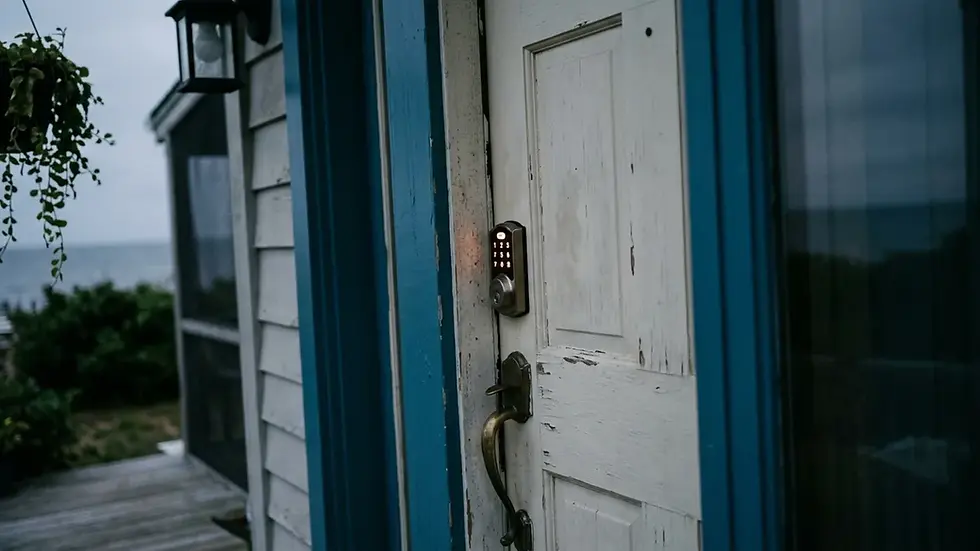
First, smart locks are the foundation. They let you issue unique codes per guest and separate one-time codes for cleaners or vendors, eliminating physical key handoffs entirely. Options like a Yale Wi-Fi-enabled lock integrate directly with several property management systems, so codes generate automatically tied to each reservation.
Second, video doorbells give you visual confirmation of check-in and check-out times without a site visit. Third, noise sensors (not recording audio, just decibel-level alerts) flag potential unauthorized parties, a specific concern in family-zoned San Diego neighborhoods like Carlsbad Village where a noise complaint can jeopardize your STR permit standing.
Fourth, and most important, a centralized platform handles the coordination layer. Tools like Guesty or Lodgify sync your calendar across Airbnb, VRBO, and Booking.com, automate the welcome message, check-in instructions, and review requests, and assign cleaning tasks to your local team automatically after each checkout. This is the layer that turns remote hosting from a full-time monitoring job into a manageable weekly review.
How Do You Build a Local Team You've Never Met in Person?
Building a reliable local team for a remote Airbnb requires hiring at minimum three roles: a cleaner, a handyman, and a co-host or trusted local contact who can respond to emergencies in person within a few hours. These three roles replace the physical presence a nearby owner would otherwise provide.
Specifically, your cleaner should follow a written checklist and, ideally, upload time-stamped photos of beds, bathrooms, and high-touch surfaces to a shared drive before locking up. Some remote hosts pay cleaners only after the next guest confirms the unit was ready, which incentivizes consistency without requiring you to inspect every turnover yourself.
Your handyman needs a standing arrangement, not a one-off contractor relationship, so a broken AC unit during a Pacific Beach summer weekend gets addressed same-day rather than next-week. Your co-host or local contact is the person who can physically walk into the property if a smart lock fails or a guest reports something a photo can't resolve.
Finding this team without meeting anyone in person usually means starting with referrals from local host groups, the Airbnb Community Center, or a property management company that already has vetted vendors in place. This is one area where paying for professional management upfront often costs less than the trial-and-error of building a team from scratch across state lines.
What a Realistic Remote Team Budget Looks Like
Budgeting for a remote team scales with the number of properties you manage. A single-unit host might pay a cleaner per-turnover fee plus a smaller monthly retainer for on-call handyman availability, while a co-host or local contact fee is typically structured as either a flat monthly rate or a percentage of revenue.
Full-service management companies commonly charge 15% to 25% of gross revenue, which bundles cleaning coordination, guest communication, maintenance dispatch, and pricing into one fee rather than three or four separate vendor relationships. For a multi-property investor managing units spread across Mission Beach and Encinitas, that consolidation often ends up cheaper than piecing together separate local contacts for each address, simply because of the coordination overhead saved.
How Do You Handle Time Zone Differences With Guests and Your Local Team?
Handling time zone gaps when managing airbnb from a distance means establishing clear response-time expectations for urgent versus non-urgent issues, rather than promising instant availability you can't deliver from a different time zone. Most guests don't expect a 2 a.m. response, but they do expect acknowledgment within a defined window.
Specifically, set your automated messaging system to confirm receipt of any guest inquiry within minutes, even if a human response takes longer. For genuine emergencies, a lockout or a safety issue, your local co-host or handyman needs a direct line and clear authority to act without waiting for your approval, since you may be asleep when the message comes in.
For example, an East Coast owner managing a La Jolla rental is three hours ahead of San Diego. A midnight guest issue on the coast is 3 a.m. for the owner. Building a local emergency contact into your setup, rather than relying on yourself as the first responder, closes that gap entirely regardless of what time zone you're in.
Additionally, non-urgent maintenance requests (a dripping faucet, a missing kitchen item) can wait for your morning review rather than triggering a 2 a.m. wake-up. The key is separating your automated system's instant acknowledgment from your team's actual response tiers, so guests feel heard immediately even when a human hasn't acted yet.
What Should You Say When Something Goes Wrong Remotely?
Having pre-written response templates for common remote-hosting incidents prevents panicked, liability-creating messages when a smart lock fails, a guest reports damage, or a neighbor complains about noise. A calm, factual response protects both your guest relationship and your review score.
For a smart lock failure, acknowledge the issue immediately, confirm you're dispatching your local contact, and provide a backup entry method if one exists (a lockbox code, a neighbor with a spare key). Avoid over-apologizing in writing, since excessive language can read as an admission of negligence if a dispute later escalates.
For a maintenance complaint, confirm the specific issue, give a realistic timeline based on what your handyman actually reports (not an optimistic guess), and offer a partial refund or credit only after you understand the full scope, not in the first message. For a noise complaint from a neighbor, document the timestamp and source, contact the guest directly and factually, and avoid assumptions about intent until you've reviewed any available evidence.
Consistent, professional language across these situations is exactly why many owners eventually shift toward a management company: it removes the emotional charge from an owner responding to their own investment property and replaces it with practiced, neutral communication that resolves issues faster.
Data Snapshot: Remote Hosting Benchmarks in San Diego
The table below summarizes verified market data relevant to owners managing airbnb from a distance in San Diego's coastal submarkets, useful for calibrating your own property's performance against real benchmarks rather than guesswork.
Metric | Figure | Source |
Median San Diego Airbnb occupancy (Feb 2026 to Jan 2026) | 71% | Airbtics, 2026 |
Average San Diego host revenue (same period) | $67,000 | Airbtics, 2026 |
Carlsbad median occupancy rate | 68-69% | GetChalet 2026 / Airbtics 2026 |
Carlsbad average daily rate | $329 | Airbtics, 2026 |
National rental vacancy rate (Q1 2026) | 7.3% | U.S. Census Bureau |
Typical full-service STR management fee | 15-25% of gross revenue | Industry standard |
Notably, a Carlsbad property performing below the 68% occupancy median or the $329 average daily rate isn't necessarily a bad investment; it's often a sign that remote pricing management or listing quality needs review. As of 2026, the gap between a well-run remote listing and a neglected one is wider than it was a few years ago, simply because guest expectations for responsiveness and listing polish have climbed.
Automation, Local Team, or Full Management: Which Approach Fits Your Property?
Choosing between full DIY automation, a hybrid local-team model, or full-service property management depends on how many properties you own, how much time you can dedicate weekly, and how far away you live. Each approach carries real trade-offs worth weighing honestly before you commit.
DIY automation with a strong tech stack works best for a single, straightforward property where the owner has time to review dashboards weekly and troubleshoot pricing personally. It's the lowest direct cost option but demands the most ongoing attention and the steepest learning curve for new hosts.
A hybrid model, DIY software plus a paid local co-host for emergencies and inspections, suits owners who want cost control but recognize they can't be the first responder from another state. This is a common setup for second-home owners who use the property personally part of the year and rent it out the rest.
Full-service management makes the most sense for multi-property portfolios, burned-out self-managers, or out-of-state owners who've already experienced a maintenance emergency or HOA notice they couldn't handle in time. One of our clients running a hybrid short-term and mid-term strategy across a San Diego coastal property reached $136,732 in annual revenue against a $98,800 short-term-only projection, a gap driven largely by professional pricing calibration and channel decisions that would be difficult to replicate part-time from out of state.
Common Mistakes Remote Hosts Make
Relying solely on Airbnb's default Smart Pricing without a comp-set review, which can quietly cost thousands per year in miscalibrated rates.
Listing only on Airbnb and avoiding VRBO or Booking.com out of fear of double bookings, leaving occupancy gaps unfilled.
Hiring a single independent cleaner with no written checklist or photo verification, which invites inconsistent turnovers and review damage.
Ignoring quarterly compliance reviews, only to discover a permit lapse or an STRO requirement change months after it took effect.
Treating the co-host or local contact relationship as informal rather than contractual, leading to slow response times during actual emergencies.
Frequently Asked Questions
Do I need to hire a co-host if I live out of state?
You don't legally need a co-host in most San Diego neighborhoods, but practically, a local contact who can respond in person within a few hours is close to essential. Smart locks and cameras solve monitoring, but they can't physically fix a broken appliance or greet a locked-out guest.
How often should I check on my remote San Diego Airbnb?
Most remote hosts review performance dashboards weekly and schedule an in-person or local-contact walkthrough monthly or quarterly. This cadence catches maintenance drift and inventory gaps before they become guest complaints, without requiring constant daily oversight.
What happens if my property doesn't have a valid STRO license?
Operating without a valid license under San Diego's ordinance can result in enforcement action, including fines, and the city accepts complaints through its official portal. Check your license status against the city's Active STRO Licenses Open Data Portal and review the full STRO Ordinance text if you're unsure of your tier.
Can dynamic pricing tools fully replace manual rate review?
Dynamic pricing tools handle the bulk of day-to-day adjustments, but they still need periodic human calibration against your specific comp set. Left unchecked for months, a miscalibrated tool can misprice a property significantly, which is why we treat pricing as an active management task, not a set-and-forget one.
Is mid-term rental a good option for a remote-managed San Diego property?
Mid-term rentals can smooth out seasonal occupancy gaps and reduce the turnover frequency a remote host has to manage, since stays run 30 days or longer instead of nightly. For the right property, a hybrid short-term and mid-term strategy can outperform a short-term-only approach on total annual revenue.
What's the biggest risk of managing an Airbnb from a distance without a system?
The biggest risk is a small issue, a missed cleaning, a lockbox failure, a noise complaint, escalating into a guest emergency or a bad review before anyone local notices. Distance doesn't create new problems; it just removes your ability to catch and fix them quickly without the right team and technology in place.
The Bottom Line on Managing Airbnb From a Distance
Managing airbnb from a distance in 2026 is a solved problem for owners willing to invest in the right stack: smart locks, a synced channel manager, a vetted local team, and disciplined pricing review. San Diego's coastal market, with median occupancy around 71% and average host revenue near $67,000 according to Airbtics, rewards owners who stay responsive even when they're states away.
But the honest trade-off is time and risk tolerance. Building your own tech stack and team from scratch takes months of trial and error, and every mistake during that period shows up as a guest complaint or a lost booking. Owners who'd rather skip that learning curve, or who've already lived through a missed maintenance emergency, tend to move toward full-service management instead.
West Coast Homestays manages more than 80 coastal properties across San Diego, Encinitas, Carlsbad, and neighboring communities, and remote ownership is the default situation for a large share of our clients, not the exception. If the systems described here sound like more than you want to build and monitor yourself, that's exactly the gap professional management closes.

If you're managing airbnb from a distance and it's starting to feel like a second job you never signed up for, West Coast Homestays handles everything from guest communication and turnovers to dynamic pricing and compliance, with documented results including a $121,000-plus revenue increase on one managed property through pricing and listing optimization alone. Visit WestCoastHomestays.com to talk through what professional management could mean for your specific property.
Written by Mark Palmiere, Owner & CEO at West Coast Homestays
Content powered by inkSTR.co
Comments