.png)

Off Season STR Strategy San Diego: Winning Nov to Feb
- Mark Palmiere

- Jul 8
- 15 min read
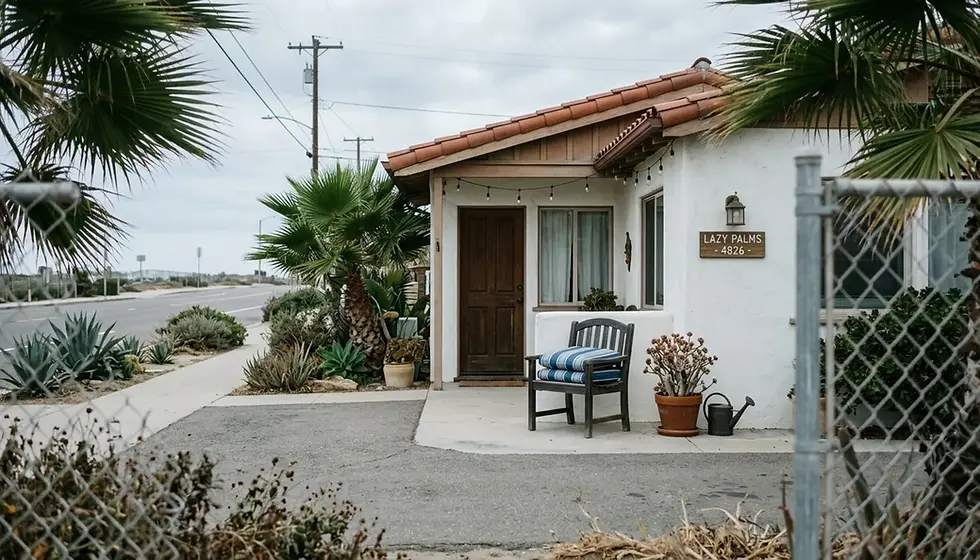
An off season STR strategy in San Diego means adjusting nightly rates down 25-40%, loosening minimum-stay rules, and actively courting remote workers, business travelers, and mid-term tenants between November and February. At West Coast Homestays, we treat these four months as the real test of whether a property is professionally managed or just coasting on summer momentum.
San Diego's low season runs November through February, with occupancy and average daily rate both softening compared to the June-August peak, though nowhere near as sharply as in colder markets.
Carlsbad short-term rentals average 43.5% occupancy in low season months (January, April, November) versus 61.9% at peak, according to AirROI data from 2026.
Encinitas vacation rentals post average monthly revenue of $7,994 at 51.4% occupancy during shoulder season windows (June 2026 through May 2026), per AirROI.
San Diego-wide, AirDNA reports 61% trailing twelve-month occupancy with a $336 average daily rate and $193 RevPAR as of June 2026, figures that hold up better than most coastal U.S. markets in winter.
Reducing nightly rates 25-40% off peak, paired with length-of-stay discounts, is the pacing approach that keeps calendars from sitting empty during the slowest weeks.
Property owners who pivot toward hybrid short-term and mid-term rental models during the off season often outperform STR-only projections, a pattern West Coast Homestays has documented directly in its own San Diego portfolio.
If you own a rental in Pacific Beach, La Jolla, or Carlsbad, you've probably noticed that San Diego doesn't really have an off season the way Aspen or the Outer Banks do. The weather barely changes. But your booking calendar does, and if you're pricing your November nights the same way you price your July nights, you're leaving money on the table every single week from Halloween through Presidents Day.
This guide breaks down exactly what changes in the off season, how much to adjust your rates, which guest segments to chase when leisure travelers thin out, and how San Diego's specific regulatory environment shapes what you can and cannot do to fill gaps. We'll also walk through the neighborhood-level numbers, because a Carlsbad property and a Mission Beach property do not behave the same way in January.
As of 2026, San Diego County's short-term rental supply is actually shrinking, down 7.7% year over year according to AirDNA's supply dashboard, even as occupancy holds at 61%. That combination, tightening inventory plus resilient demand, is exactly why a smart off season strategy matters more this year than it did two years ago. Fewer competing listings means the operators who price and market intelligently in the low season capture a disproportionate share of what demand remains.
What Is the 75-55 Rule for Airbnb?
The 75-55 rule is an informal STR pricing heuristic suggesting hosts aim for roughly 75% occupancy at rates that still deliver at least 55% of peak-season revenue per booked night. It's not an official Airbnb policy, but a shorthand some revenue managers use to balance volume against rate integrity during slower months.
Applied to San Diego, the rule pushes back against the instinct to slash prices to fill every night. Specifically, a Pacific Beach two-bedroom that commands $350 a night in July shouldn't drop to $120 in December just to guarantee bookings. A floor closer to $190-$210, roughly 55-60% of peak, protects your margin while still undercutting competitors who haven't adjusted at all. The mistake we see most often at West Coast Homestays is owners who either freeze their pricing year-round or panic-discount the moment a week shows empty. Neither works. As a result, static pricing leaves nights unbooked that could have sold at a modest discount, while panic discounting trains repeat guests to wait for fire sales.
The better approach ties directly into dynamic pricing tools built for San Diego's seasonal curve, adjusted weekly rather than left on autopilot. AirDNA's glossary on seasonality makes a similar point: length-of-stay discounts often outperform flat rate cuts because they reward guests for filling more consecutive nights, which is exactly what an off season calendar needs.

What Is the STR Loophole Strategy?
The STR loophole strategy, in the context of San Diego off season planning, refers to using mid-term and corporate rental stays (30 nights or more) to legally bypass the occupancy volatility and per-night regulatory friction of pure short-term rentals during slow months. This isn't a tax loophole; it's an operational one built around demand type, not duration alone. San Diego's short-term rental ordinance regulates nightly and weekly stays tightly, requiring an active City of San Diego STRO registration and adherence to zoning tiers documented on the Active STRO Licenses Open Data Portal. Stays of 30-plus nights fall outside most of these nightly-rental restrictions entirely, which is why a hybrid model becomes so valuable exactly when nightly demand softens.
We've placed properties with insurance relocation clients at $20,000 a month and structured a 13-month corporate relocation contract at $18,000 a month, both during periods when the same unit would have struggled to hit 45% occupancy as a pure nightly rental. One owner running a hybrid strategy in a coastal San Diego neighborhood hit $136,732 in annual revenue, 25% above their comp set's occupancy performance, compared to a $98,800 projection if the property had stayed STR-only. That gap came almost entirely from filling winter gap-nights with mid-term placements instead of leaving them vacant. Additionally, mid-term stays sidestep the guesswork of nightly pricing entirely for 30-90 day stretches, which is a real relief during January and February when demand forecasting gets noisy. Explore our take on hybrid rental strategy versus a full STR exit if you're weighing whether to keep a property in the nightly pool at all.
What Is the 80/20 Rule for Airbnb?
The 80/20 rule for Airbnb, as applied to off season revenue, holds that roughly 80% of your annual profit comes from about 20% of your booking windows, typically the peak weeks and major event dates. The remaining 80% of the calendar, including your entire off season, contributes the other 20% but requires disproportionately more active management to protect. This means your energy in November through February should go toward defending margin on the 80% of nights that generate a smaller slice of revenue, not chasing the fantasy of matching July performance. Specifically, that means tighter cost control on cleaning and turnover fees, sharper minimum-stay flexibility, and less reliance on any single OTA.
At West Coast Homestays, this is where our full-service property management approach earns its keep. Off season months are when the operational discipline, standardized turnover checklists, cross-channel calendar sync, and weekly rate reviews, separates properties that stay profitable from ones that just tread water until June. A single missed price adjustment during a slow week can cost more in opportunity than a month of diligent off-season management saves. In contrast, self-managing owners often check their listing once a week during peak season and once a month during the off season, precisely when attention matters most because demand is thinner and mistakes are costlier per booking. If you're managing several units, this gap compounds; see our notes on co-host management practices that boost revenue across a portfolio rather than a single listing.
What Is the 2% Rule for Rentals?
The 2% rule is an investment screening benchmark suggesting a rental property's monthly income should equal at least 2% of its purchase price to be considered a strong cash-flow deal. Almost no coastal San Diego STR property clears this threshold on a pure short-term basis alone, which is exactly why off season strategy and diversified rental structure matter so much for the math to work at all. For example, a $1.2 million La Jolla property would need to generate $24,000 a month to satisfy the 2% rule, a number that's unrealistic even at peak summer rates. What actually moves the needle is optimizing every month of the year, not just July and August, plus layering in mid-term and corporate placements that raise the effective annual average.
San Diego's broader rental market context matters here too. According to Kidder Mathews' Q1 2026 Multifamily Market Report, county-wide multifamily vacancy hit 5.4% in early 2026, up from a historic low of 2.64% in 2021, while Zumper data shows median two-bedroom rent fell to $2,950 in April 2026, an 8% year-over-year decline. Long-term rental returns are softening across the county. Short-term and hybrid rental income, when managed with a real off season plan, is one of the few levers still generating meaningfully higher yield than a standard 12-month lease in most coastal submarkets. Coastal neighborhoods including Del Mar, Encinitas, Solana Beach, and La Jolla have held vacancy closer to 3% even as county-wide numbers climbed, according to CoStar data, which tells you demand for well-located coastal units remains strong. The question isn't whether your property can attract guests. It's whether your pricing and channel strategy captures that demand efficiently across all twelve months, not just the six warm ones.
How Should You Price Your San Diego Rental by Season?
San Diego's rental year breaks into four demand tiers: June-August peak, March-May spring shoulder, September-October fall shoulder, and November-February low season. Each tier calls for a different pacing strategy relative to market comp sets, and pricing the same way across all four is the single most common mistake we see.
Season | Months | Pacing Strategy | Typical Occupancy Pattern |
Peak | June-August | Price 5-10% behind market to capture volume | Highest of the year; Carlsbad peaks at 61.9% |
Spring shoulder | March-May | Balanced positioning against comp set | Moderate, rising toward peak |
Fall shoulder | September-October | Balanced positioning; watch for event spikes | Moderate, tapering from peak |
Low season | November-February | Pace 10-15% ahead of market | Lowest; Carlsbad averages 43.5% |
Pacing "ahead of market" during low season, a benchmark referenced by Freewyld Foundry's pacing framework, means your rate sits slightly below comparable listings to win the booking, not that you're chasing the lowest price on the page. There's a meaningful difference between competitive pricing and a race to the bottom that trains guests to expect discounts year-round. Notably, Encinitas data illustrates the swing clearly. Peak-season monthly revenue there averages $11,838, climbing to $13,835 in July at a $599 average daily rate and 68.6% occupancy, according to AirROI's 2026 report. Compare that to the shoulder-season average of $7,994 at 51.4% occupancy, and you can see why treating November through February with the same rate card as July is a losing strategy.
What San Diego Neighborhoods Behave Differently in the Off Season?
San Diego's coastal neighborhoods do not soften uniformly in the off season; each has a distinct demand floor shaped by its guest demographic and local draws. Mission Beach, La Jolla, Pacific Beach, Carlsbad, and Encinitas each require a slightly different off-season playbook. Mission Beach, a narrow peninsula wedged between the Pacific and Mission Bay, sees a steep contrast between its dense summer boardwalk crowds and a much quieter winter. Even so, RedAwning has reported Mission Beach occupancy ranging from 73% to 93% depending on the property and season, a range that holds up better than most because the neighborhood's walkability and bay access keep it attractive to weekend visitors even in January.
La Jolla, by contrast, draws an older, higher-income traveler less sensitive to seasonal pricing swings. Properties along Coast Boulevard near the cliffside caves and La Jolla Cove tend to hold rate integrity better in winter than beach-adjacent Pacific Beach units, which skew toward a younger, more price-sensitive crowd. Carlsbad benefits from proximity to LEGOLAND and the Carlsbad Village shopping district, giving it a family-travel floor that persists into shoulder months even as pure beach demand fades. Encinitas leans on its surf culture around Swami's Beach and its wellness-oriented downtown, which attracts a slightly different low-season guest: remote workers and long-weekend visitors rather than pure vacationers. As a result, Encinitas properties with a dedicated workspace often convert better in December and January than Pacific Beach units marketed purely as beach getaways. If you're comparing markets for investment purposes, our Encinitas rental market guide breaks down these dynamics further.

How Do You Fill Off Season Nights With Remote Workers and Business Travelers?
Filling off season nights with remote workers means positioning your listing around reliable high-speed internet, a dedicated workspace, and monthly discount tiers rather than marketing purely as a vacation destination. This shift in framing, not a shift in the property itself, is what converts a slow November calendar into a booked one. Specifically, add a listing photo that clearly shows a desk setup, note internet speeds of 50 Mbps or faster in your description, and build in weekly and monthly discounts in the 20-40% range. That discount tier isn't a giveaway; it's what fills 20-30 additional off-season nights at rates that still clear your variable costs, which beats an empty calendar every time.
Business travelers connected to San Diego's convention and biotech sectors also fill gaps that leisure travelers won't touch in February. A weekly discount aimed at this segment captures multi-night stays that a single-night leisure booking never would. At West Coast Homestays, we've placed properties into insurance relocation and short-term corporate housing arrangements precisely because this segment books in the exact months, November through February, when the leisure market goes quiet. Notably, this doesn't mean converting your whole portfolio to mid-term rentals. It means building the flexibility to capture both guest types depending on what the calendar shows three weeks out. For owners managing more than one property, our guide on booking marketing tactics that work across channels covers how to structure this without creating a scheduling mess.
How Do San Diego STR Regulations Affect Your Off Season Playbook?
San Diego's short-term rental ordinance requires every operator to hold an active STRO registration tied to a specific zoning tier, and this registration status shapes exactly how flexible you can be with off season minimum stays and guest turnover frequency. Ignoring this framework while chasing off season occupancy is how compliant operators accidentally become non-compliant ones. The city enforces a transient occupancy tax of 13.5% on nightly revenue, collected the same way whether you're booking a summer week or a January weekend, so your off season pricing math needs to build this in from the start rather than treating it as an afterthought. You can verify current fee schedules directly on the City of San Diego STRO official page, and check your property's specific registration status through the Active STRO Licenses Open Data Portal, which the city updated as recently as April 2026.
Certain zones and HOA-governed buildings restrict or ban nightly rentals altogether, which is exactly why mid-term placements matter as an off season lever, not just a revenue tactic. A 30-plus-night stay often falls outside the nightly STRO restrictions entirely, giving owners in tightly zoned buildings a legal path to occupancy during months when nightly bookings would be capped or prohibited. Before shifting strategy, confirm your property's tier using the City of San Diego Community Planning Area map, since Mission Beach carries different rules than most other coastal CPAs. We regularly field questions from out-of-state owners who assume off season pricing flexibility overrides zoning limits. It doesn't. The full STRO Ordinance text spells out exactly which stay lengths and tiers apply to your address, and it's worth a five-minute read before you commit to any aggressive off-season campaign.
What Does a Step-by-Step Off Season Campaign Look Like?
An off season STR campaign in San Diego follows a repeatable sequence: audit your listing, adjust pricing and minimum stays, retarget your guest segment, refresh your photos, and schedule maintenance during the gaps you create. Running these steps in order, rather than reacting week to week, is what separates a planned strategy from panic discounting.
Audit your listing 60 days before low season begins. Update photos to reflect fall or winter light, add any workspace or cozy-amenity photos (fireplace, hot tub), and rewrite your description to mention nearby off-season events rather than summer beach activities.
Rebuild your rate calendar with tiered minimum stays. Shift from a 3-night minimum to 2-night, or even 1-night midweek, specifically for November through February, while keeping weekend minimums slightly higher to protect against fragmented single-night bookings.
Launch weekly and monthly discount tiers. Set these in the 20-40% range off your nightly rate, aimed squarely at the remote-worker and business-traveler segments discussed above.
Expand beyond Airbnb. Cross-list on VRBO and consider direct booking incentives; owners relying on a single channel typically see the steepest off-season occupancy drops because they're competing against every other single-channel listing at once.
Build a local event calendar into your marketing. San Diego's off season includes food and wine festivals, art shows, and sporting events that can offset otherwise quiet weeks; align a short promotional push around each one.
Use the gaps for maintenance. Schedule HVAC servicing, pest control, and deep cleans during your slowest booked weeks so your property re-enters peak season in better shape, not scrambling to catch up in May.
Review performance in February. This is genuinely the month that tells you whether your strategy worked. Owners who treat January and February as a write-off miss the chance to course-correct before peak season pricing decisions lock in.
This is the exact cadence our team runs across the properties we manage in San Diego, Encinitas, and Carlsbad. The owners who skip step six, the maintenance window, consistently pay more for repairs later because small issues go unaddressed while a property sits underbooked.
How Do Packages and Local Events Help Fill the Off Season?
Seasonal packages bundle your rental with a local experience, whale-watching, brewery tastings, or a military-family discount, to give off-season guests a reason to book beyond just needing a place to sleep. This tactic works because it reframes a quiet winter weekend as a planned trip rather than a fallback option. San Diego's winter calendar includes whale-watching season along the coast, several food and wine festivals, and recurring art shows that draw visitors specifically because it's the off season and hotel rates have dropped too. Pairing a two-night stay with a local dining credit or event ticket costs you little relative to an otherwise empty weekend, and it differentiates your listing from a dozen others offering the same discount with no added value.
San Diego's proximity to several military installations also creates a durable niche: extended family visits tied to deployments or reassignments often land in the off season, and a straightforward extended-stay discount captures this segment without any elaborate marketing. We've seen San Diego-based operators like Skye Management SD lean into similar seasonal positioning, and it reflects a broader pattern across the market: properties that market around what's actually happening locally in January outperform ones marketed identically year-round.
What Are the Most Common Off Season Mistakes San Diego Owners Make?
The most common off season mistake is applying a single blanket discount instead of a tiered strategy, followed closely by ignoring minimum-stay flexibility and neglecting cross-channel distribution. Each of these compounds the others, which is why isolated fixes rarely solve the underlying problem.
Blanket discounting instead of tiered pricing: A flat 30% cut across every night ignores that weekends still draw more demand than midweek Tuesdays, even in January.
Rigid minimum stays: Keeping a 3-night summer minimum in place through February shuts out midweek business travelers who only need one or two nights.
Single-channel reliance: Listing only on Airbnb means competing against the full off-season glut on one platform instead of diversifying demand across VRBO and direct channels.
Stale listing photos: Summer beach photos in a December listing signal to guests that the host isn't actively managing the property.
Skipping maintenance: Owners who don't use slow weeks for HVAC servicing or deep cleaning often pay more in emergency repairs once peak season bookings resume.
Ignoring mid-term demand entirely: Treating every vacancy as a nightly-rental problem, rather than considering a 30-plus-night placement, leaves real revenue on the table during the slowest stretches.
At West Coast Homestays, the properties that perform best in January and February are consistently the ones where owners let us run dynamic pricing adjustments weekly instead of setting a rate once and walking away. A miscalibrated pricing tool, left unattended for months, can cost an owner $30,000 to $40,000 across a single year. The off season is where that gap becomes most visible, because there's no summer demand surge to paper over the mistake.
Frequently Asked Questions
When exactly is San Diego's off season for short-term rentals?
San Diego's off season generally runs November through February, excluding the New Year's holiday and any major local festivals. Occupancy and average daily rate both soften during this window, though San Diego's mild winter climate means the drop is far less severe than in seasonal markets that see snow or extreme heat swings.
How much should I lower my nightly rate in the off season?
Most San Diego operators reduce nightly rates 25-40% below peak-season pricing, paired with length-of-stay discounts rather than a single flat cut. Carlsbad's low-season occupancy averages 43.5% compared to 61.9% at peak, so pricing needs to reflect that real occupancy gap, not just guesswork.
Should I switch to mid-term rentals during the off season?
A hybrid approach, keeping some nightly availability while placing longer 30-plus-night stays during your slowest weeks, typically outperforms an all-or-nothing switch. One hybrid strategy documented in our own portfolio generated $136,732 in annual revenue against a $98,800 STR-only projection, driven largely by filling winter gap nights with mid-term placements.
Do San Diego STR regulations change during the off season?
The underlying STRO registration and tax requirements from the City of San Diego apply year-round and do not loosen in winter. However, mid-term stays of 30-plus nights often fall outside nightly-rental restrictions, giving owners in tightly zoned buildings more flexibility during slow months specifically.
What guest segments book San Diego rentals in January and February?
Remote workers, business travelers tied to conventions or biotech, extended-family visitors connected to military installations, and locals seeking a short staycation make up most off-season demand. Marketing toward these segments, rather than pure leisure travelers, is what fills weekday nights that beach-focused listings typically miss.
Is it worth doing maintenance during the off season?
Yes. Slower weeks with fewer bookings are the ideal window for HVAC servicing, pest control, and deep cleaning, since these tasks don't compete with guest turnovers. Owners who skip this window often face costlier emergency repairs once peak-season demand returns in the spring.
How does San Diego's off season compare to the rest of the country?
San Diego's off season is notably shallow compared to most U.S. markets because the climate barely changes month to month. AirDNA reports 61% trailing twelve-month occupancy county-wide as of June 2026, a figure that holds up far better through winter than seasonal destinations that depend on snow sports or summer-only beach access.
Can I use Airbnb's Smart Pricing tool for off season adjustments?
Airbnb's Smart Pricing tool can serve as a baseline, but it often misreads local seasonal nuance, like Carlsbad's family-travel floor or La Jolla's rate resilience, that a manually reviewed pricing strategy catches. Most operators we work with use Smart Pricing as a starting point, then apply weekly manual adjustments on top of it.
Conclusion: Turning San Diego's Off Season Into a Revenue Strategy, Not a Dead Zone
An effective off season STR strategy in San Diego combines tiered pricing cuts of 25-40%, flexible minimum stays, remote-worker and business-traveler targeting, and a willingness to place mid-term tenants when nightly demand thins out between November and February. The numbers back this up: Carlsbad's 43.5% low-season occupancy and Encinitas's $7,994 average shoulder-season monthly revenue both show real, quantifiable softening, but not a market that goes dark. The owners who treat these four months as a planning window, not a write-off, consistently outperform those who freeze their listing until spring. That's the difference between a property that merely survives the calendar year and one that compounds revenue across all twelve months. As of 2026, with San Diego's STR supply tightening 7.7% year over year even as occupancy holds steady, the operators who execute a real off season plan are capturing a growing share of demand that competitors are leaving unclaimed.

If your calendar has gone quiet since Halloween and you're not sure whether that's normal or a sign your pricing needs work, West Coast Homestays manages 80-plus rental properties across San Diego's coastal neighborhoods and has documented results including a $121,000-plus revenue increase from dynamic pricing and listing optimization on a single property. Visit West Coast Homestays to find out what your property's off season could actually look like with a full-time revenue strategy behind it.
Written by Mark Palmiere, Owner & CEO at West Coast Homestays
Content powered by inkSTR.co


Comments