_edited.png)


Keep Your Airbnb Booked All Slow Season: 2026 Guide

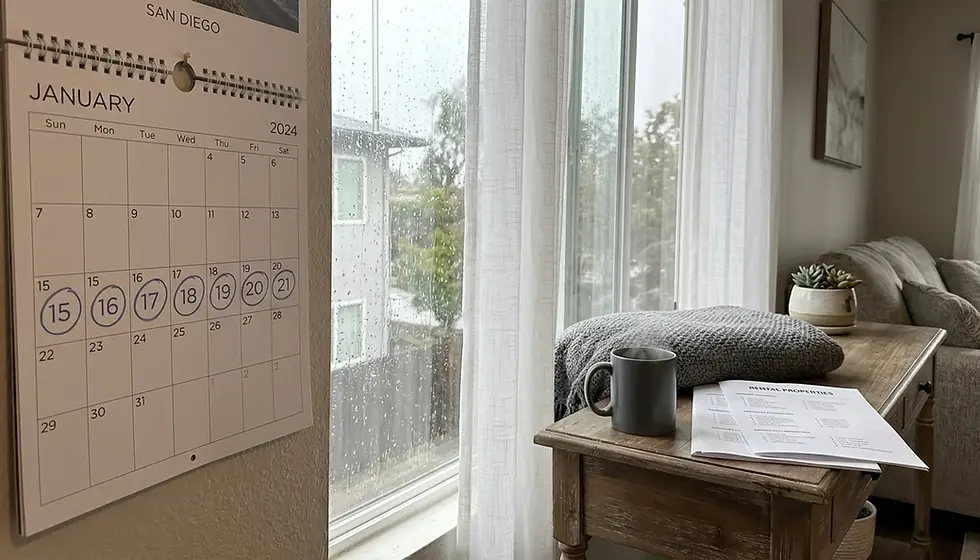
Keeping your Airbnb booked during slow season means combining calibrated discount pricing, expanded distribution across OTAs, and targeted marketing toward guest segments who travel year-round, like remote workers, business travelers, and monthly renters. In San Diego, low season (January, February, November) averages 47.9% occupancy compared to 61.1% in peak summer, according to West Coast Home Stays market data from 2026. At West Coast Homestays, we manage that seasonal gap for property owners across San Diego's coastal neighborhoods every year, and the properties that stay full off-peak all share the same handful of tactics.
San Diego's slow season (January, February, November) averages 47.9% occupancy versus 61.1% in peak summer (West Coast Home Stays, 2026), so a 13-point gap is the baseline problem you're solving.
Cutting base nightly rates 20-30%, not 50%, avoids signaling distress to the Airbnb algorithm while still moving the needle on bookings during low-demand months.
Adding Booking.com and VRBO alongside Airbnb can add 12-25 points of occupancy in shoulder and low season months by widening your guest pool beyond a single platform's search traffic.
Monthly discounts of 30-45% and length-of-stay pricing convert your property from a nightly rental into a mid-term option that appeals to relocating professionals and traveling nurses.
National STR operators typically target 60-75% annual occupancy to sustain healthy cash flow and platform ranking, a benchmark worth measuring your own slow-season performance against.
A hybrid short-term/mid-term strategy took one San Diego property from a projected $98,800 to an achieved $136,732 in annual revenue, largely by filling gap nights that would otherwise sit vacant.
Slow season isn't a mystery. It's math. Fewer travelers are searching, so the properties that keep bookings coming aren't the ones with the best amenities, they're the ones that adjust price, expand where they're listed, and change who they're marketing to. San Diego's coastal neighborhoods still see steady demand in January and February compared to landlocked markets, but a 13-point occupancy swing between peak and low season is real money left on the table if you're not adjusting your strategy.
This guide walks through the specific pricing bands, distribution moves, and guest-targeting tactics that keep a calendar full when demand drops, plus the operational details most articles skip entirely: how to diagnose your property's unique low-season pattern, how to structure a length-of-stay discount matrix, and when relaxing house rules actually helps rather than hurts. As of 2026, the hosts who treat slow season as a pricing and distribution problem, not a marketing problem, consistently outperform their comp set.
What Are the Slowest Months for Airbnb?
The slowest months for Airbnb in most U.S. markets, including San Diego, are January, February, and November, when travel demand drops after the December holidays and before spring break season begins. West Coast Home Stays' 2026 market data shows San Diego low-season occupancy averaging 47.9%, compared to 61.1% during the June through August peak.
That said, "slow season" isn't identical everywhere. Coastal markets like San Diego, Encinitas, and Carlsbad see less severe drops than inland or seasonal ski destinations because year-round mild weather keeps a baseline of leisure and business travel flowing. Still, a nearly 13-point occupancy gap is significant. On an 80-night annual difference, that's real revenue.
Before you touch pricing, pull your own property's historical booking data for the last 12 to 24 months if you have it. Specifically, look at which weeks had the steepest drop-offs and whether that pattern lines up with the citywide averages or diverges. A Pacific Beach studio and a La Jolla three-bedroom don't necessarily share the same slow months, since one skews toward spring-break travelers and the other toward retirees and business travelers who book year-round. Diagnosing your specific pattern, rather than assuming it matches the citywide average, is the first step every owner should take before adjusting rates.

What Is the 75-55 Rule in Airbnb?
The 75-55 rule is an informal pricing benchmark some hosts use to describe a target range: aiming to keep occupancy near 75% during shoulder periods while avoiding rates that fall below roughly 55% of peak-season pricing. It's not an official Airbnb policy, it's a rule of thumb some revenue-focused hosts apply when building seasonal pricing tiers.
In practice, the concept behind it matters more than the exact numbers. The idea is that dropping your rate too aggressively (below that 55% threshold) can suppress perceived value and hurt long-term brand positioning, even if it fills a few extra nights in the short term. Industry data supports staying within a moderate discount band: cutting your base nightly rate 20-30% during low season, not 50%, keeps your listing competitive without signaling distress to Airbnb's search algorithm or to guests comparing your listing against others in the same comp set.
At West Coast Homestays, we build seasonal pricing matrices for every property we manage rather than applying a single flat discount. A La Jolla oceanview unit and an Encinitas bungalow don't respond to the same discount curve, because their guest bases have different price sensitivity. Whatever ratio you land on, the principle holds: moderate, data-informed discounts outperform panic pricing every time.
What Is the 80-20 Rule for Airbnb?
The 80-20 rule, applied to short-term rentals, generally refers to the idea that roughly 80% of your bookings and revenue come from 20% of your strategic decisions, typically pricing accuracy, listing quality, and guest targeting. For slow-season planning specifically, this means a small number of high-leverage moves (calibrated pricing, multi-channel distribution, and length-of-stay discounts) drive most of your occupancy recovery.
Rather than spreading effort across a dozen minor tweaks, prioritize the handful of levers that actually move the needle. Specifically: adjusting your base rate within the 20-30% discount band, listing on at least one additional OTA beyond Airbnb, and building a length-of-stay discount structure for 7-night and 28-night stays. Those three changes typically account for the bulk of slow-season occupancy recovery, based on what we consistently see across the properties West Coast Homestays manages in San Diego, Carlsbad, and Oceanside.
Everything else, seasonal photos, welcome gifts, minor amenity additions, matters, but it's the remaining 20% of impact. If you only have time to execute three changes before your next slow season, make them pricing, distribution, and length-of-stay discounts. The rest is optimization on the margins.
What Is the 25 Rule on Airbnb?
The 25 rule generally refers to keeping your slow-season discount from exceeding roughly 25% below your standard shoulder-season rate in a single adjustment, allowing you to make incremental cuts rather than one dramatic drop. This staged approach lets you monitor booking response before committing to deeper discounts.
For example, instead of cutting a $250 nightly rate to $150 overnight, you'd move to $187 first (a 25% cut), watch booking velocity for two to three weeks, and only cut further if occupancy doesn't respond. This mirrors the broader industry guidance of adjusting pricing at least 90 days in advance and monitoring future occupancy trends before making additional changes, a practice referenced by pricing specialists like OptimizeMyBnb's slow-season pricing guidance.
Tools like PriceLabs can automate these incremental adjustments through rule sets tied to your booking window, letting you set floor and ceiling prices that adjust automatically as demand data comes in. But automation only works if the underlying rules are calibrated correctly. We've seen owners plug in a pricing tool, walk away, and lose $30,000 to $40,000 in a single year because the tool's settings didn't match their property's actual demand pattern. Revenue management isn't "set it and forget it," even with good software.
How Do You Build a Slow-Season Discount Matrix by Stay Length?
A slow-season discount matrix is a pricing structure that applies different discount percentages based on how many nights a guest books, typically offering steeper discounts for longer stays to reward commitment and reduce turnover costs. This is one of the most underused tactics in short-term rental pricing, and most competitor guides skip it entirely.
A practical matrix for a San Diego coastal rental during low season might look like this:
Stay Length | Typical Discount Band | Guest Segment Targeted |
1-2 nights | 10-15% off base rate | Spontaneous weekend travelers, local staycationers |
3-6 nights | 15-20% off base rate | Remote workers, small families, couples |
7-13 nights | 20-30% off base rate | Extended leisure travelers, digital nomads |
14-27 nights | 25-35% off base rate | Traveling nurses, insurance relocation clients |
28+ nights | 30-45% off base rate | Corporate housing, monthly renters |
Notice the discount bands widen as stay length increases, but they stay within the 20-30% moderate range for the shorter windows where most nightly bookings actually happen. The steepest discounts (30-45%) only apply to the 28-plus night tier, which is exactly where monthly discount guidance from industry sources lands. This tiered approach protects your average daily rate on short stays while still capturing revenue from guests who'd otherwise book nowhere and leave your calendar empty.
This is also where mid-term rentals become a genuine slow-season strategy rather than a fallback. West Coast Homestays has placed insurance relocation tenants at rates equivalent to $20,000 a month and structured a 13-month corporate relocation contract at $18,000 a month, filling exactly the kind of extended vacancy window that a nightly-only strategy leaves open. If your property sits empty for three or four weeks every winter, a properly priced 30-day booking often outperforms what you'd earn from scattered short stays at a steep discount.
Should You Expand Beyond Airbnb During Slow Season?
Expanding your listing to additional booking platforms during slow season is a proven way to increase visibility to guest segments who don't search Airbnb first. Adding Booking.com and VRBO alongside your existing Airbnb listing can add 12 to 25 points of occupancy during shoulder and low-demand months, since each platform draws a different traveler demographic and search algorithm.
Booking.com, for instance, skews toward international travelers and guests who are used to hotel-style booking flows. VRBO tends to attract families and groups planning longer stays. If your property is only listed on Airbnb, you're competing for a shrinking pool of searches during the exact months when total demand is already down. Multi-channel distribution spreads that risk.
The catch most self-managing owners run into is calendar synchronization. Manually updating three separate platforms invites double bookings, which is the single fastest way to tank your response rate and superhost status simultaneously. Channel management software or a professional co-management partner solves this by syncing availability in real time across every platform automatically. This is exactly the kind of operational layer West Coast Homestays builds into every full-service management engagement, since a missed sync during a slow-season push for extra bookings can cost you more in cancellation penalties than the additional channel ever generated.

Which Guest Segments Book During Slow Season?
The guest segments most likely to book short-term rentals during slow season are business travelers, remote workers, traveling healthcare professionals, and corporate housing seekers, since these groups travel on schedules unrelated to school breaks or summer vacation timing. Targeting these segments specifically, rather than waiting for leisure travelers to return, is what separates a full winter calendar from an empty one.
Corporate housing brokers, hospital staffing agencies placing traveling nurses, film and TV production companies scouting extended-stay housing, and conference organizers booking blocks of rooms all represent demand that doesn't disappear in January. If your property has a dedicated workspace, even a simple desk with good lighting, and you can document reliable Wi-Fi speeds in your listing description, you're positioned to capture remote workers who book 7 to 30 night stays regardless of season.
Practical steps to reach these guests:
Add workspace photos to your listing and specifically tag high-speed Wi-Fi (ideally 250 Mbps or faster) in your amenity description.
Update your listing title and description to reference proximity to hospitals, corporate offices, or convention centers if your property is near any of these.
Offer flexible check-in and check-out times for slow-season guests, since business travelers often arrive or depart outside standard windows.
Reach out to corporate housing brokers directly rather than waiting for organic search traffic to find you.
At West Coast Homestays, corporate and insurance relocation placements represent one of our most consistent slow-season revenue streams. These guests pay premium monthly rates for furnished, professionally managed properties, and they book through relationships and referral channels most individual owners simply don't have access to on their own.
How Do You Safely Relax House Rules Without Hurting Your Reputation?
Relaxing house rules during slow season, such as allowing pets, reducing minimum stay requirements, or loosening noise restrictions, can expand your addressable guest pool, but only if done selectively and documented clearly in your listing. This is one of the most overlooked slow-season levers, and getting it wrong can create real reputational risk.
Making your listing pet-friendly, for example, immediately opens your calendar to a guest segment many competing listings exclude. But it also means updating your cleaning protocol and potentially your cleaning fee to account for pet hair and allergen concerns for future guests. Reducing your minimum stay from three nights to one night attracts spontaneous weekend travelers, but it also increases turnover frequency, which means your cleaning team needs the capacity to handle more frequent, possibly same-day, resets.
The rule changes worth making during slow season are the ones with low downside risk: dropping minimum stays, enabling Instant Book to capture last-minute searches, and adding flexible cancellation policies for extended stays. Rule changes with higher risk, like loosening noise policies in noise-sensitive neighborhoods such as parts of Pacific Beach or Mission Beach, are rarely worth the potential HOA or neighbor complaint. Know which rules protect your long-term standing and which ones only exist out of habit.
How Does Local and Staycation Marketing Fill Slow-Season Gaps?
Staycation marketing means promoting your short-term rental to nearby residents looking for a short getaway without the cost or hassle of air travel, and it's a genuinely underused tactic during slow months when out-of-town demand drops. San Diego residents in inland neighborhoods, for example, represent a real audience for a weekend at a Carlsbad or Encinitas beach property just 30 to 45 minutes away.
Local Facebook groups, neighborhood community boards, and even a simple email to past guests offering a discount for themselves or referred friends can generate bookings that never show up in your Airbnb search impressions data. Automated post-checkout messaging to previous guests, offering a modest slow-season discount for a return stay, taps into an audience that already trusts your property and skips the acquisition cost of a stranger discovering your listing cold.
Partnering with a local micro-influencer or travel content creator for a promotional stay in exchange for social content can also extend reach beyond what organic search delivers during low-traffic months. This works best for distinctive properties, a design-forward Encinitas cottage or a La Jolla unit with cove views, where the visual content genuinely stands out rather than blending into generic listing photos.

What Do Slow-Season Occupancy Benchmarks Actually Look Like?
Slow-season occupancy benchmarks vary meaningfully by market and property type, but national and regional data give you a realistic target to measure against. The average U.S. Airbnb occupancy rate in 2026 sits around 56% annually, translating to roughly 204 booked nights per year, according to Awning's 2026 market data.
Nationally, professional short-term rental operators generally aim for 60-75% annual occupancy to maintain healthy cash flow and platform ranking. In San Diego specifically, West Coast Home Stays' 2026 data shows peak summer occupancy at 61.1% against low-season occupancy of 47.9%, a gap that widens further in specific submarkets. Carlsbad rentals, for comparison, show a median occupancy around 69% annually according to Airbtics' 2026 data, though estimates vary by source and property type, with GetChalet reporting figures between 50% and 68% depending on the property segment analyzed.
Market / Segment | Occupancy Benchmark | Source |
U.S. national average (2026) | ~56% annual | Awning, 2026 |
San Diego peak season (Jun-Aug) | 61.1% | West Coast Home Stays, 2026 |
San Diego low season (Jan, Feb, Nov) | 47.9% | West Coast Home Stays, 2026 |
Carlsbad median (Nov 2024-Oct 2026) | 69% | Airbtics, 2026 |
Professional operator target | 60-75% annual | Industry benchmark |
What this data tells you is straightforward: if your property is dipping meaningfully below the 47.9% San Diego low-season average, or well under the 60% professional-operator target, something in your pricing, distribution, or listing presentation needs attention. If you're an investor comparing San Diego Airbnb management approaches, occupancy benchmarks like these are the clearest signal of whether your current strategy is working or leaving money on the table.
What Mistakes Do Hosts Make During Slow Season?
The most common slow-season mistake hosts make is cutting prices too aggressively, by 50% or more, in a single move rather than adjusting incrementally within the 20-30% band that keeps a listing competitive without appearing distressed. This single error compounds with several other common missteps that quietly erode revenue.
Waiting until demand has already collapsed to adjust pricing. Industry guidance suggests reviewing and adjusting future pricing at least 90 days ahead, not reacting after a slow week already happened.
Staying single-platform. Relying only on Airbnb search traffic when Booking.com and VRBO could add 12 to 25 points of occupancy during exactly the months you need it most.
Ignoring length-of-stay pricing entirely. A flat nightly rate with no monthly discount structure leaves 28-plus night bookings, and the revenue they represent, on the table.
Treating every discount the same regardless of guest segment. A weekend leisure traveler and a 30-day corporate relocation tenant should never see the same pricing logic.
Neglecting the listing itself. Seasonal photos, updated amenity tags, and a description that speaks to remote workers or extended-stay guests all matter more in slow season, not less, when competition for a shrinking pool of searches intensifies.
Based on what we consistently see managing coastal San Diego properties, the owners who treat slow season reactively, cutting prices only after bookings stall, always underperform the owners who plan their seasonal pricing matrix and distribution strategy months in advance.
How Do You Diagnose Your Property's Unique Low-Season Pattern?
Diagnosing your property's specific low-season pattern means comparing your own historical occupancy and booking pace data against citywide or neighborhood benchmarks, rather than assuming your property follows the general San Diego average automatically. Every property has a slightly different demand curve based on bedroom count, neighborhood, and guest type.
Start by pulling your last two years of booking data, if available, and mapping occupancy week by week. Compare that against a market penetration index, essentially how your booking pace stacks up against similar listings in your immediate comp set, not the citywide average. A three-bedroom Mission Beach property competing with dozens of similar units faces a different low-season pattern than a one-of-a-kind La Jolla cliffside unit with limited direct competition.
If you don't have two years of your own data yet, because you're a first-time host or recently launched, use your immediate neighborhood's general pattern as a starting baseline and adjust as your own booking history accumulates. This is a gap most slow-season guides skip entirely: they tell you general benchmarks exist, but not how to build your own. A property-specific pricing strategy always outperforms one built on citywide averages alone, which is exactly why revenue management is a service, not a one-time setup, at West Coast Homestays.
How Do Automation Tools Help You Stay Booked Off-Peak?
Automation tools and property management software allow hosts to manage dynamic pricing, guest messaging, and multi-channel distribution at scale without manually adjusting every listing daily, which is especially valuable during slow season when margin for error narrows. Industry data shows firms using automation and software can manage 150 to 250 properties per manager, versus 50 to 75 without it, a gap that illustrates just how much manual effort automation replaces.
Pricing tools like PriceLabs let you set rule-based discount bands tied to booking window and stay length, automatically applying the kind of tiered discount matrix outlined earlier in this guide. Automated guest messaging can send past-guest re-engagement offers without you remembering to do it manually every week. Channel management software keeps your Airbnb, VRBO, and Booking.com calendars synced in real time, eliminating the double-booking risk that keeps many self-managing owners from expanding channels in the first place.
The limitation of automation is that it only performs as well as its configuration. A pricing tool set up with the wrong comp set or an outdated seasonal curve will confidently generate the wrong rate, and you won't necessarily notice until months of underperformance have already passed. This is where many self-managing owners get burned, they trust the software completely and never audit whether it's actually calibrated to their property's real demand pattern.
What Practical Steps Should You Take Right Now?
The practical starting point for improving slow-season bookings is auditing your current pricing structure against the 20-30% moderate discount band, confirming you're listed on at least one platform beyond Airbnb, and checking whether your listing speaks to extended-stay or remote-work guests at all. These three checks take under an hour and often reveal the biggest gaps immediately.
Audit your current nightly rate against a 90-day-out pricing calendar. If you haven't adjusted rates for the upcoming slow months yet, start now rather than waiting for bookings to slow first.
Build a stay-length discount matrix using the bands outlined earlier, from 10-15% off short stays up to 30-45% off 28-plus night bookings.
List on at least one additional OTA if you're currently Airbnb-only, and set up calendar synchronization before you do to avoid double bookings.
Update your listing photos and description to include workspace and Wi-Fi speed details if your property could reasonably serve remote workers.
Reach out to past guests with a modest slow-season return offer rather than relying entirely on new organic search traffic.
Review your house rules for low-risk changes, like enabling Instant Book or reducing minimum stays, that expand your addressable guest pool without reputational downside.
If this list feels like a lot to manage on top of everything else self-managing already demands, that's a reasonable reaction. This is precisely the kind of seasonal revenue strategy West Coast Homestays builds into full-service management for every property in our San Diego portfolio, so owners aren't reverse-engineering a discount matrix from scratch every October. You can also review our approach to VRBO dynamic pricing for a deeper look at how cross-platform rate calibration works in practice, or explore our investment-focused content if you're weighing a hybrid STR/MTR strategy for a specific property.
Frequently Asked Questions
How much should I discount my Airbnb during slow season?
Cut your base nightly rate by 20-30% during slow season rather than 50% or more, which can signal distress to Airbnb's algorithm and make your listing appear devalued. For stays of 28 nights or longer, discounts of 30-45% are appropriate, since monthly guests represent a different pricing logic than nightly travelers.
Should I list my Airbnb on other platforms during slow season?
Yes. Adding Booking.com and VRBO alongside Airbnb can add 12 to 25 points of occupancy during shoulder and low-demand months by reaching guest segments who don't search Airbnb first. Just make sure your calendars sync automatically across platforms to avoid double bookings.
What guests should I target during Airbnb's slow season?
Target business travelers, remote workers, traveling healthcare professionals, and corporate housing seekers, since their travel schedules don't follow school breaks or summer vacation patterns. Adding workspace photos, tagging high-speed Wi-Fi, and offering flexible check-in times helps your listing appeal directly to these segments.
Is mid-term rental better than short-term during slow season?
For gap weeks that would otherwise sit vacant, mid-term rentals (28-plus nights) can significantly outperform scattered short stays at a steep discount, especially for corporate relocation or traveling healthcare tenants. West Coast Homestays has structured mid-term placements at rates equivalent to $18,000 to $20,000 a month for the right property, filling exactly the kind of extended vacancy that nightly-only pricing leaves open.
What are the slowest months for Airbnb bookings?
January, February, and November are typically the slowest months nationally and in San Diego specifically, with West Coast Home Stays 2026 data showing 47.9% average occupancy in those months compared to 61.1% during the June through August peak. Coastal markets tend to see a less severe drop than inland or seasonal destinations because of year-round mild weather.
Does Instant Book help during slow season?
Enabling Instant Book can increase your listing's visibility in Airbnb search results and capture last-minute travelers who don't want to wait for host approval. It's a low-risk change worth making during slow months, since spontaneous last-minute bookings are more common when guests are watching for deals rather than planning far in advance.
How far in advance should I adjust my slow-season pricing?
Industry guidance suggests monitoring future occupancy and adjusting pricing at least 90 days ahead of your slow season, rather than reacting after bookings have already stalled. Incremental adjustments, watching booking response for two to three weeks before cutting further, work better than one large price drop.
Can I make my Airbnb pet-friendly just for slow season?
Yes, and it's one of the lower-risk rule changes available, since it expands your addressable guest pool without the reputational downside of, say, loosening noise policies. Just update your cleaning protocol and fee structure to account for pet-related turnover requirements before making the change.
The Bottom Line on Keeping Your Airbnb Booked Through Slow Season
Keeping your Airbnb booked during slow season comes down to three levers that matter more than everything else combined: calibrated pricing within the 20-30% discount band, distribution across at least two OTAs, and a length-of-stay matrix that captures mid-term guests you'd otherwise miss entirely. San Diego's low-season occupancy sits around 47.9% against a 61.1% summer peak, and closing that gap is achievable with the right combination of these tactics, not by guessing or panic-discounting when bookings first slow down.
As 2026 continues, the operators who plan their seasonal pricing matrix months ahead, rather than reacting to an empty calendar in real time, consistently outperform the ones who don't. Whether that means auditing your own pricing bands this week or exploring a hybrid short-term and mid-term strategy for the properties that sit vacant every winter, the data supports acting early.
Managing all of this well, pricing calibration, multi-channel distribution, guest segment targeting, and length-of-stay discounts simultaneously, is demanding even for an experienced host. It's exactly the kind of seasonal revenue work West Coast Homestays handles for the 80-plus properties across San Diego, La Jolla, Pacific Beach, Encinitas, Carlsbad, Oceanside, and Mission Beach currently under our management.

If your calendar tends to empty out every winter, that's usually a sign your pricing or distribution strategy needs adjusting, not a sign your property or location is the problem. West Coast Homestays builds seasonal pricing matrices, manages multi-channel distribution, and structures hybrid short-term and mid-term strategies for properties across San Diego's coastal neighborhoods, including one hybrid engagement that took a property from a projected $98,800 to an achieved $136,732 in annual revenue. Reach out to discuss what your property's slow-season strategy could look like.
Written by Mark Palmiere, Owner & CEO at West Coast Homestays
Content powered by inkSTR.co
Comments