_edited.png)


Vacation Rental Turnover Checklist That Kills Bad Reviews


A vacation rental turnover checklist is a room-by-room task list that standardizes cleaning, restocking, and inspection between guest stays so every arrival meets the same quality bar. At West Coast Homestays, we run this exact process across more than 80 properties in San Diego's coastal neighborhoods, and the pattern is consistent: nearly every 1-star review we've seen traced back to a missed turnover step, not a bad location or an unlucky guest.
A complete turnover checklist covers five phases: pre-clean prep, room-by-room cleaning, restocking, safety inspection, and a final walk-through, typically taking 45 to 210 minutes depending on property size, according to turnover inspection data from RapidEye.
Proof photos matter: RentalReady and RapidEye both recommend 3 to 10 timestamped photos of the entry, kitchen, bathroom, and made bed after each turnover to resolve disputes and confirm standards were met.
Same-day turnovers on weekends are the highest-risk window for missed standards, especially for owners self-managing multiple listings across Pacific Beach or Mission Beach.
Cleanliness reviews carry disproportionate weight in guest ratings, and at West Coast Homestays, we've documented that a full 5-star review profile can translate into roughly 20% more annual revenue compared to a listing with mixed reviews.
Consistency between cleaners matters more than any single checklist item. A checklist only works if every person on your team follows it identically, regardless of who's on shift.
Building the checklist into your PMS workflow, rather than keeping it on a clipboard, is the difference between a system and a suggestion.
If you're self-managing a San Diego short-term rental in 2026, your turnover process is probably the single biggest lever you're not optimizing. Pricing gets attention. Photos get attention. Turnover quality, the thing guests actually experience the moment they walk in, often gets whatever time is left after the cleaner rushes to the next job.
That's a mistake, and it's an expensive one. A guest who opens the door to a lingering smell, a stained pillowcase, or a Wi-Fi password that doesn't work isn't going to remember your ocean view. They're going to remember the smell. Based on what we see across our managed portfolio at West Coast Homestays, turnover failures are the single most preventable cause of review damage, and they're almost entirely solvable with a standardized checklist.
This guide breaks down a complete vacation rental turnover checklist by room, explains how to adapt it for different property types, and shows you how to train a cleaning team so every turnover feels identical no matter who's holding the mop. We'll also cover the parts most turnover guides skip entirely: tying specific checklist steps to specific review categories, and building the checklist into your actual operating workflow instead of a laminated sheet nobody reads after week three.
What Belongs on a Vacation Rental Turnover Checklist?
A vacation rental turnover checklist is a standardized sequence of cleaning, restocking, and inspection tasks organized by room, designed to reset a property to guest-ready condition between stays. Specifically, the checklist should cover five zones: kitchen, bathroom, bedrooms, living and common areas, and a final property-wide walk-through. Each zone needs its own sub-tasks, not a generic "clean the house" instruction.
As a result, cleaners working from a detailed checklist produce consistent results turnover after turnover, while cleaners working from memory or verbal instructions introduce variation that shows up in guest reviews. Industry checklist frameworks like the ones published by HostMoat and RapidEye assign time estimates and priority levels (critical, standard, if-time) to each task, which helps your team triage when a same-day turnover is running short on time.
Notably, the checklist should not stop at "clean." It needs to include restocking consumables, safety inspections (smoke detectors, carbon monoxide detectors, appliance function), and documentation, meaning photos or notes that prove the standard was met. Most self-managing owners we talk to at West Coast Homestays have a cleaning checklist but no inspection or documentation layer, which is exactly where things fall through.
Which Kitchen Tasks Actually Prevent Bad Reviews?
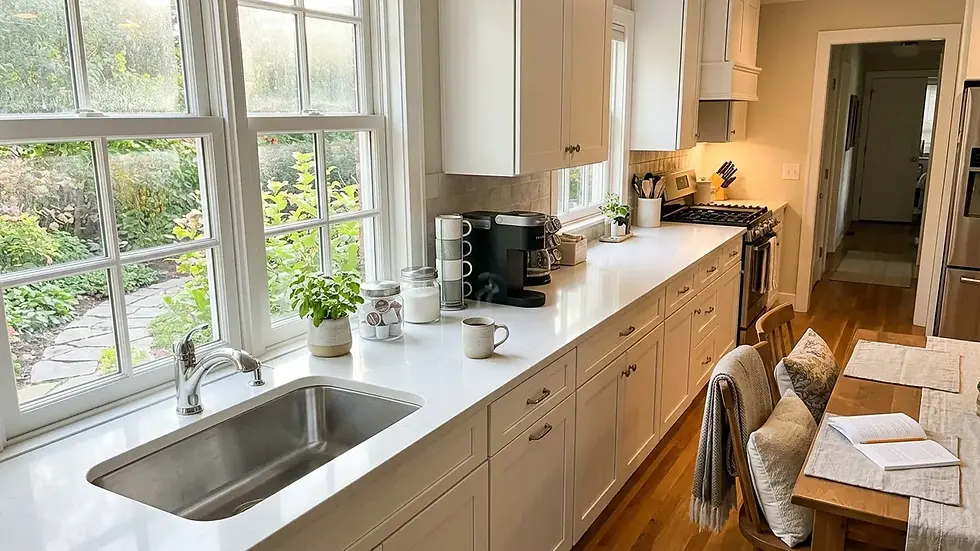
Kitchen turnover tasks that prevent bad reviews focus on odor control, surface sanitation, and appliance resets, since kitchens are where guests spend meaningful time and where lingering smells or grime get noticed fastest. RapidEye's turnover framework allocates roughly 2 to 3 minutes per countertop and backsplash wipe, 2 minutes for sink scrubbing, and 1 to 3 minutes checking oven interiors for buildup.
First, run and empty the dishwasher, then wipe its interior gasket, a step HostMoat specifically calls out because a musty dishwasher smell is one of the fastest ways to tank a cleanliness score. Additionally, check the oven and microwave interior for spills; a splattered microwave is a five-second fix that guests notice immediately.
Second, check the refrigerator for expired condiments and leftover guest food. RentalReady recommends checking expiration dates on anything left behind and removing it, since a forgotten jar of salsa from three guests ago is a common complaint. Also check behind the fridge and under the stove for dropped debris, an if-time task, but one worth doing during weekly deep cleans even if you skip it on same-day turnovers.
Third, restock consumables completely: dish soap, a sponge, paper towels, trash bags, coffee, and tea, per HostMoat's restocking list. Shake the salt and pepper shakers to confirm the contents haven't clumped, a small detail RentalReady flags that most checklists miss entirely. An empty coffee canister on day one is a guaranteed complaint from a guest who planned their morning around it.
Vacation Rental Cleaning Checklist | Complete Airbnb Turnover Guide for 5-Star Reviews
What Do Bathroom Turnovers Need to Cover?
Bathroom turnover tasks center on scrubbing, restocking, and a final polish pass, because bathrooms generate the highest concentration of hygiene complaints in guest reviews when standards slip. RapidEye's time estimates put toilet scrubbing (inside and out) at 2 to 3 minutes, shower and tub cleaning at 3 to 4 minutes, and floor cleaning at 1 to 2 minutes per bathroom.
Start with the toilet and shower or tub, the two fixtures guests inspect most closely on arrival. As a result, any visible soap scum, hair, or water spots in these areas will surface in a review faster than almost any other issue in the property. Follow with the sink, mirror, and countertop, then finish with the floor.
Restocking is non-negotiable here. RentalReady specifies at least 2 rolls of toilet paper per bathroom, plus soap, shampoo, and conditioner if you provide them. A single missing roll of toilet paper generates a disproportionate number of guest complaints relative to how cheap it is to prevent. RentalReady's proof-photo guidance also calls for a shot showing clear glass and polished taps, both a documentation step and a forcing function that makes cleaners actually finish the polish pass instead of skipping it.
For high-touch surfaces specifically, sanitize door handles, light switches, and any shared toiletry dispensers. This is one of the categories most self-managed hosts skip entirely, and it's one of the first things a hospitality-trained team checks during our turnover protocol at West Coast Homestays.
How Should Bedrooms and Living Areas Be Reset?
Bedroom and living area resets require a full linen change, a debris check between cushions and under furniture, and a decor straighten-up, since these spaces are where guests notice both cleanliness and the "staged" feel that separates a professional rental from a self-managed one. Fresh linens are the baseline. Beyond that, RentalReady's checklist calls for checking for stains before remaking the bed, not after, which prevents a discovered stain from delaying the entire turnover.
For living rooms, vacuum couch cushions and check between them for debris, coins, remote controls, or crumbs left by the previous guest. HostMoat's checklist includes checking under the bed and inside drawers for forgotten items as a standard step, paired with a documented lost-property process so returned items don't create a liability headache.
Additionally, test all lights and replace any burned-out bulbs, then check fan blades and blinds for visible dust, a task RentalReady lists explicitly because dust on visible surfaces is one of the top "looks unclean even though it's clean" complaints in guest reviews. Straighten decor and spot-clean small stains on furniture or rugs before moving to the final walk-through.
For San Diego coastal properties specifically, sand tracked in from beach visits is a recurring issue in Pacific Beach and Mission Beach units. Add a dedicated floor and entryway pass to your bedroom and living area checklist if your property sits within a few blocks of the sand.
What Goes Into the Final Walk-Through and Safety Check?
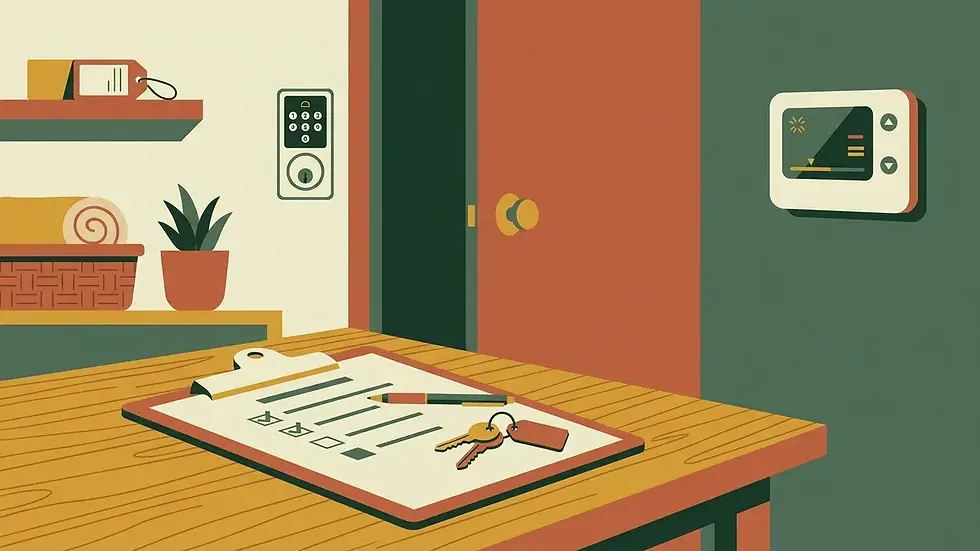
The final walk-through is the last checkpoint before a turnover is marked complete, and it covers thermostat settings, lock codes, Wi-Fi function, lighting, and a smell test across the entire unit. RentalReady's framework treats this as a distinct phase from room cleaning, not an afterthought, because it's the stage that catches system-level problems a room-by-room pass would miss.
Specifically, set the thermostat to your designated arrival temperature, lock all doors and windows, and update the smart lock code if your property uses one. Confirm Wi-Fi is functioning by connecting a device, not just checking that the router has power. Turn on porch or entry lighting so an evening arrival isn't fumbling for a doorknob in the dark.
Run a smell check throughout the property, paying attention to ventilation in bathrooms and kitchens if the unit has sat closed for a stretch. A stale or musty smell is one of the fastest ways to lose a 5-star rating even when every visible surface is spotless. Confirm the house manual or Wi-Fi card is present and legible, per RentalReady's guidance, since a missing manual generates avoidable guest messages.
Safety checks belong in this same phase: test smoke detectors and carbon monoxide detectors, confirm all appliances function, and verify windows and doors lock properly. Reference guidance from RentResponsibly.org if you want a broader framework for turnover-related safety inspections beyond cleaning.
Finally, take a timestamped photo of the clean property for your records. RentalReady recommends this as standard practice, and RapidEye's guide suggests 5 to 10 photos covering entry, kitchen, bathroom, bed, and living area, which gives you documented proof if a guest disputes the condition of the unit at check-in.
How Does This Checklist Actually Prevent Specific Bad Reviews?
A turnover checklist prevents bad reviews by mapping each cleaning and inspection step directly to a review category guests actually complain about: cleanliness, communication, accuracy, and check-in. Most published checklists stop at "clean the kitchen" without connecting that task to the review outcome it's protecting against, which is a gap worth closing if you want your checklist to actually change your ratings.
Consider the categories directly:
Common Bad Review Complaint | Checklist Step That Prevents It |
Smell (musty, stale, previous guest odor) | Ventilation pass and smell check during final walk-through |
Stained sheets or towels | Check for stains before remaking bed; full linen swap every turnover |
Missing or damp towels | Laundry-handling flow with dedicated dirty linen collection before restocking |
Broken Wi-Fi at check-in | Device-based Wi-Fi test, not just a router power check, during walk-through |
Dirty bathroom on arrival | Toilet and shower scrub with proof photo of clear glass and polished taps |
Missing amenities (soap, coffee, toilet paper) | Full restocking pass against a fixed consumables list every turnover |
Property doesn't match photos | Decor straighten-up and staging pass as part of living area reset |
Notably, "smell" and "missing amenities" are the two categories that self-managing owners underestimate most. Neither requires deep cleaning skill. Both require discipline, meaning someone actually runs the ventilation fan and actually checks the coffee canister every single time, not just when they remember.
How Do You Adapt the Checklist for Different Property Types?
A vacation rental turnover checklist needs property-specific adjustments because a beach house, a ski cabin, and a city condo generate different debris, wear patterns, and guest behaviors. A generic checklist applied identically across property types leaves gaps that show up as recurring complaints specific to that property's use case.
For San Diego coastal properties in Pacific Beach, Mission Beach, or La Jolla, sand and salt residue require an additional floor and entryway pass beyond the standard vacuum. Beach towels and outdoor rinse stations also need their own restocking line item, since guests use these constantly and they wear out faster than indoor linens.
For Encinitas or Carlsbad properties closer to surf culture and family travel, expect more outdoor gear (boards, bikes, strollers) tracked through common areas, which means a slightly longer entryway and living area reset. Properties near Carlsbad's family attractions also see more juice boxes, snacks, and toys left behind, worth flagging in your lost-property protocol.
City condos, by contrast, typically need less floor-level debris management but more attention to high-touch surfaces (elevators, shared hallways aren't your responsibility, but door handles and keypads within the unit see heavier use in shorter, higher-frequency stays). Adjust your time estimates accordingly rather than assuming every property needs the same 90-minute block.
How Do You Train Cleaning Teams to Deliver Identical Results?
Training a cleaning team to deliver identical turnover results requires a written checklist paired with photo documentation requirements and a standardized order of operations, not a one-time verbal walkthrough. Most self-managing owners we work with at West Coast Homestays started with a checklist that worked fine with one trusted cleaner, then fell apart the moment a second person joined the rotation or the regular cleaner called in sick.
First, sequence the checklist in a fixed order: kitchen, then bathrooms, then bedrooms and living areas, then final walk-through. A fixed sequence prevents skipped steps that happen when cleaners work in whatever order feels natural to them that day. Second, require proof photos at defined checkpoints, not as an optional extra. If a photo requirement exists, cleaners tend to actually complete the step they're photographing, which is part of why the practice works.
Third, build in a supervisor spot-check on a rotating schedule, even if it's just once every ten turnovers. In contrast to relying entirely on trust, periodic verification catches drift before it becomes a pattern that shows up in three consecutive guest reviews. At West Coast Homestays, our turnover operations run on standardized inspection checklists specifically because consistency across dozens of properties and multiple cleaning contractors only holds up when the process doesn't depend on any one person's memory.
Fourth, treat the checklist as a living document. Update it when a specific complaint recurs. If guests keep mentioning a squeaky drawer or a stubborn stain on a particular sofa, that item goes on the checklist permanently until it's resolved at the source.
How Do You Build the Checklist Into Your Actual Workflow?
Embedding a turnover checklist into your property management workflow means connecting checklist completion to automated triggers in your PMS, rather than relying on a printed sheet that lives in a kitchen drawer. As of 2026, most channel managers and PMS platforms support task automation tied to booking calendars, which removes the manual step of someone remembering to notify the cleaner.
Specifically, set up an automated notification that fires the moment a guest checks out, alerting your cleaning team and starting a countdown to the next check-in. If you're running same-day turnovers on weekends, a common scenario in Pacific Beach during summer, that automation is the difference between a cleaner arriving with three hours to work versus ninety minutes.
Additionally, digitize the checklist itself using a shared app or form rather than paper, so photo uploads happen in real time and get logged against the specific reservation. This creates a searchable record if a guest disputes cleanliness later, and it gives you visibility into which turnovers are running long before it becomes a pattern of late check-ins.
Finally, consider turning a condensed version of your checklist into a guest-facing asset. A short pre-arrival message listing what's been freshly prepared (fresh linens, restocked coffee, tested Wi-Fi) sets expectations and signals professionalism before the guest even walks in. Few turnover guides mention this step, but it's a low-effort way to convert your internal process into a guest trust signal.
What Are the Most Common Turnover Mistakes Owners Make?
The most common turnover mistakes among self-managing San Diego hosts involve rushing same-day turnovers, skipping documentation, and treating restocking as optional when the budget feels tight. Each of these mistakes is preventable, and each one shows up directly in review scores.
Skipping proof photos to save time. Without photos, you have no record to dispute a guest's cleanliness complaint, and you can't verify whether your cleaner actually completed the checklist or just claimed to.
Under-restocking to cut costs. A missing roll of toilet paper or an empty coffee canister costs pennies to prevent but generates outsized guest frustration relative to the savings.
Using the same checklist for every property type. A beach house near Mission Beach and a city condo have different wear patterns; a one-size checklist misses property-specific risks.
No backup plan for cleaner no-shows. A single point of failure in your cleaning staff means one sick day turns into a missed turnover and a same-day cancellation risk.
Treating the checklist as a suggestion instead of a requirement. If completion isn't tracked or verified, standards drift within weeks, especially across multiple cleaners.
Ignoring the final walk-through. Cleaning the rooms without checking thermostat, locks, Wi-Fi, and smell means guests can walk into a spotless unit that still feels wrong.
Based on what we see managing more than 80 properties across San Diego's coastal neighborhoods, the owners who struggle most with reviews aren't the ones with older properties or tougher locations. They're the ones running turnover without a documented, enforced system. That gap is exactly where San Diego property management support tends to pay for itself fastest.
Turnover Checklist vs. Full-Service Cleaning Management: What's the Real Difference?
A DIY turnover checklist gives you a framework, but full-service cleaning and turnover management adds enforcement, documentation, and backup staffing that a printed checklist alone can't provide. The distinction matters most during peak season, when same-day turnovers stack up and a single missed step affects multiple properties in a row.
Factor | DIY Checklist (Owner-Managed) | Professional Turnover Management |
Consistency across cleaners | Depends on individual training and memory | Standardized inspection protocol across all staff |
Documentation | Optional, often skipped under time pressure | Photo proof logged against every reservation |
Backup coverage | Owner scrambles if cleaner cancels | Vetted contractor network with same-day backup |
Restocking oversight | Owner tracks and reorders manually | Built into recurring turnover workflow |
Review impact | Variable, tied directly to cleaner reliability | Protected through inspection and accountability layer |
A single missed turnover can cost you a 5-star review you can't get back, and at West Coast Homestays, we've seen that cleanliness scores tie directly to revenue: a fully 5-star review profile has translated into roughly 20% more annual income for properties in our portfolio compared to listings with mixed reviews. If you're weighing whether to keep managing turnovers yourself, that revenue gap is worth running the numbers on before deciding.
For owners managing more than one property, such as across Pacific Beach and Mission Beach simultaneously, the coordination burden of same-day turnovers multiplies fast. That's precisely the scenario where our Airbnb co-hosting and full-service turnover operations exist to take the coordination problem off your plate entirely.
Frequently Asked Questions
How long should a vacation rental turnover take?
Turnover duration typically ranges from 45 to 210 minutes depending on property size and the number of bedrooms and bathrooms, based on turnover time estimates from RapidEye's inspection framework. Larger coastal properties with multiple bathrooms and outdoor spaces sit toward the higher end of that range, while studio or one-bedroom condos clear faster.
What should be restocked at every turnover, no exceptions?
Non-negotiable restocking items include toilet paper (at least 2 rolls per bathroom), dish soap, sponges, paper towels, trash bags, and coffee or tea, per HostMoat's turnover checklist. Skipping these low-cost items generates a disproportionate number of guest complaints relative to what they cost to keep stocked.
How many proof photos should a cleaner take after each turnover?
Most turnover frameworks recommend 3 to 10 timestamped photos covering the entry, kitchen, bathroom, made bed, and living area, per guidance from RentalReady and RapidEye. These photos create a documented record if a guest later disputes the cleanliness of the property at check-in.
Do I need a separate checklist for same-day turnovers?
Same-day turnovers benefit from a prioritized version of your standard checklist that flags critical versus if-time tasks, since time pressure means some lower-priority items (dusting fan blades, checking behind the fridge) may need to wait for the next scheduled deep clean. Critical tasks like bathroom sanitation, linen changes, and safety checks should never be skipped, even under time pressure.
How does turnover quality actually affect my Airbnb rating?
Turnover quality directly drives your cleanliness sub-rating on Airbnb, which factors into your overall star rating and search ranking. At West Coast Homestays, we've observed that properties maintaining a 5-star review profile generate meaningfully more annual revenue than comparable listings with mixed reviews, making turnover consistency one of the highest-leverage areas an owner can control.
Should I hire a professional turnover service or keep managing cleaning myself?
Hiring professional turnover management makes sense once you're managing multiple same-day turnovers weekly, operating more than one property, or living out of state without local oversight. If you're self-managing a single property with reliable, trained help and time to spot-check consistently, a well-built DIY checklist can work; the moment any of those conditions change, the coordination burden outweighs the cost savings.
What's the difference between a cleaning checklist and a full turnover checklist?
A cleaning checklist covers only the physical cleaning tasks (wiping, vacuuming, scrubbing), while a full turnover checklist adds restocking, safety inspection, documentation, and a final walk-through covering thermostat, locks, and Wi-Fi. The full turnover version is what actually prevents guest complaints, since many bad reviews stem from missing amenities or system issues rather than dirty surfaces alone.
Conclusion: A Checklist Only Works If It's Enforced
A vacation rental turnover checklist is only as good as the discipline behind it. The room-by-room tasks, the restocking lists, the proof photos, and the final walk-through covering locks, Wi-Fi, and smell all matter, but none of it prevents a bad review if it isn't followed identically every single time, regardless of which cleaner is on shift that day.
Heading into 2026, the owners seeing the strongest review performance across San Diego's coastal rental market are the ones who've turned their checklist into a system: digitized, photo-documented, and tied to automated notifications rather than a printed sheet. That shift is rarely about working harder. It's about removing the dependency on any one person remembering every step.
Managing turnover well in San Diego isn't complicated. It's demanding, and it requires the same consistent attention every single turnover, whether it's your third booking or your three-hundredth. The owners who do it profitably either build the systems to handle that consistency themselves, or they partner with a team that already has.

If turnover coordination has become the part of hosting you dread most, West Coast Homestays provides professional cleaning and turnover services built around standardized inspection protocols across all 80-plus properties we manage in San Diego's coastal neighborhoods. Visit WestCoastHomestays.com to find out how a consistent, documented turnover process could protect your ratings and your revenue.
Written by Mark Palmiere, Owner & CEO at West Coast Homestays
Content powered by inkSTR.co



Comments