_edited.png)


What Owners Miss About Vacation Rental La Jolla Shores

Updated: Aug 31
West Coast Homestays
La Jolla Shores vacation rentals in 2026 require a city-issued STR permit and transient occupancy tax remittance of approximately 14.5% on the first $10,000 of room rate under San Diego's Short-Term Rental Ordinance.
Typical coastal STR markets in San Diego, including La Jolla, achieve annual occupancies in the 65 to 75% band with average daily rates between $275 and $500-plus, per AirROI market data.
Parking is the most overlooked operational variable: street parking near La Jolla Shores Beach fills by mid-morning on summer weekends, and rentals with dedicated spots command higher rates and fewer complaint reviews.
Total guest costs regularly exceed listed nightly rates by 30 to 50% once cleaning fees, pet fees, and minimum-stay premiums are factored in.
A hybrid short-term and mid-term rental strategy consistently outperforms pure STR on annual net revenue for La Jolla Shores properties with HOA or seasonal constraints.
Five-star reviews generate approximately 20% more annual revenue per property, and La Jolla Shores guests most frequently cite cleanliness and check-in ease in their ratings.
La Jolla Shores is not a forgiving market for owners who approach it casually. The neighborhood draws guests who have stayed in premium coastal rentals before and who compare every detail of their experience against those prior stays. That expectation gap, between what a guest expects and what a property actually delivers, is the single most reliable predictor of a 4-star review instead of a 5-star one.
This guide covers what the listing catalog pages and platform aggregators do not: the regulatory landscape in 2026, the real cost picture for guests, the parking situation no one wants to discuss honestly, the revenue ceiling for different property types, and what owners need to understand before placing a La Jolla Shores property on Airbnb or any other channel. Whether you are evaluating a new acquisition or trying to diagnose underperformance in an existing listing, the details below are where the difference is made.
What Makes a Vacation Rental La Jolla Shores Property Different From the Rest of San Diego?
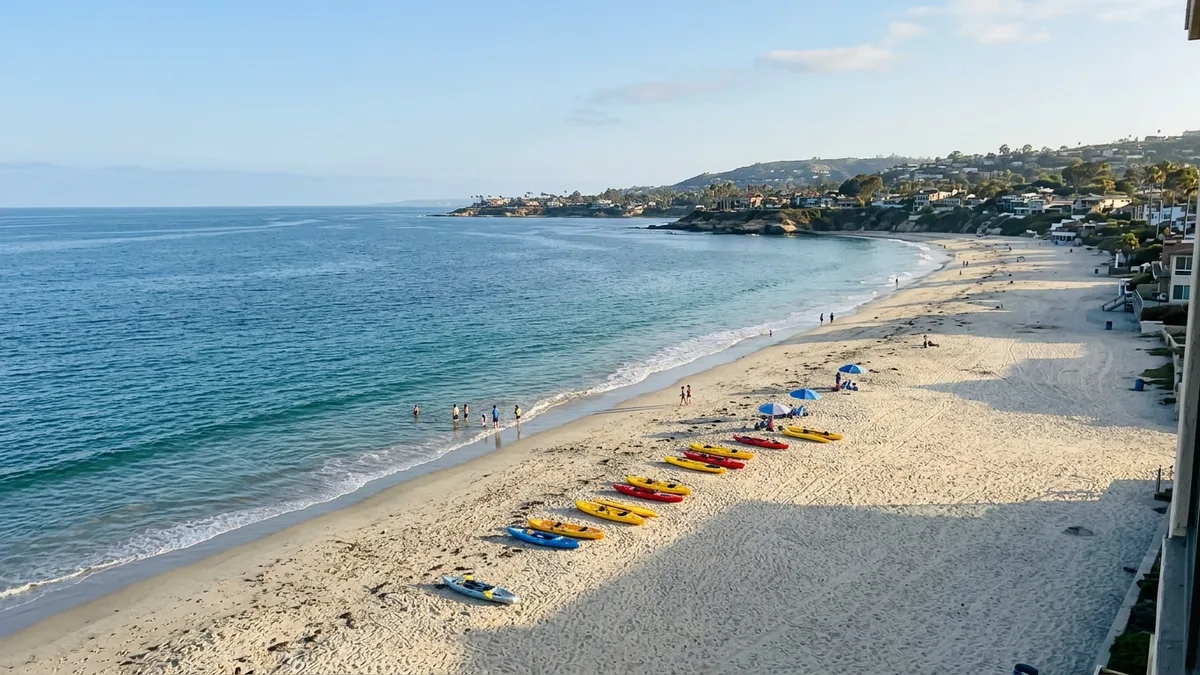
A vacation rental at La Jolla Shores refers to a short-term or mid-term lodging property located in the La Jolla Shores neighborhood of San Diego, California, which occupies the coastal strip north of the La Jolla Cove between the Scripps Institution of Oceanography pier and the residential streets east of Camino del Oro. This specific geography creates a demand profile that differs meaningfully from Pacific Beach, Mission Beach, and even La Jolla Village properties a mile to the south.
First, the beach itself is wider, calmer, and more family-oriented than the surf-heavy breaks at Pacific Beach or Windansea. Snorkeling, kayaking, and scuba diving launches are accessible directly from the sand, which draws a guest demographic that books longer stays and spends more per night than the typical 2-night weekend visitor at other San Diego beaches.
Specifically, the proximity to Avenida de la Playa's walkable restaurant and retail corridor means that guests at a well-located La Jolla Shores vacation rental can reach Wayfarers bakery, Paradisea restaurant, and several seafood spots without a car. That walkability is a genuine amenity that top listings name explicitly in their titles and descriptions, and it converts to measurable booking performance.
La Jolla Shores also benefits from the Birch Aquarium at Scripps, the Ellen Browning Scripps Park access point nearby, and the tide pools that draw visitors year-round. Notably, about 38% of La Jolla households are renter-occupied, according to RentCafe data, which reflects a neighborhood where the rental market, both short and long-term, is deeply embedded in the local housing fabric.
Additionally, the micro-geography matters operationally. Properties within two to three blocks of Avenida de la Playa and the beach access points at La Jolla Shores Drive command the highest nightly rates. Properties east of Camino del Oro, while still marketed as La Jolla Shores, carry a 10 to 15 minute walk to the sand and typically perform 15 to 20% below their closer counterparts on ADR.
What Do La Jolla Shores STR Regulations Actually Require in 2026?
Short-term rental regulation in La Jolla Shores means full compliance with San Diego's Short-Term Residential Occupancy (STRO) Ordinance, which governs all rentals of 30 days or less within the nine city council districts. As of 2026, every La Jolla Shores vacation rental requires a valid city-issued STRO permit, a registered Transient Occupancy Tax account, and active collection and remittance of the city's TOT, currently set at approximately 14.5% on the first $10,000 of room rate. You can apply for a permit through the City of San Diego STRO online portal, and the authoritative source for current fee schedules and regulatory updates is the City of San Diego STRO official page.
Beyond the city-level requirement, La Jolla Shores properties face an additional layer of complexity. Many condominium buildings and planned residential communities in the neighborhood are governed by homeowners associations that impose their own short-term rental restrictions. These HOA rules may include minimum stay requirements of 7 to 30 days, noise curfews, parking allocation limits for rental guests, and in some cases outright prohibitions on rentals shorter than 30 days. You need to verify HOA governing documents before listing any La Jolla Shores condo or attached home.
California law adds a third consideration: rentals longer than 30 continuous days are exempt from the state transient occupancy tax requirement, which creates a direct financial incentive for the mid-term rental strategy discussed later in this guide. For owners with HOA restrictions or seasonal vacancy gaps, this exemption makes the 30-plus-day placement structurally attractive.
Violations of the STRO ordinance carry meaningful penalties. The city's STRO violation reporting portal is actively used by neighbors, and enforcement has tightened since 2026. Operating without a permit in La Jolla Shores is not a minor oversight; it is a code enforcement matter with the capacity to result in fines and forced removal from platforms. Get the permit first.
What Does a La Jolla Shores Vacation Rental Actually Cost to Book?
The total cost of booking a vacation rental at La Jolla Shores refers to the complete out-of-pocket expense a guest pays, which frequently runs 30 to 50% above the listed nightly rate once platform fees, cleaning fees, pet fees, and applicable taxes are added. This gap between advertised price and checkout total is one of the most common sources of negative guest sentiment in the La Jolla Shores market, and it is entirely preventable with transparent listing practices.
Here is a practical breakdown of what the full cost picture looks like across different property types as of 2026:
Cost Component | Typical Range (La Jolla Shores) | Notes |
Nightly rate (studio/1-bed condo) | $250 to $400/night | Higher July through August |
Nightly rate (2-3 bed home near beach) | $450 to $900/night | Oceanfront adds significant premium |
Cleaning fee (typical) | $150 to $350 per stay | Higher for larger properties and peak season |
Airbnb service fee (guest side) | Typically 14 to 16% of subtotal | Per Airbnb published fee structure |
Transient Occupancy Tax | Approximately 14.5% on room rate | City of San Diego rate, first $10,000 |
Pet fee (if applicable) | $150 to $250 per stay | $250 is common in verified La Jolla listings |
5 to 7 nights required | Forces longer bookings at peak ADR |
For a 4-night summer stay in a 2-bedroom La Jolla Shores home at $600 per night, the total before the guest confirms can easily reach $3,500 to $3,800 once cleaning, service fees, and taxes are added. That is not unusual for coastal San Diego, but it is a number guests need to see clearly upfront. Listings that bury fees in the final checkout screen generate more cancellations and lower satisfaction scores than listings that address the full cost structure honestly in the property description.
What Are the Parking and Access Realities Nobody Warns You About?
Parking at La Jolla Shores is a genuine operational challenge that competitor listing pages and aggregator sites consistently fail to address. Street parking along La Jolla Shores Drive, Calle de La Playa, and the adjacent blocks fills by 9 a.m. on summer weekends, and the metered lots near the beach reach capacity not long after. Guests arriving by car at 11 a.m. on a July Saturday are likely to spend 20 to 30 minutes circling before finding a spot, often blocks away from the rental property.
For La Jolla Shores vacation rental owners, this has a direct impact on listing performance. Specifically, properties that offer one or more dedicated off-street parking spaces convert better in search, earn higher review scores, and justify premium nightly rates compared to comparable properties that rely on street parking. A dedicated space is not a luxury amenity in La Jolla Shores; it is a practical necessity for guests arriving with beach gear, coolers, and luggage.
If your La Jolla Shores rental does not include parking, address this proactively in the listing description rather than leaving it as a surprise on arrival. Name the nearest parking structure, describe the realistic walk to the beach from it, and note the paid daily rates. Guests who are prepared for the parking reality leave better reviews than guests who feel ambushed by it.
Access logistics extend beyond parking. La Jolla Shores Beach itself has limited ADA-accessible beach matting, and the soft sand approach from most street-access points is not trivial for guests with mobility limitations or young children carrying equipment. Rentals within 2 to 3 blocks of the beach access points at the foot of La Jolla Shores Drive have a material advantage over properties a 10-minute walk from the water. Be precise about actual walking distances in your listing, because guests who discover the stated "steps from the beach" means 12 minutes at a normal pace will document that discrepancy in their review.
What Revenue Can a La Jolla Shores Vacation Rental Realistically Generate?
Revenue potential for a La Jolla Shores vacation rental depends on property type, bedroom count, proximity to the beach, parking availability, and management quality. According to AirROI market data covering May 2026 through April 2026, the typical San Diego coastal short-term rental generates approximately $57,901 in annual gross revenue at a 50% occupancy rate and a $383 average daily rate. La Jolla Shores properties, given their premium location and higher ADR ceiling, consistently outperform that citywide average.
Professional STR hosts in coastal San Diego markets like La Jolla target 65 to 75% annual occupancy. July is the peak month, reaching roughly 61% citywide occupancy with proportionally higher rates; January is the softest, at approximately 47%. La Jolla Shores properties, because they attract snorkelers, divers, and aquarium visitors year-round, tend to have a flatter seasonal curve than Pacific Beach or Mission Beach, which helps stabilize annual revenue across the calendar.
How Do Property Types and Amenities Affect Booking Performance?
Property type determines the ADR ceiling and the guest segment you will attract. Beachfront homes with rooftop decks, outdoor cooking areas, and chef-grade kitchens, like the 2,800-square-foot properties verified in current Airbnb listings, command nightly rates that reach the top of the $500-plus ADR band. Studio and one-bedroom condos near the beach typically land in the $250 to $400 range and attract couples and solo travelers on shorter stays.
Amenities that move the needle most in La Jolla Shores include: dedicated parking (covered above), outdoor living space with a grill or BBQ, a fully equipped kitchen that can handle a family dinner without a trip to the store, and self check-in capability. Beachfront access, a hot tub, and a private outdoor shower all support higher ADR in the verified listing data from top-performing properties in the area.
Review volume and rating are the other revenue multipliers. The top-reviewed La Jolla Shores properties on Airbnb have accumulated hundreds of reviews with scores consistently at 4.85 to 4.99. Based on portfolio data at West Coast Homestays, five-star reviews generate approximately 20% more annual revenue per property through improved search placement and higher conversion rates. That is not a marginal improvement; at a $57,000 annual revenue baseline, it is worth roughly $11,000 per year in incremental bookings.
For owners considering a hybrid strategy, the mid-term rental model adds a meaningful stabilizer. One of our clients running a hybrid STR and MTR approach across a San Diego coastal property generated $136,732 in annual revenue, well above the $98,800 projection under a pure STR strategy, by filling shoulder-season gaps with 30-plus-day corporate and relocation placements. La Jolla Shores is particularly well-suited to this model given the proximity to UC San Diego, Scripps Research, and the Sorrento Valley biotech corridor, which generates reliable demand for furnished monthly rentals. You can explore more about Airbnb management strategies for coastal properties and how the hybrid model works in practice.
What Is the Best Time to Visit La Jolla Shores Beach and How Does It Affect Pricing?
The best time to visit La Jolla Shores Beach refers to the period from late spring through early fall, approximately May through October, when daytime temperatures at the beach range from 66 to 77 degrees Fahrenheit, rainfall is minimal, and the water is warmest for snorkeling and kayaking. This matches the peak STR demand window and corresponds to the highest nightly rates across La Jolla Shores vacation rentals.
Winter temperatures at La Jolla Shores typically run between 50 and 66 degrees Fahrenheit. The beach is much quieter from December through February, and STR demand drops proportionally. January is historically the weakest month for San Diego coastal occupancy. But for La Jolla Shores specifically, the Birch Aquarium and nearby museums continue drawing visitors, which means the off-season valley is shallower here than in beach neighborhoods that lack year-round cultural attractions.
For pricing strategy, the seasonal demand curve in La Jolla Shores rewards dynamic rate management over fixed pricing. A flat nightly rate misses the July premium window, which drives the highest ADR of the year, and it also holds rates too high during January and February, causing vacancies that a slightly lower price would have filled. Dynamic pricing errors across a portfolio can cost $30,000 to $40,000 in a single month when misapplied during peak demand, which is why manual rate-setting for a La Jolla Shores property is a genuine financial risk rather than a minor inefficiency.
Early morning visits on weekdays are the best way to experience La Jolla Shores without the summer crowds. That knowledge is useful to communicate in your listing's local guidebook: guests who arrive at the beach by 7:30 a.m. have the sand largely to themselves and enjoy the calmest conditions for snorkeling, while afternoon arrivals share the water with dozens of kayak tours and diving groups. The hosts who include this kind of practical local knowledge in their welcome materials earn better reviews than those who provide generic attraction lists. For more on building a competitive listing in this market, see our guide on building an Airbnb brand in San Diego in 2026.

What Should Property Owners Know Before Listing a La Jolla Shores Rental?
Listing a vacation rental at La Jolla Shores means navigating a set of practical requirements and strategic decisions that other neighborhoods simply do not present at the same level of complexity. The combination of high regulatory scrutiny, competitive listing density, and a guest base with elevated expectations creates a context where preparation is not optional.
First, get the compliance infrastructure in place before you photograph the property. The STRO permit application in San Diego requires a Transient Occupancy Tax certificate and a Rental Unit Business Tax account as prerequisites. You can look up existing TOT certificate numbers through the City's open data portal and verify that your RUBT account is active before submitting your STRO application. Operating without the permit even for a few weeks while you wait to "figure it out" exposes you to code enforcement risk in a neighborhood that has active neighbor oversight.
Second, photograph the property professionally before the first booking, not after a few stays. La Jolla Shores guests are browsing listings that include professionally lit interiors, accurate depictions of the outdoor space, and clear visual confirmation of amenities like parking and beach equipment. Amateur photography is immediately identifiable in the search results and costs you click-throughs before a guest has read a single word of your description.
Third, set realistic minimum-stay requirements calibrated to the season. A 2-night minimum in July fills your calendar with short, high-turnover bookings that increase cleaning costs and raise the probability of guest dissatisfaction from rushed turnovers. A 5-night summer minimum reduces turnover frequency and attracts families who plan proper vacations, which is the guest segment most likely to leave a 5-star review. In January and February, dropping to a 2 or 3-night minimum recovers occupancy from travelers who would otherwise pass on the rental.
Fourth, address the parking situation in your listing description with specific, honest language. Note the number of dedicated spaces (if any), the nearest public parking structure and its daily rate, and a realistic walking time from street parking to the property entrance. Guests who find the parking situation exactly as described do not mention it in their review. Guests who feel misled about it absolutely do.
Finally, consider whether full self-management is the right structure for your situation. A La Jolla Shores vacation rental operated at the level the market demands requires coordinated pricing adjustments, professional guest communication, reliable turnover cleaning between same-day checkouts, and maintenance response capability for when something breaks between a 10 a.m. checkout and a 3 p.m. check-in. That is a full operational system, not a part-time side task. West Coast Homestays handles that operational system across 80-plus properties in San Diego's coastal neighborhoods, with the revenue data to demonstrate what professional management changes in practice. If you want to understand the cost structure of management versus self-management, our San Diego property management cost guide walks through the tradeoffs in detail.
Frequently Asked Questions About La Jolla Shores Vacation Rentals
Do La Jolla Shores vacation rentals require a city permit in 2026?
Yes. Every vacation rental at La Jolla Shores operating as a short-term rental of 30 days or less must hold a valid City of San Diego STRO permit under the Short-Term Residential Occupancy Ordinance. The application is submitted through the city's Accela online portal, and the permit requires a prior TOT certificate and active Rental Unit Business Tax account. Operating without a permit carries code enforcement risk and potential fines.
What is the parking situation at La Jolla Shores Beach for rental guests?
Parking near La Jolla Shores Beach is consistently limited, particularly from June through August when street parking fills by mid-morning on weekends. Rentals that include one or more dedicated off-street parking spaces command higher nightly rates and generate fewer guest complaints. If your property relies on street parking, address this proactively in the listing description with accurate information about the nearest parking options and walking distances.
What are the typical hidden costs when booking a La Jolla Shores vacation rental?
The total cost of a La Jolla Shores vacation rental stay commonly runs 30 to 50% above the listed nightly rate. Key additional costs include the Airbnb service fee (typically 14 to 16% of the subtotal), cleaning fees of $150 to $350 per stay, San Diego's transient occupancy tax of approximately 14.5% on the room rate, and pet fees that commonly reach $250. Summer peak seasons often require minimum stays of 5 to 7 nights, which affects total trip cost as well.
What annual revenue can a La Jolla Shores vacation rental generate?
According to AirROI market data for 2026, the typical San Diego coastal short-term rental generates approximately $57,901 annually at a 50% occupancy rate and a $383 average daily rate. La Jolla Shores properties outperform that citywide average due to their premium location, higher ADR ceiling, and year-round demand from marine tourism and nearby research institutions. Professionally managed properties with strong review profiles and dynamic pricing consistently achieve 65 to 75% annual occupancy.
Is a mid-term rental strategy better than short-term for La Jolla Shores properties?
For some La Jolla Shores properties, specifically those with HOA restrictions on short stays or with seasonal occupancy gaps from November through February, a hybrid strategy combining STR and mid-term placements of 30-plus days outperforms a pure STR approach on annual net revenue. The proximity to UC San Diego, Scripps Research Institute, and the Sorrento Valley biotech corridor creates consistent demand for furnished monthly rentals from researchers, relocating professionals, and insurance placement tenants.
What distinguishes La Jolla Shores from La Jolla Village as a vacation rental market?
La Jolla Shores refers specifically to the beachfront and near-beach residential area north of the Cove, centered on Avenida de la Playa and La Jolla Shores Drive. La Jolla Village is the commercial and residential district roughly a mile to the south near Prospect Street and Girard Avenue. Shores rentals prioritize beach access and water activities, while Village rentals appeal to guests focused on dining, galleries, and the boutique retail corridor. ADR ceilings in the Shores are comparable to Village properties but driven by different amenity values.
What neighborhoods does West Coast Homestays manage vacation rentals in?
West Coast Homestays manages short-term and mid-term vacation rentals across seven coastal San Diego neighborhoods: San Diego, La Jolla, Pacific Beach, Mission Beach, Encinitas, Carlsbad, and Oceanside. The company handles listing optimization, dynamic pricing, guest communication, cleaning coordination, maintenance, and channel management across its portfolio of 80-plus properties.
Conclusion: Getting La Jolla Shores Right in 2026
A La Jolla Shores vacation rental is one of the strongest short-term rental positions available in San Diego, but only when it is operated with the same rigor the market demands. The STR permit is non-negotiable. The parking situation needs honest disclosure. The total cost picture needs to be transparent from the first search result. And the pricing strategy needs to respond to the pronounced seasonal demand curve, not hold a flat rate through July and January alike.
The gap between a top-performing La Jolla Shores rental, one in the 65 to 75% annual occupancy band with a premium ADR and a consistent stream of 5-star reviews, and a mid-performing one is almost never about the property itself. It is about the operational system behind it: how the listing is built, how rates are adjusted, how guests are communicated with, and how turnovers are managed. Those are execution decisions, not location decisions.
As of 2026, STR demand in San Diego has grown to represent nearly 20% of total lodging demand, up from roughly 10% before 2020 according to CoStar Analytics data. That growing competition makes listing quality and operational excellence more important, not less, for any La Jolla Shores owner who wants to hold a position in the top revenue tier.
If your La Jolla Shores property is not performing at the level the market supports, or if you are evaluating a new acquisition and want to know what professional management actually changes about the revenue trajectory, West Coast Homestays manages the full operational system: listing build, dynamic pricing, guest communication, turnover coordination, maintenance, and channel management. Our portfolio data shows that properties with hybrid STR and MTR strategies can generate $136,732 annually against projections closer to $98,800 under an STR-only model. That is a real outcome from a real property, not a projection. West Coast Homestays is easy to reach at WestCoastHomestays.com if you want to see what that looks like for your property specifically.
Written by Mark Palmiere, Owner & CEO at West Coast Homestays


Comments