_edited.png)


Vacation Rental Interior Design That Books More Guests


Vacation rental interior design is the process of furnishing, styling, and staging a short-term rental property so that it converts online browsers into confirmed bookings: and turns first-time guests into repeat ones. At West Coast Homestays, we manage 80-plus properties across San Diego's coastal neighborhoods, and the pattern is consistent: properties with intentional design choices outperform visually generic competitors on click-through rate, nightly rate, and guest review scores. Design is not decoration. It is a revenue lever.
TL;DR
Vacation rental interior design directly affects listing click-through rate, booking conversion, and the nightly rate guests will accept: properties that look distinctive in photos command measurably more per night than identical-spec units with generic furnishings.
Color palette strategy matters: blue tones are widely cited as the most effective primary color for coastal and neutral STR interiors because they signal calm and cleanliness, while earthy browns and beiges can read as dated and unwelcoming in listing photography.
Durability and cleanability are non-negotiable design constraints for STRs: white bleachable sheets, washable slipcovers, and hard flooring with area rugs (kept away from beds and dining tables) reduce turnover time and protect your review scores simultaneously.
In San Diego's competitive coastal market, the staging aesthetic should match the neighborhood: coastal modern in La Jolla, surf-casual in Pacific Beach, organic wellness in Encinitas. Generic beach decor does not distinguish any of these.
Designing specifically for listing photos (not just for in-person experience) is one of the most underdeveloped optimization opportunities in the STR market. The first three photos determine whether a guest clicks or scrolls past.
Professional redesign cycles for STR properties run every 2 to 3 years, compared to 8 to 10 years for primary residences, according to industry data from Vacation Rental Designers: budget accordingly from the start.
Most San Diego property owners invest heavily in location and then spend as little as possible on the interior. That logic makes sense for a long-term rental where tenants supply their own personality. But for short-term rentals, the space itself is the product. A guest browsing Airbnb or VRBO is making a split-second visual decision between your listing and six others at the same price point. What they see in the first three photos determines whether they click through or keep scrolling.
This guide covers vacation rental interior design from a revenue-first perspective. You will find room-by-room priorities, color and furniture selection principles grounded in what actually performs in San Diego's coastal markets, a framework for designing spaces that survive high-turnover operations, and a section on how to design specifically for listing photography: an angle that nearly every competitor article ignores entirely. Whether you are launching a new property in Carlsbad, refreshing a Pacific Beach unit that has been underperforming, or deciding whether to hire a professional designer, the principles here apply directly.
The goal is not a beautiful space for its own sake. The goal is a space that books at a premium rate, earns 5-star reviews consistently, and does not fall apart after 50 guest cycles. Those three objectives are not always compatible: and understanding the tradeoffs is where the real design work begins.

What Does Vacation Rental Interior Design Actually Mean for STR Revenue?
Vacation rental interior design refers to the deliberate selection of colors, furniture, lighting, and decor for a short-term rental property, with the specific goal of maximizing bookings, nightly rate, and guest satisfaction. This is distinct from residential interior design, where the primary audience is the person living in the space. In an STR context, you are designing for two separate audiences: the guest who will experience the space in person, and the potential guest who will evaluate it from a thumbnail photo at 11 p.m. on their phone.
Specifically, research cited by Vacation Rental Designers (VRD) , a North American professional community focused on STR design , indicates that property size and capacity accounts for approximately 72% of nightly rate determination, while equipment and amenities account for 18%, and location features the remaining 11%. That means the quality and presentation of what is inside your property influences nearly a fifth of what guests are willing to pay. For a coastal San Diego property generating $100,000 annually, a 10% rate increase through better design and staging is worth $10,000 per year. Not a decoration budget. A revenue investment.
Additionally, VRD industry data notes that STR properties need redesigns every 2 to 3 years, compared to 8 to 10 years for primary residences. High occupancy creates real physical wear. Budget for this from the start, or your listing photos will look dated within two busy summers.
For more on how design intersects with listing performance and revenue strategy, the West Coast Homestays team explores related tactics in our content on building an Airbnb brand in San Diego for 2026.
Which Colors Work Best in a Vacation Rental Interior?
Color strategy for vacation rental interior design means choosing a palette that photographs well, appeals broadly to your target guest demographic, and communicates the character of your specific location. The wrong palette does not just look bad in person: it actively suppresses listing click-through rates because it photographs flat or uninviting.
Blue is consistently cited as the strongest primary color choice for vacation rentals, particularly coastal properties. It is the stated favorite color of the largest share of the population, and it reads as calm, clean, and fresh in listing photography. For San Diego coastal properties, a palette built around soft navy, ocean blue, or coastal teal , anchored in whites and light naturals , aligns with the environment your guests are traveling to experience.
Earthy browns and heavy beiges are worth avoiding as dominant tones. They photograph warm in incandescent light but muddy in daylight photography, and they can read as dated or low-energy to the modern Airbnb browser. That said, a warm sand or linen neutral works well as a base when paired with brighter accent colors.
The color repetition rule is practical and worth following: use up to five colors total, but repeat each one at least three times throughout the space. A throw pillow color that also appears in the artwork and a kitchen accessory feels intentional. The same color used once looks accidental. Cohesion in photography signals quality to guests who are evaluating listings quickly.
In San Diego's distinct neighborhoods, color strategy should track with local character. La Jolla calls for coastal modern tones: crisp whites, deep blues, and warm gold accents that reflect its upscale, ocean-view character. Pacific Beach supports a more relaxed surf palette with faded blues, washed woods, and natural textures. Encinitas responds well to organic wellness tones: sage greens, warm whites, and natural linen. Applying a Pacific Beach surf-casual palette to a La Jolla condo is a mismatch that guests notice, even if they cannot articulate why.
How Should You Choose Furniture for a Short-Term Rental?
Furniture selection for vacation rental interior design requires balancing three competing priorities: visual appeal in photography, physical durability under high-turnover conditions, and ease of cleaning between guest stays. Most owners optimize for the first and underinvest in the second and third, then wonder why their property looks worn two years into operation.
Skip matching furniture sets. This is one of the more counterintuitive principles, but it is consistently supported by experienced STR operators. When an entire living room comes from a single retail package, it looks identical to dozens of other listings at the same price tier. Guests have seen that gray sectional and matching coffee table set in enough listings that it signals "generic rental." Mixing a quality sofa in a neutral with a vintage coffee table or a statement accent chair creates a more distinctive, magazine-editorial feel that photographs well and justifies a higher nightly rate.
Durability is non-negotiable. Upholstered pieces need to be either performance fabric or slipcover-friendly. Light-colored slipcovers that can be washed between stays are a practical choice for sofas and armchairs: they look clean because they are clean, and a replacement slipcover costs far less than reupholstering or replacing a sofa after a stain incident. For bedrooms, slatted or upholstered bed frames in solid construction hold up better than decorative headboards with thin slats that guests lean against repeatedly.
Hard flooring (tile or wood) outperforms carpet in every STR context. It cleans faster, photographs better, and does not trap odors. Area rugs add warmth and sound absorption, but placement matters: keep rugs out from under beds and away from dining tables. These are the two highest-traffic zones for food and liquid, and a rug under a dining table becomes an expensive cleaning problem within one guest cycle.
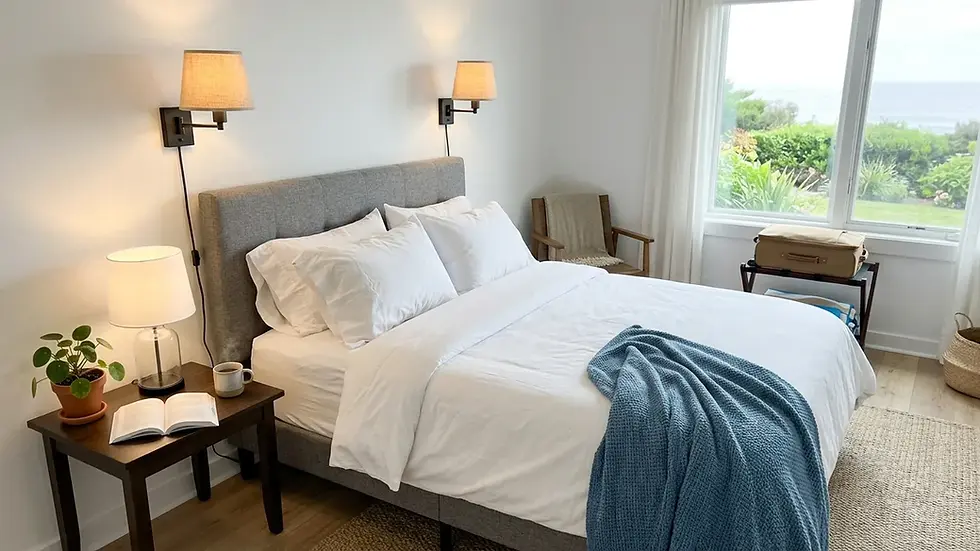
Practical additions that guests consistently notice positively: luggage racks in bedrooms (they keep bags off beds and floors, preserving linens), quality mattresses that photograph premium (Endy Mattresses are specifically noted by STR operators for their transport-friendly packaging and strong guest perception), and bedside lighting that does not require a full table. Plug-in sconces mounted to the wall solve the space problem in smaller bedrooms without sacrificing the warm layered-lighting feel that photographs well.
What Lighting Strategy Produces Better Listing Photos and Guest Experiences?
Lighting is one of the most underdeveloped elements of vacation rental interior design. Most owners rely on the overhead fixtures that came with the property. Those fixtures produce flat, institutional light that makes even well-furnished rooms look mediocre in photography.
Layered lighting means providing at least three light sources per room at different heights: overhead (ambient), mid-level (lamps, sconces), and accent (under-cabinet, shelf, or landscape). This is what professional photographers and interior designers call "the hotel room" effect: it creates depth, warmth, and visual interest in photography, and it gives guests the ability to set the mood during their stay rather than living under a single overhead bulb.
For living rooms, a floor lamp in the corner combined with a table lamp on a console creates the warm pooling-of-light effect that photographs exceptionally well at dusk. For bedrooms, bedside lamps or sconces eliminate the flat-light problem and create the kind of ambient glow that reads as premium in listing photos.
Outdoor lighting is frequently overlooked but highly photogenic. Bistro string lights over a patio or deck add an immediate resort-level feel to outdoor spaces and photograph beautifully in evening shots. For San Diego coastal properties where outdoor entertaining is a year-round selling point, landscape lighting on pathways and in garden beds adds depth and polish to exterior shots that competitors with purely utilitarian outdoor spaces cannot match.
One practical note: photograph every room with the lights on, curtains open, and at mid-morning or golden hour when daylight is available. Rooms photographed with overhead fluorescents alone will always look worse than the same room photographed with layered warm lighting supplemented by natural light. The photography session itself should be treated as a design deliverable, not an afterthought after the furniture arrives.
How Do You Design a Vacation Rental Specifically for Listing Photos and Booking Conversion?
Designing for listing photography means making deliberate decisions about sight lines, hero moments, and visual anchors in each room, with the specific goal of producing images that stop a guest's scroll and prompt a click-through. This is the content gap that virtually no competitor article addresses, and it is one of the highest-leverage design decisions you can make.
Guests on Airbnb or VRBO make their first evaluation from a thumbnail, typically 250 to 300 pixels wide on a mobile device. The image that covers that thumbnail must communicate three things instantly: the space is clean, it is well-furnished, and it is somehow distinctive. A room that ticks all three in a thumbnail gets clicked. A room that looks like every other Airbnb does not.
First, identify the hero shot for each room. The hero shot is the single photograph that will carry the most weight in your listing gallery. For a beachfront property, the hero shot is almost always an interior view looking toward the ocean through large windows. For an inland property, it is typically the living room or the outdoor entertaining space. Design the furniture arrangement and decor specifically to support this shot. The sofa should face the view. The throw pillows should add color contrast. The coffee table should be clear of clutter except for one or two intentional styling items.
Second, think about depth and layers. Flat rooms with a single furniture row and blank walls look one-dimensional in photography. A room with a foreground element (coffee table, rug edge, armchair corner), a mid-ground focal point (sofa, console), and a background element (gallery wall, fireplace, window view) photographs with significantly more visual interest. Interior designers call this compositional depth. STR operators call it "why guests click on that listing and not mine."
Third, consider the order of your photo gallery on the listing. Most platforms show the first photo as the hero, then cycle through the sequence. Put your most distinctive room first, then the master bedroom, then the outdoor space, then secondary rooms. Guests who are genuinely interested will view every photo; guests who are casually browsing make their evaluation from the first two or three. Those first photos are your entire marketing budget in visual form.
If you are managing multiple properties or preparing a new San Diego listing for launch, the team at West Coast Homestays incorporates photography staging as part of every listing optimization engagement: the space and the photography are treated as a single deliverable, not two separate tasks.
What Is the Turnover-Proof Design Framework for High-Volume STR Properties?
Turnover-proof vacation rental interior design refers to a systematic approach to furnishing and staging a property so that it can be cleaned, reset, and prepared for the next guest quickly and consistently, without accumulating visible wear between professional cleaning visits. This is the operational design framework that most style-focused articles skip entirely.
The principle is simple: every design choice should be evaluated against two questions. First, how long does it take to clean this element during a standard turnover? Second, what does it look like after 50 guest cycles? A velvet accent chair looks beautiful in listing photos. It also absorbs odors, shows every impression from a guest sitting on it, and cannot be spot-cleaned between stays. A performance-fabric armchair in a similar silhouette photographs nearly as well and survives two years of San Diego summer rentals with a wipe-down between stays.
Bedding strategy is where most STR operators make their most consequential design-meets-operations decision. White sheets are the correct choice for almost every vacation rental, and not primarily for aesthetic reasons. White sheets can be bleached between stays, eliminating the gradual yellowing and staining accumulation that makes colored or patterned bedding look visibly used within a few months of operation. Guests also perceive white bedding as cleaner, regardless of the actual cleaning standard, which is a meaningful psychological factor for review scores.
For mattresses, invest in quality. A guest who sleeps poorly leaves a review about it. A quality mattress is also a design element: a thick, well-made mattress with proper pillows photographs as premium in listing photos in a way that a thin mattress dressed in expensive linens does not.
Hard surfaces beat soft ones in every high-traffic zone. Tile or engineered hardwood in kitchens, bathrooms, and main living areas cleans faster than carpet and does not hold odors. In bedrooms, area rugs add warmth but should be kept away from the bed footprint: a guest dragging a suitcase across carpet leaves scuff marks and hair; a guest doing the same across a hard floor is cleaned in thirty seconds.
Labeling light switches, circuit breakers, and remote controls is an operational design choice that reduces guest frustration and negative review mentions. It takes twenty minutes and costs almost nothing, but it eliminates a disproportionate share of the "I couldn't figure out the..." reviews that accumulate on otherwise well-designed properties.
How Does San Diego Neighborhood Character Affect STR Design Choices?
San Diego STR interior design should reflect the specific character of the neighborhood where the property sits, not generic "beach house" aesthetics that could describe any coastal town in North America. Guests booking a La Jolla property have different expectations than guests booking Mission Beach: and a design that satisfies both groups satisfies neither fully.
La Jolla attracts a higher-income, older traveler who is less price-sensitive and more discerning about quality. The design appropriate for La Jolla leans coastal modern: clean architectural lines, high-quality upholstery in neutral whites and deep blues, art that references the cliffs and coves rather than generic surfer iconography, and kitchen appointments that communicate a premium experience (quality cookware, a well-stocked bar cart, a coffee setup that goes beyond a drip machine). This is the market where thoughtful staging translates most directly into nightly rate increases.
Pacific Beach serves a younger, higher-energy crowd, particularly on summer weekends when Garnet Avenue draws a vibrant bar and restaurant scene. The design palette here can be more relaxed and playful: washed woods, surf-inspired artwork, indoor-outdoor flow that makes the most of San Diego's year-round climate, and durable furniture that can absorb a group of friends without showing every impression. The goal is fun and photogenic, not formal.
Mission Beach sits on a narrow peninsula between the Pacific and Mission Bay, and the rental density is high. With so many competitive listings in close proximity, design differentiation matters more here than almost anywhere in San Diego. A property with a distinctive identity , a specific design theme, a standout outdoor space on the bay side, or a kitchen that photographs as a legitimate cooking destination , has a real competitive advantage over the dozens of visually similar units within walking distance.
Encinitas supports an organic wellness aesthetic that reflects its surf culture, independent businesses, and lower property density compared to the beach-dense neighborhoods further south. Think natural linens, plants, locally made ceramics, and a kitchen stocked for guests who actually cook. This is not a market where generic coastal blue-and-white reads as distinctive. The guests coming to Encinitas are often specifically seeking something that feels less mass-produced.
Carlsbad skews toward families, partly due to LEGOLAND proximity and partly due to its slightly more suburban character compared to Pacific Beach or Mission Beach. Family-optimized design priorities include: bunk bed configurations that photograph as an amenity rather than a space compromise, kitchen organization that makes it easy for families to manage meals, outdoor spaces with both seating and room for kids to move, and decor that can survive contact with guests under age ten.

What Design Choices Have the Clearest Impact on Revenue and Reviews?
Revenue-linked vacation rental interior design refers to specific staging and furnishing decisions that have a documented, measurable relationship to occupancy rate, average daily rate (ADR), or review scores. Most design articles skip this question entirely. Here is what the data and operational experience actually support.
Design Element | Primary Revenue Impact | Operational Impact | Priority Level |
Professional listing photography after staging | Higher click-through rate, supports premium nightly rate | One-time investment | Critical |
White bleachable bedding | Positive cleanliness review mentions | Faster turnover, lower replacement cost | Critical |
Layered lighting (3+ sources per room) | Better listing photos, premium guest experience perception | Low maintenance | High |
Distinctive color palette (avoids matching sets) | Higher listing click-through, supports rate premiums | Initial effort, long-term benefit | High |
Performance fabric or slipcover upholstery | Preserves visual quality for longer, delays costly replacement | Faster cleaning, lower damage claims | High |
Hard flooring in high-traffic zones | Avoids carpet odor complaints that sink review scores | Significantly faster turnover cleaning | Medium-High |
Outdoor bistro string lights | Photographs as a premium amenity, extends outdoor season appeal | Minimal maintenance | Medium |
Luggage racks in bedrooms | Positive guest experience mentions, protects linens from floor contact | Reduces floor cleaning scope | Medium |
Labeled light switches and remotes | Reduces friction mentions in reviews | Reduces guest communication volume | Low cost, high value |
The clearest connection between design and revenue runs through photography. Properties with professionally photographed, well-staged interiors consistently achieve higher click-through rates on Airbnb and VRBO than comparable properties with amateur photos. Higher click-through rates mean more booking inquiries, which gives the listing algorithm a positive signal, which further improves placement. The design investment compounds through the platform's ranking system.
Review scores are the second revenue pathway. A 5-star cleanliness rating compared to a 4-star rating can represent a 20% revenue gap over time, based on how heavily booking platforms weight cleanliness in their ranking algorithms. Bedding quality, hard floor surfaces, and the elimination of rug traps in high-spill zones all contribute directly to the cleanliness scores that determine long-term listing visibility.
Drone photography and video content, as recommended by experienced STR design operators in the Georgia mountain market, deserve consideration for San Diego coastal properties. An aerial shot showing your property's proximity to the ocean, Mission Bay, or a specific beach access point communicates location value more clearly than any interior shot. For a Pacific Beach or Mission Beach property where the location premium is a primary booking driver, drone photography is one of the highest-ROI photography investments available.
Should You Hire a Professional STR Interior Designer or DIY?
The decision between professional vacation rental interior design services and a DIY approach comes down to three factors: your available time, your design confidence, and the revenue potential of your specific property. For most San Diego coastal properties in 2026, the ROI case for professional staging is stronger than most owners assume.
Professional services range significantly in scope and cost. Transparent pricing from established STR design firms starts at around $150 per bedroom for a professional consultation, rising to $500 or more per bedroom for a "freshen up" scope, and $4,000 or more for a total makeover package. These figures reflect market-rate pricing for dedicated STR design services, as published by firms operating in competitive vacation rental markets.
For a two-bedroom La Jolla property with an annual revenue potential of $90,000 to $120,000, a $3,000 to $6,000 design investment that produces better photos, supports a 10% rate increase, and extends the visual life of the furnishings by two years pays for itself within a single booking season. For a Carlsbad property at lower average rates, the math is tighter but still frequently positive.
The stronger argument for professional design is not cost. It is the difference between generic and distinctive. A skilled STR designer does not just select furniture: they identify the specific visual identity that will make your listing recognizable in a sea of thumbnail images on a competitive booking platform. That identity is worth real money in click-through rate and nightly rate tolerance. Vacay Rental Design and similar STR-specialist design firms focus specifically on creating "Instagrammable spaces" and booking-platform-optimized aesthetics, which is a fundamentally different brief than what a residential interior designer typically delivers.
If you are going the DIY route, commit to the photography investment regardless. You can furnish well on your own. But professional listing photography after a thoughtful self-staging effort will outperform even a beautifully designed space photographed poorly. That photography session is non-negotiable.
For owners managing the full operational complexity of a San Diego STR alongside a career or other properties, the interior design question rarely sits in isolation. It connects to listing optimization, pricing strategy, and platform ranking in ways that compound over time. If you are evaluating the full picture of what your property could earn with professional management and staging behind it, the team at West Coast Homestays offers interior design and staging as part of a full-service management engagement. The properties we manage in Pacific Beach, La Jolla, and Encinitas treat design and revenue strategy as connected, not separate, decisions.
Frequently Asked Questions About Vacation Rental Interior Design
How much does vacation rental interior design cost for a San Diego property?
STR interior design services typically range from $150 per bedroom for a professional consultation to $4,000 or more for a full property makeover, based on market-rate pricing published by dedicated vacation rental design firms. For a two-bedroom coastal San Diego property, expect a practical staging and refresh budget of $2,000 to $5,000 for a meaningful visual upgrade, excluding furniture replacement. The ROI case is strong for properties with high revenue potential, since better photos and design directly support higher nightly rates.
What is the best color palette for a vacation rental interior?
Blue tones are the most broadly recommended primary color for vacation rental interiors because they are consistently cited as the most universally appealing color and they photograph well in natural light. For San Diego coastal properties specifically, a palette of white, soft navy or ocean blue, and warm natural accents (rattan, linen, wood) aligns with the coastal character guests are seeking. Avoid heavy browns and beiges as dominant tones, as they often photograph flat and dated. The rule of five colors, each repeated at least three times throughout the space, creates the cohesion that reads as high-quality in listing photos.
Should I use white sheets in my vacation rental?
Yes. White sheets are the practical and design-correct choice for virtually every short-term rental. They can be bleached between guest stays, eliminating the gradual discoloration that makes patterned or colored bedding look visibly used within a few months of operation. Guests also perceive white bedding as cleaner at first impression, which contributes positively to cleanliness review scores. The maintenance trade-off , more frequent replacement as whites eventually gray , is outweighed by the cleaning consistency and guest perception benefit.
How often does a vacation rental need to be redesigned or refreshed?
Industry data from Vacation Rental Designers indicates STR properties need a design refresh every 2 to 3 years, compared to 8 to 10 years for primary residences. High turnover creates physical wear on upholstery, flooring, and soft furnishings faster than residential use. Budget for a partial refresh at the two-year mark (replacing high-wear items like throw pillows, rugs, and accent pieces) and a more comprehensive update at four to five years. Properties that look visually dated in listing photos suffer in click-through rate competition even when the underlying space is clean and functional.
What rooms should I prioritize when designing a vacation rental on a limited budget?
Prioritize the master bedroom and the living room first, because those are the two rooms that appear most prominently in listing photos and carry the most weight in guest booking decisions. A well-staged master bedroom communicates quality sleep and a premium experience; a well-staged living room signals social comfort and visual appeal for groups. The kitchen matters for review scores but matters less for the initial booking click. Bathrooms are low-cost and high-impact for perceived cleanliness, so a fresh shower curtain, coordinated towels, and a clear countertop cost very little and photograph well.
How does interior design affect listing ranking on Airbnb and VRBO?
Interior design affects Airbnb and VRBO ranking indirectly through three performance signals the platforms measure: click-through rate, review scores (particularly cleanliness), and booking conversion rate. A listing with high-quality, well-staged photos earns more clicks for the same impression volume, which the platform algorithm reads as positive engagement. Higher cleanliness review scores improve overall listing quality ratings, which influence algorithmic placement. And properties that justify higher nightly rates while maintaining occupancy generate higher revenue per available night (RevPAR), a metric that reflects overall listing quality in competitive market segments.
Is design strategy different for Airbnb versus VRBO versus luxury rental platforms?
Yes. Airbnb's guest base skews younger and more experience-oriented; design choices that feel distinctive, locally rooted, or Instagrammable perform especially well there. VRBO attracts a larger share of family travelers and longer-stay bookings, where functional space planning, bunk configurations, and kitchen quality matter more than aesthetic distinctiveness. Luxury platforms like Plum Guide or Homes and Villas by Marriott apply editorial quality standards that require genuinely high-spec furniture, art, and finishes: generic rental-grade furnishings will not pass those platform curation reviews regardless of how well they photograph on a standard Airbnb listing.
The Bottom Line on Vacation Rental Interior Design in 2026
Vacation rental interior design is not a decorating exercise. It is a calculated set of decisions that affect how many guests click on your listing, what nightly rate they will accept, and what review score they leave when they check out. The properties earning premium rates in San Diego's coastal market in 2026 are not always the biggest or the best-located. They are frequently the ones whose owners understood that the design of the space and the photography of that design are the first product guests evaluate, before they ever set foot inside.
The principles that hold across all San Diego markets: choose a palette that matches the neighborhood's character, not generic beach-house clichés. Invest in photography after staging. Use white bleachable bedding, performance fabrics, and hard flooring in high-traffic zones. Design for the listing photo first and the in-person experience second. And budget for a refresh every two to three years, because wear is real and dated listing photos quietly cost you bookings every single month.
The most expensive design mistake is not bad taste. It is indifference. A property furnished without a clear guest in mind, photographed without professional lighting, and listed without a distinctive identity is competing on price alone. In San Diego's coastal markets, that is a race you cannot win.

If your San Diego property is visually strong but not performing at the rates its location deserves, the issue is often the presentation, not the property. West Coast Homestays offers interior design and staging as part of our full-service management engagement, alongside listing optimization, dynamic pricing, and 24/7 guest support. With 80-plus coastal properties under management and documented revenue outcomes including a $121,000-plus increase through combined pricing and listing optimization, our team treats design and revenue strategy as connected decisions from day one. If you want to know what professional staging and management could mean for your specific property, visit WestCoastHomestays.com and start the conversation.
Written by Mark Palmiere, Owner & CEO at West Coast Homestays
Content powered by inkSTR.co


Comments