_edited.png)


San Diego Real Estate Management: Your 2026 FAQ Guide

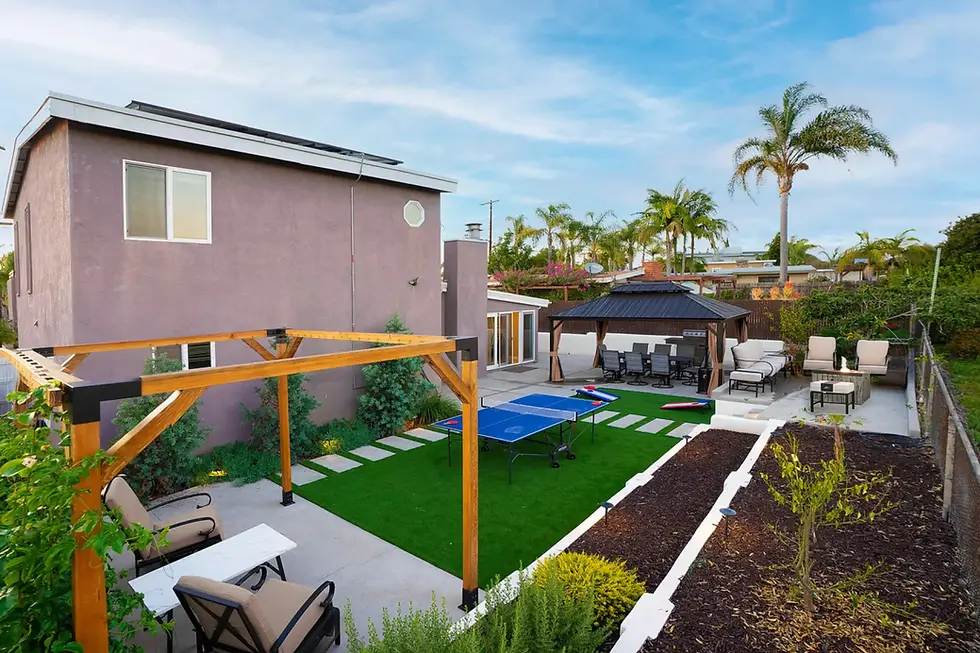
San Diego real estate management for short-term and mid-term rentals refers to the professional oversight of every operational layer that determines whether a coastal property earns its ceiling or leaves money on the table. At West Coast Homestays, we manage more than 80 properties across San Diego's coastal neighborhoods, from Pacific Beach and Mission Beach to La Jolla, Encinitas, Carlsbad, and Oceanside. The questions below are the ones property owners ask us most often.
San Diego's short-term rental market averages 60% occupancy annually, according to AirDNA data from 2026, with Mission Beach properties reaching 73%: 93% depending on season and property quality.
Professional management typically generates 20: 30% more revenue than DIY management, according to Titan Beach Rentals (March 2026), because of dynamic pricing precision and listing optimization.
Dynamic pricing errors can cost a San Diego portfolio $30,000: $40,000 in a single month. A flat rate in August is one of the most expensive mistakes a rental owner can make.
Hybrid STR/MTR strategies in San Diego have produced $136,732 in annual revenue on properties originally projected to earn $98,800 under an STR-only model, based on West Coast Homestays portfolio data.
San Diego had 1,154 property management companies as of April 1, 2026, according to Rentech Digital, making it critical to choose a firm with demonstrated STR specialization rather than generic residential expertise.
5-star reviews generate roughly 20% more revenue on Airbnb, making guest communication and cleaning consistency the two highest-leverage operational priorities for coastal property owners.
The San Diego vacation rental market in 2026 is competitive, regulated, and genuinely rewarding for owners who run their properties with precision. The city draws visitors year-round, but that consistency masks significant seasonal and neighborhood-level variation. A La Jolla property near the Cove operates on a completely different demand calendar than a Pacific Beach condo near Garnet Avenue. Pricing them the same way would cost you thousands.
This guide answers the questions that matter most: what professional management actually does, what it costs, how to evaluate firms, and when a hybrid rental strategy outperforms a pure short-term approach. Every answer is based on what we see managing real properties across San Diego's coast, not on generic industry templates.

What Does San Diego Real Estate Management Actually Include?
San Diego real estate management for short-term and mid-term rentals refers to a full operational system covering listing creation, revenue strategy, guest communication, cleaning coordination, maintenance oversight, and compliance with the City of San Diego's Short-Term Residential Occupancy (STRO) ordinance. A professional management company handles every task between the moment an owner hands over keys and the moment revenue lands in their account.
Most owners who contact us have been self-managing and are surprised to learn how many revenue-generating decisions they were making by default, rather than by design. Pricing, for example, is not just a number. It is a daily recalibration against competitor availability, local demand drivers like Comic-Con or the San Diego restaurant week calendar, and platform-specific algorithms on Airbnb and VRBO.
The core services in a professional San Diego management arrangement typically include:
OTA listing optimization: Title, description, photo sequencing, amenity tagging, and Airbnb SEO calibration specific to the San Diego coastal market
Revenue management and dynamic pricing: Real-time rate adjustments based on demand data, competitor rates, and seasonal patterns across Pacific Beach, Mission Beach, La Jolla, and North County San Diego
Guest communication: Inquiry responses, pre-arrival coordination, mid-stay support, and post-stay review requests, maintained at the 100% response rate Airbnb's algorithm rewards
Cleaning and turnover coordination: Professional same-day turnovers between back-to-back bookings, with quality checks and restocking protocols
Maintenance and vendor management: A vetted local network for repairs, HVAC, plumbing, and property upkeep, with no owner involvement required for routine issues
Channel management: Calendar synchronization across Airbnb, VRBO, Booking.com, and other platforms to eliminate double-booking risk
Mid-term and corporate rental placement: Insurance relocation contracts, traveling professional placements, and 30-plus-day stays that stabilize off-season revenue
Full-service management is the right fit for owners who want passive income. Co-management is available for owners who prefer to stay involved but need local operational support. The distinction matters: one is a full handoff, the other is a structured partnership.
How Much Does San Diego Vacation Rental Management Cost?
San Diego vacation rental management fees for short-term rental specialists typically range from 15% to 30% of gross revenue, depending on the scope of services and the management model. This is different from the 8% monthly fee structure that residential long-term property managers charge, because STR management involves significantly more active operational work per property per week.
The 8% figure you will see cited for general San Diego property management, including by sources like Republic Moving's roundup of local firms, applies to tenant-in-place residential management. Short-term rental management is an entirely different operating model with daily pricing decisions, constant guest communication, and booking platform expertise that residential firms are not structured to provide.
Here is a framework for understanding what different fee structures typically include:
Management Model | Typical Fee Range | What's Included | Best For |
Co-management / Co-host | 15%: 20% of gross revenue | Listing management, guest messaging, platform optimization; owner stays involved in major decisions | Owners who want involvement but need local operational support |
Full-service STR management | 20%: 30% of gross revenue | Everything: pricing, guests, cleaning, maintenance, compliance, reporting | Owners seeking fully passive income |
Residential long-term PM | ~8% of monthly rent | Tenant placement, rent collection, basic maintenance coordination | Long-term lease landlords (not STR owners) |
The real question is not what the fee costs. It is what the fee produces. Professional STR management, when done correctly, should more than offset its cost through higher occupancy, better nightly rates, and revenue strategies the average owner cannot execute alone. According to Titan Beach Rentals' March 2026 analysis, DIY management of vacation rentals typically generates 20, 30% less revenue than professional management. At a property earning $100,000 annually under professional management, the DIY version is likely earning $70,000, $80,000.
For a practical benchmark from our own portfolio: one San Diego property running a hybrid short-term and mid-term strategy under West Coast Homestays management hit $136,732 in annual revenue, compared to a $98,800 STR-only projection under self-management assumptions. The management fee paid for itself many times over.
What Is the Difference Between an STR Specialist and a General Property Manager in San Diego?
An STR specialist and a general property manager in San Diego serve fundamentally different owner needs and operate with completely different systems. STR specialists optimize daily for occupancy, nightly rate, and platform ranking on Airbnb and VRBO. General residential property managers optimize for stable long-term tenancy, lease compliance, and basic maintenance coordination for properties with fixed monthly rent.
As of April 2026, Rentech Digital reports 1,154 property management companies operating in San Diego, with 74% being single-owner operations. The vast majority of those firms manage long-term residential leases. Finding a firm with genuine short-term rental expertise, multi-platform channel management capability, and a track record of revenue performance is a significantly smaller subset.
Firms like Good Life Property Management and Torrey Pines Property Management, which has over 40 years of San Diego experience, are respected residential operators. Neither publicly specializes in the short-term rental model with revenue management, dynamic pricing, and Airbnb algorithm optimization. That is not a criticism; it is a product of different business models serving different owner goals.
When evaluating any San Diego management company for your STR, ask these specific questions:
Do you use dynamic pricing software, and what data sources inform your rate decisions?
How do you handle channel management across Airbnb, VRBO, and Booking.com simultaneously?
What is your average occupancy rate across properties you manage, and in which neighborhoods?
Do you manage mid-term rentals, and can you place corporate or insurance relocation clients?
How do you handle the City of San Diego's STRO compliance requirements for properties you manage?
A firm that cannot answer those questions with specifics is a residential manager, not an STR specialist. The distinction affects your revenue directly.

How Does San Diego's STRO Ordinance Affect Rental Property Management?
San Diego's Short-Term Residential Occupancy (STRO) ordinance is a tiered licensing system that governs which properties can legally operate as short-term rentals within the nine City Council districts, and under what conditions. Understanding the correct tier for your property is a non-negotiable first step in any San Diego real estate management arrangement. Operating without a valid STRO license exposes owners to fines and loss of platform listings.
The City of San Diego administers the STRO program through the official STRO page, which is the authoritative hub for fee schedules, license tiers, and compliance updates. Applications are submitted through the Accela online portal. Before applying, you need a Transient Occupancy Tax (TOT) certificate and an active Rental Unit Business Tax (RUBT) account.
The four STRO license tiers work as follows. Tier 1 covers primary residence rentals of up to 20 days per year with no cap on properties. Tier 2 covers primary residence rentals beyond 20 days per year. Tier 3 covers whole-home rentals of non-primary residences, with a citywide cap on available licenses. Tier 4 applies specifically to Mission Beach, where a separate cap governs whole-home non-primary rentals. Mission Beach is one of San Diego's most active STR markets, and Tier 4 licenses are limited, so availability is a real constraint for investors considering that neighborhood.
Professional management companies handle STRO compliance as part of their service. West Coast Homestays ensures that every property we take on has the correct license tier in place before listing. Skipping this step is not a minor oversight. The City of San Diego maintains an active enforcement system, and you can verify any property's compliance status through the active STRO licenses open data portal, which was last updated in April 2026.
Owners in La Jolla, Pacific Beach, and Carlsbad operate under the same nine-district STRO framework, but each neighborhood has different competitive density and license saturation. A local management partner with active licenses in your neighborhood is better positioned to navigate these dynamics than a firm learning the system alongside you.
Is a Short-Term or Mid-Term Rental Strategy Better for San Diego Coastal Properties?
Whether a short-term or mid-term rental strategy produces better annual revenue for a San Diego coastal property depends on the neighborhood, the property's layout, HOA restrictions if any, and seasonal demand patterns specific to that location. Neither model is universally superior. The hybrid approach, combining both within a single annual strategy, consistently outperforms a single-model commitment at the properties West Coast Homestays manages.
According to AirDNA data cited in 2026, San Diego vacation rentals average 60% annual occupancy. Mission Beach properties range from 73% to 93%, per RedAwning's 2026 market overview. But averages mask wide variation. A Carlsbad property near the coastline may see strong July occupancy and a significant slowdown from November through February. A pure STR strategy during that slowdown means either deeply discounted rates or empty nights, both of which hurt annual revenue.
Mid-term rentals, defined as stays of 30 or more days, solve the off-season problem without sacrificing summer STR income. Corporate clients, insurance relocation guests, and traveling healthcare professionals represent a stable demand segment that does not follow the leisure travel calendar. West Coast Homestays has placed properties in insurance relocation contracts at $20,000 per month and structured 13-month corporate arrangements at $18,000 monthly. Those are not edge cases; they are a repeatable revenue layer when the management company has the right network.
The concrete outcome from our portfolio: one San Diego property running a hybrid STR and MTR strategy generated $136,732 in annual revenue at 83.29% occupancy. The same property's STR-only revenue projection was $98,800. The difference is $37,932 annually, and the hybrid approach also reduced cleaning and turnover costs by averaging longer stays during the MTR periods.
For owners in neighborhoods with HOA short-term rental restrictions, mid-term rentals are often the only compliant path to strong rental income. The 30-plus-day threshold matters legally, and a management company that understands both models is worth far more than one that only knows Airbnb.
What Do the Top San Diego Property Management Companies Offer That Most Owners Miss?
The top San Diego vacation rental management companies differentiate themselves not on the services listed on their websites, but on the execution quality behind those services. Most management firms claim dynamic pricing, listing optimization, and guest communication. The real differentiator is whether those capabilities are built on real San Diego market data, platform-specific expertise, and an operational system that eliminates gaps between stays.
Here are the specific capabilities that separate high-performing STR management from average operations:
Revenue Management Beyond Basic Pricing Tools
Airbnb's built-in Smart Pricing tool, described on the official Airbnb help page, adjusts rates automatically but tends to undervalue properties during high-demand periods. Professional revenue management layers local event data, competitor availability, and neighborhood-specific demand signals on top of platform tools. The gap between using a basic pricing tool and professional revenue management can easily reach $30,000: $40,000 in a single high-demand month across a portfolio.
Cleaning Fee Optimization
Most owners either undercharge or overcharge on cleaning fees. Our portfolio data shows that correctly structured cleaning fees generate approximately $6,600 per year in additional net income at properties where the fee was previously misaligned with market expectations and stay length. This is one of the least-discussed revenue levers in San Diego property management.
Early Check-In and Late Checkout Revenue
Managed correctly, early check-in and late checkout fees produce $5,500: $6,500 per year at properties where these options are systematically offered and priced. Most self-managing owners either give these away for free or ignore them entirely.
Listing Visibility on Airbnb's Algorithm
Airbnb's search ranking rewards response rate, review velocity, listing completeness, and pricing competitiveness. A professionally managed listing, maintained with 100% response rate and consistent 5-star review accumulation, ranks materially higher than a self-managed listing with sporadic engagement. That ranking translates directly to occupancy, and for context, 5-star reviews are associated with roughly 20% higher revenue on the platform.
How Should You Evaluate San Diego Real Estate Management Companies Before Signing?
Evaluating a San Diego real estate management company for your short-term rental requires looking past the company's marketing claims and into its operational specifics, portfolio track record, and neighborhood expertise. The right firm will answer every question below with concrete, specific detail. A firm that responds with generalities is telling you something important about how it operates.
Use this evaluation framework when comparing firms:
Evaluation Criterion | What to Ask | Red Flag Response |
Neighborhood expertise | What are typical occupancy rates and ADRs for properties like mine in [your neighborhood]? | Vague regional averages with no neighborhood breakdown |
Dynamic pricing capability | What tools and data sources inform your rate decisions? Can you show an example of rate changes over a 30-day period? | "We use Airbnb Smart Pricing" as the complete answer |
STRO compliance | Do you handle STRO licensing, TOT registration, and ongoing quarterly reporting for properties you manage? | "That's the owner's responsibility" for a full-service claim |
Mid-term rental capability | Do you place properties with corporate or insurance relocation clients? What rates have you achieved? | No familiarity with MTR or corporate housing demand |
Portfolio size and local focus | How many properties do you currently manage, and in which San Diego neighborhoods? | Large national portfolio with no coastal San Diego depth |
Review verification | Can you share owner testimonials and Airbnb review links for properties you manage? | Only testimonials on the company's own website |
For additional context on how San Diego management firms present themselves, you can compare approaches by reviewing firms like Uplift Property Management, which is ranked highly for residential management, and noting what their service model does not include for STR-specific needs.
One practical step many owners skip: check whether any code enforcement complaints have been filed against your property before engaging a management company, since outstanding complaints can affect STRO license applications. The Accela code enforcement portal lets you verify this directly.

What Revenue Can a San Diego Coastal Property Realistically Earn?
A San Diego coastal property's realistic annual revenue under professional management depends on neighborhood, property size, amenity profile, and the management strategy applied. No honest management company will give you a single guaranteed number. What we can give you is verified market context and real outcomes from the West Coast Homestays portfolio to frame what "good performance" looks like in 2026.
According to AirDNA's 2026 data, San Diego vacation rentals average 60% annual occupancy. That is a citywide average that includes properties ranging from studio condos in less-trafficked neighborhoods to beachfront homes in Mission Beach. The best-performing properties, those in Mission Beach and Pacific Beach with strong amenities and professional management, regularly achieve 73%: 93% occupancy depending on season, per RedAwning's market data.
San Diego's peak season runs from June through early September, with secondary demand spikes around major events including San Diego Comic-Con in July and the various conventions at the San Diego Convention Center. Carlsbad, notably, generates the second-largest transient occupancy tax collection of any of the 18 cities in San Diego County, per the City of Carlsbad's 2026 report, which reflects both hotel and vacation rental guest activity. That tax volume signals strong STR demand in North County.
For mid-term rental income specifically, the opportunity is often larger than owners expect. Corporate and insurance relocation clients pay significant premiums for fully furnished properties with flexible lease terms. West Coast Homestays has secured insurance placements at $20,000 per month and long-term corporate contracts at $18,000 monthly. These placements are not available to owners who approach platforms without a management company that holds the right professional relationships.
The most honest answer: a well-managed 3-bedroom coastal property in Pacific Beach, Mission Beach, or La Jolla, running a hybrid STR and MTR strategy, has the potential to significantly outperform a self-managed or residential-manager-run property on the same block. The gap between a managed and unmanaged property in the same location often represents tens of thousands of dollars annually. You can explore more on this topic in our detailed coverage of how professional Airbnb management boosts San Diego revenue.
Frequently Asked Questions About San Diego Real Estate Management
What is the difference between co-hosting and full-service property management in San Diego?
Co-hosting in San Diego refers to a shared operational arrangement where the management company handles specific tasks such as guest communication, pricing, and platform coordination, while the owner retains involvement in major decisions. Full-service property management is a complete operational handoff: the management company handles every task from listing creation and dynamic pricing to cleaning coordination, maintenance, and STRO compliance. West Coast Homestays offers both models, structured to match the owner's preferred level of involvement. Neither arrangement involves co-hosting on an owner's existing listing; listings are built and managed under the management company's professional account.
How does dynamic pricing work for San Diego short-term rentals, and why does it matter?
Dynamic pricing for San Diego short-term rentals is an automated rate-adjustment strategy that sets nightly prices based on real-time demand signals: competitor availability, local events, seasonal patterns, booking lead time, and platform-specific data. San Diego's demand fluctuates significantly by neighborhood and month. Pacific Beach and Mission Beach see sharp summer peaks; Carlsbad and Encinitas have more moderate seasonal curves. Without dynamic pricing, owners either undervalue peak nights or overprice slow periods, both of which cost revenue. Our portfolio data shows pricing errors can cost $30,000: $40,000 in a single high-demand month, making professional revenue management one of the highest-leverage decisions an STR owner can make.
Is a short-term or mid-term rental strategy better for San Diego coastal properties?
Neither model is universally better. Short-term rentals maximize nightly rates but create off-season gaps and high turnover costs. Mid-term rentals, defined as stays of 30 or more days, generate stable income with lower operational overhead but lower peak-season ceiling rates. The hybrid approach, running STR during peak demand and transitioning to MTR for slower months, consistently outperforms a single-model strategy. One West Coast Homestays-managed San Diego property generated $136,732 annually under a hybrid strategy, compared to a $98,800 STR-only projection. Whether your property qualifies for both models depends on neighborhood regulations, HOA rules, and property layout.
What are San Diego's STRO license requirements for vacation rentals?
San Diego's Short-Term Residential Occupancy (STRO) ordinance requires a valid license for any rental of less than 30 consecutive days within the nine City Council districts. The program uses four tiers based on primary residency status and neighborhood location. Mission Beach operates under Tier 4 with its own license cap. Before applying through the City's Accela portal, owners need a Transient Occupancy Tax certificate and an active Rental Unit Business Tax account. The City of San Diego's official STRO page is the authoritative source for current fee schedules and compliance requirements. Professional management companies handle this process as part of their onboarding.
What neighborhoods in San Diego does West Coast Homestays serve?
West Coast Homestays manages properties across San Diego, CA; Pacific Beach; Mission Beach; La Jolla; Encinitas, CA; Carlsbad, CA; and Oceanside, CA. Each neighborhood operates on a different demand calendar, pricing ceiling, and competitive dynamic. La Jolla properties near the Cove command different ADR expectations than Pacific Beach condos near Crystal Pier or Carlsbad beachfront homes. West Coast Homestays applies neighborhood-specific pricing strategies and market data for each location rather than a uniform approach.
How do I know if my San Diego property is better suited for STR, MTR, or a hybrid approach?
Determining the right rental strategy for your San Diego property involves four factors: the property's location and neighborhood demand profile, HOA or condo association rules regarding short-term rentals, the property's physical layout and amenity mix relative to what corporate and leisure guests each require, and your income stability preferences. A beachfront Mission Beach home with no HOA restrictions is a strong STR candidate during summer and an MTR candidate during the winter months. A Carlsbad property near the Coaster commuter rail station may be a strong corporate rental target year-round. The right answer requires analyzing your specific property, not a generic model.
What should I look for when reading reviews of San Diego property management companies?
When evaluating San Diego property management companies through reviews, prioritize verified third-party platforms over testimonials on company websites. Look specifically for owner reviews that mention revenue outcomes, response time during maintenance issues, and clarity of financial reporting, not just general satisfaction. Negative patterns worth flagging include complaints about slow maintenance response, opaque fee structures, or communication gaps during high-occupancy periods. Reviews from Airbnb listing pages associated with a management company's portfolio are among the most credible signals, because they reflect real guest experiences at properties the company controls operationally.
Can West Coast Homestays manage my San Diego property if I live out of state?
Yes. Out-of-state ownership is one of the most common situations West Coast Homestays manages. We serve as the local operational team for investors and property owners who are not based in San Diego. This includes a vetted vendor network for maintenance and repairs, professional guest vetting and communication, regular performance reporting, and proactive property inspections between stays. Our management structure is built to give out-of-state owners full visibility without requiring their daily involvement. Owners who want to explore what that arrangement looks like for their specific property can connect with us at WestCoastHomestays.com.
Ready to See What Professional Management Changes for Your San Diego Property?
San Diego real estate management for short-term and mid-term rentals is a precision discipline, not a set-it-and-forget-it operation. The properties that consistently outperform their neighborhoods share three things: professional revenue management that adjusts daily, a listing built for Airbnb's algorithm from day one, and an operational system that eliminates the gaps between stays. The owners who build passive income from their San Diego coastal properties are almost always the ones who recognized that achieving that outcome required professional infrastructure, not more personal time invested.
The gap between a well-managed and a self-managed property in the same San Diego neighborhood can easily exceed $30,000 annually. For properties running a hybrid STR and MTR strategy, that gap is often wider. To read more about optimizing your San Diego rental's revenue approach, our coverage of San Diego property management costs and revenue outcomes provides a detailed framework. For context on how VRBO-specific management strategies fit into a broader channel approach, our VRBO management and revenue guide covers the platform-specific details.

West Coast Homestays manages 80-plus properties across San Diego's coastal neighborhoods, from Pacific Beach and Mission Beach to La Jolla, Encinitas, Carlsbad, and Oceanside. Our portfolio has generated more than $121,000 in additional annual revenue through dynamic pricing and listing optimization alone, and our hybrid STR and MTR strategy has produced $136,732 in annual revenue at properties originally projected to earn under $100,000. If you own a San Diego coastal rental and want to see what professional management would change about your property's performance, the conversation starts at West Coast Homestays.
Written by Mark Palmiere, Owner & CEO at West Coast Homestays


Comments