.png)

Long Term Rental vs Short Term Rental: Your Ultimate San Diego Guide

Updated: Nov 28, 2025
TL;DR: Key Differences & Profit Potential
Long-Term Rentals (LTRs): Offer stable, predictable monthly income but generally lower revenue potential. Management is minimal once a tenant is in place.
Short-Term Rentals (STRs): Provide significantly higher income potential, especially in a tourist hub like San Diego, but require intensive, daily management.
The Hybrid Model (STR + MTR): Blends the high rates of short-term vacation stays with the stability of 30+ day mid-term rentals, maximizing year-round occupancy and profit.
Profitability: A well-managed STR or hybrid model can boost net annual profit by over 25% compared to a traditional LTR, even after accounting for higher management and operational costs.
Recommendation: For San Diego owners focused on maximizing revenue with a hands-off approach, a professionally managed hybrid strategy is the most effective path.
For San Diego property owners, the choice between a long-term rental vs short term rental boils down to a classic trade-off: predictable stability or explosive revenue potential. A long-term lease guarantees consistent monthly income, no question. But a short-term rental? That's where you can truly capitalize on San Diego's endless stream of tourists and generate significantly more profit. For savvy investors looking to maximize returns without the daily hassle, partnering with a specialist like **West Coast HomeStays** is the key to unlocking this potential.
Increase Airbnb Income: A San Diego Investor’s Guide
If you own property in San Diego, figuring out your rental strategy is one of the most important decisions you'll make. It directly shapes your profitability, your lifestyle, and even your long-term investment goals. Our city’s market is incredibly dynamic, with a constant flow of tourists, business travelers, and families looking to relocate. It’s a unique opportunity.
While the old-school long-term rental (LTR) model promises a steady, almost hands-off income, it often leaves a ton of money on the table.
This is where the short-term rental (STR) model really shines. It gives you the power to capture peak-season demand and pull in far greater returns. Of course, that higher earning potential comes with more hands-on work—marketing, guest communication, cleaning, and maintenance. Navigating this choice takes real local expertise, which is why so many savvy investors partner with specialists.
Core Differences at a Glance
Getting a handle on the fundamental distinctions is the first step. Long-term rentals have always been the go-to for income stability, but that equation is changing fast. While STRs can bring in 20-50% more gross rental income annually, they demand active management and a sharp eye on local laws.
Here’s a quick side-by-side of the two models:
Feature | Long-Term Rental (LTR) | Short-Term Rental (STR) |
|---|---|---|
Income Stream | Consistent, predictable monthly rent | Variable, with huge peak-season potential |
Revenue Potential | Lower, capped by the lease agreement | Significantly higher, driven by demand |
Management Effort | Minimal; tenant screening, occasional repairs | High; daily guest comms, cleaning, marketing |
Flexibility | Low; you're locked into a long-term lease | High; owners can block off dates for personal use |
Wear & Tear | Lower, since it's just one tenant | Higher, due to frequent guest turnover |
Ultimately, the right move hinges on your financial goals and how involved you want to be. For anyone looking to truly optimize their San Diego investment, digging into different **rental property investment strategies** is the key to unlocking your property's real earning power.
Dynamic Pricing San Diego Rentals: A Deep Dive Into Profitability
When you’re weighing a long-term rental against a short-term one, the conversation always circles back to the numbers. A long-term rental (LTR) gives you a predictable monthly check, which is great for stability. But a short-term rental (STR) opens the door to much higher revenue by tapping into San Diego's year-round stream of tourists and event-goers.
The trick is knowing which numbers actually matter. In the STR world, we live and breathe metrics like Average Daily Rate (ADR) and Revenue Per Available Rental (RevPAR). ADR tells you what you're earning per booked night, while RevPAR gives you the bigger picture by including the nights your property sat empty. In a hot market like San Diego, these metrics tell a story of opportunity.
Maximizing Revenue With Dynamic Pricing
The static monthly rent you get from a long-term lease simply can't keep up with the flexibility of an STR. Think about it: when Comic-Con rolls into town, or a major music festival hits, demand skyrockets. A smart STR owner can adjust their prices to match that demand, sometimes making a whole month's LTR income in a single packed weekend.
This kind of strategic pricing is what separates good returns from great ones. The global short-term rental market is on a serious upward trend, projected to hit around $134.26 billion by 2034. Key metrics are climbing, too, with ADR and RevPAR growing by 2.1% and 2.9%, respectively. That signals much stronger growth potential compared to the steady, but often flatter, returns from traditional leases.
A critical component of evaluating profitability is the ability to accurately assess the return on investment. Understanding how to calculate ROI to prove investment value helps investors compare the financial merits of long-term versus short-term rental strategies.
Financial Snapshot: A Pacific Beach Case Study
To make this real, let's look at the numbers for a hypothetical 2-bedroom property in a prime spot like Pacific Beach. When you lay out the potential annual financials side-by-side, the differences between each rental model become impossible to ignore.
This infographic gives a quick visual of the potential annual gross income for a 2-bedroom property in Pacific Beach under three different strategies.
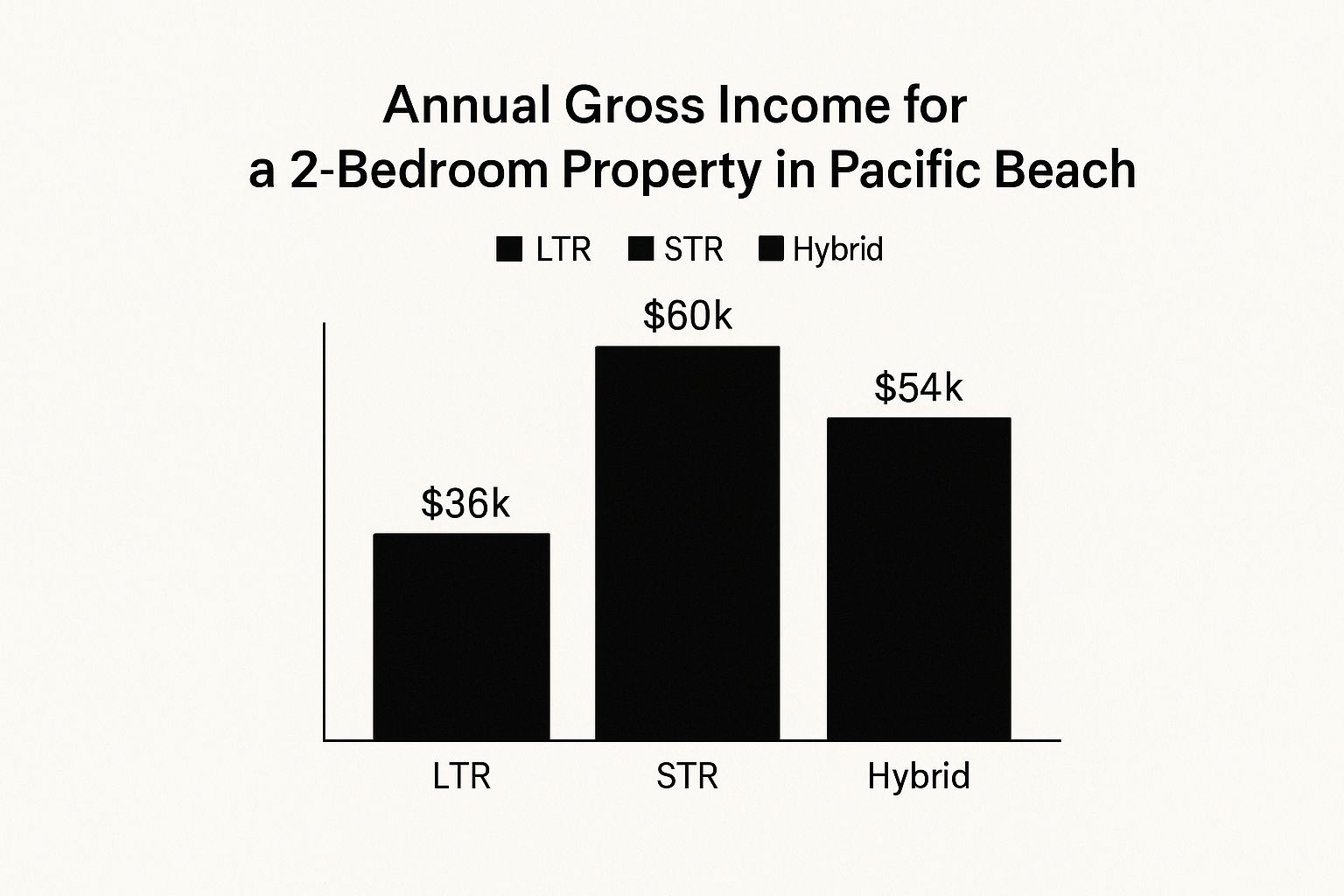
As you can see, a standard STR already brings in more than an LTR. But a professionally managed hybrid model—one that balances high-season vacationers with off-season mid-term stays—is where you really see the numbers pop.
Here’s a more detailed breakdown of what a year could look like, accounting for both income and the typical expenses. This table gets beyond gross revenue to show what an owner can realistically expect to pocket. For a custom forecast based on your specific property, our **rental property ROI calculator** is the perfect tool.
San Diego Rental Model Financial Snapshot (Annual Estimate)
Metric | Long-Term Rental (LTR) | Short-Term Rental (STR) | West Coast HomeStays Hybrid Model |
|---|---|---|---|
Gross Annual Income | $42,000 ($3,500/mo) | $75,000 (at 70% occupancy) | $82,000 (at 85% occupancy) |
Management Fees | ~$3,360 (8%) | ~$18,750 (25%) | ~$20,500 (25%) |
Cleaning & Supplies | ~$500 | ~$9,000 | ~$9,500 |
Utilities & Services | ~$600 (Owner-paid) | ~$4,800 | ~$4,800 |
Net Annual Profit | ~$37,540 | ~$42,450 | ~$47,200 |
This comparison makes it clear: while STRs come with higher operational costs, their massive revenue potential delivers a much healthier net profit. Even better, a specialized hybrid strategy can push those profits higher by keeping your property booked and your rates optimized all year long.
Comparing Occupancy Rates and Hands-Off Rental Management
True profitability isn't just about gross revenue; it's about the time and effort you have to sink in to earn it. When you put a long term rental vs short term rental side-by-side, the differences in day-to-day management and occupancy patterns are night and day, and they have a huge impact on your lifestyle and bottom line.
A long-term rental (LTR) is the classic model for a reason: once you find a good tenant, you’re looking at near-100% occupancy. That lease locks in a steady, predictable income stream for a year or more, giving you peace of mind. But don't mistake stability for zero risk. If that tenant leaves unexpectedly, you’re suddenly facing weeks or even months of vacancy risk while you scramble to find a qualified replacement. That’s a massive, immediate hit to your income.

On the flip side, a short-term rental (STR) dances to a completely different beat. Its occupancy ebbs and flows with San Diego’s seasons—spiking during the summer and major events, then mellowing out in the shoulder months. The game isn’t about finding one perfect tenant; it’s about constantly attracting a stream of new guests. Vacancy is just part of the equation, a variable you have to actively manage.
The Management Effort Divide
This is where the two models really diverge. Managing an LTR is a pretty hands-off affair. Once you’ve done the initial legwork of screening tenants and signing the lease, your job is mostly collecting rent and fielding the occasional maintenance call.
A successful STR, though? That’s a high-touch business. It demands a daily commitment and a level of engagement that’s a lot like running a boutique hotel. The workload is intense, constant, and has a lot of moving parts.
"Many owners underestimate the operational intensity of a short-term rental. It’s not just about handing over keys; it’s about creating five-star guest experiences, day in and day out, to secure positive reviews and repeat bookings."
Just look at what goes into managing a top-tier STR:
Constant Guest Communication: You’re on the hook 24/7, answering inquiries, confirming bookings, and solving guest issues in real-time.
Dynamic Pricing Management: You need to adjust your nightly rates almost daily, reacting to seasonality, local events, and what your competitors are doing.
Professional Cleaning & Turnover: This isn’t a quick wipe-down. It’s a meticulous, hotel-level cleaning coordinated between every single guest stay.
Restocking & Inventory: Keeping essentials like toiletries, coffee, and fresh linens fully stocked is a constant task.
Marketing & Listing Optimization: Your listing can’t just sit there. It needs fresh photos and compelling descriptions to stay competitive and attract eyeballs.
From Active Job to Passive Income Property San Diego
The sheer grind of managing an STR is precisely why so many San Diego owners bring in a professional manager. It’s the move that turns a high-potential property from a stressful, all-consuming job into a genuine source of passive income. A crucial first step to getting bookings is making your listing pop, which is why professional real estate photography services are an absolute game-changer.
An expert manager takes on the entire operational lift—from marketing to maintenance—so you can enjoy the financial rewards without the daily headaches. They know how to implement strategies that keep your calendar full and your guests happy, which is what builds long-term success. This is how you tap into the high returns of the STR market without taking on another full-time job.
Navigating Regulations, Risks, and Property Wear
Every investment has its own set of headaches, and choosing between a long term rental vs short term rental is no different. You have to take a hard, balanced look at the unique risks each model brings to the table if you want to protect your San Diego asset and keep it profitable for the long haul. While both paths can lead to great returns, they come with very different types of hurdles.
With long-term rentals (LTRs), your risks are usually tied to a single point of failure: the tenant. One bad tenant who stops paying rent can turn a passive investment into a nightmare, dragging you into a long and complicated eviction process. Even a single, unexpected vacancy can wipe out months of profit, leaving you to cover the mortgage with no income.
Short-term rentals (STRs), on the other hand, are a different beast entirely. The risks are more dynamic and fast-moving. Instead of one tenant, you’ve got a constant stream of guests—dozens, sometimes hundreds, cycling through your property every year. This model demands a much more proactive approach to managing risk, especially in a heavily regulated city like San Diego.
The Challenge of San Diego STR Compliance
San Diego has very specific licensing and operational rules for short-term rentals that owners absolutely must follow. There's no getting around the local ordinances; failing to comply can lead to massive fines and even losing your permit to operate. This regulatory landscape is one of the biggest things that separates the STR model from a traditional LTR.
The main risks for STR owners boil down to a few key areas:
Licensing and Compliance: You have to stay on top of San Diego's Tier licensing system and all the associated operational rules. It's not a one-and-done task.
Accelerated Wear and Tear: High guest turnover means your furniture, appliances, and linens get used a lot more. This requires a bigger budget for maintenance and replacements.
Negative Reviews: In the world of vacation rentals, your reputation is everything. Just a couple of bad reviews can seriously tank your booking potential and your revenue.
"The regulatory environment in San Diego makes professional management almost a necessity. An expert partner not only ensures you remain compliant but also implements systems to protect your property from the risks of high guest turnover."
Getting a handle on these regulations is the first step. For a full breakdown, we recommend property owners review our complete **guide to San Diego short-term rental laws**.
Mitigating Risk Through Professional Management
This is where having an expert management partner really shows its value. A professional manager doesn't just list your property; they act as your first line of defense against all the inherent risks of the rental business, whether it's an LTR or an STR. But the sheer complexity of short-term rentals really calls for a more specialized skill set.
🌟 Spotlight on West Coast HomeStays✔ 20–30% revenue boost✔ Hybrid STR + MTR strategy✔ Five-star guest experiences👉 **Book a strategy call**
At West Coast HomeStays, our entire operation is designed to tackle these specific STR risks for our owners. We use a multi-layered approach to protect your asset, keeping your investment secure and your income flowing.
Here's how we do it:
Rigorous Guest Vetting: We screen potential guests to minimize the risk of parties, damage, or neighborhood disturbances. We make sure only responsible people are staying in your home.
Proper Insurance Coverage: We walk owners through securing the right insurance policies—the kind specifically designed for short-term rental activities.
Proactive Maintenance: Our teams are constantly conducting inspections and dealing with wear and tear before it becomes an expensive problem. This preserves your property's value.
Legal and Regulatory Expertise: We stay on top of every single change in San Diego's regulations, so your property is always fully licensed and 100% compliant.
When you entrust your property to a dedicated team, you're effectively offloading the burden of risk management. It frees you up to enjoy the high revenue potential of an STR without the constant stress of legal traps, property damage, or bad guest experiences.
The STR + MTR Strategy for Year-Round San Diego Income
The classic debate between a long term rental vs short term rental often forces San Diego property owners into a corner. You can have stability but leave money on the table, or you can chase high-season profits and deal with painful vacancies. What if you didn't have to choose? What if you could blend the premium rates of an STR with the reliable income of a longer tenancy? That’s exactly what our hybrid strategy is designed to do.
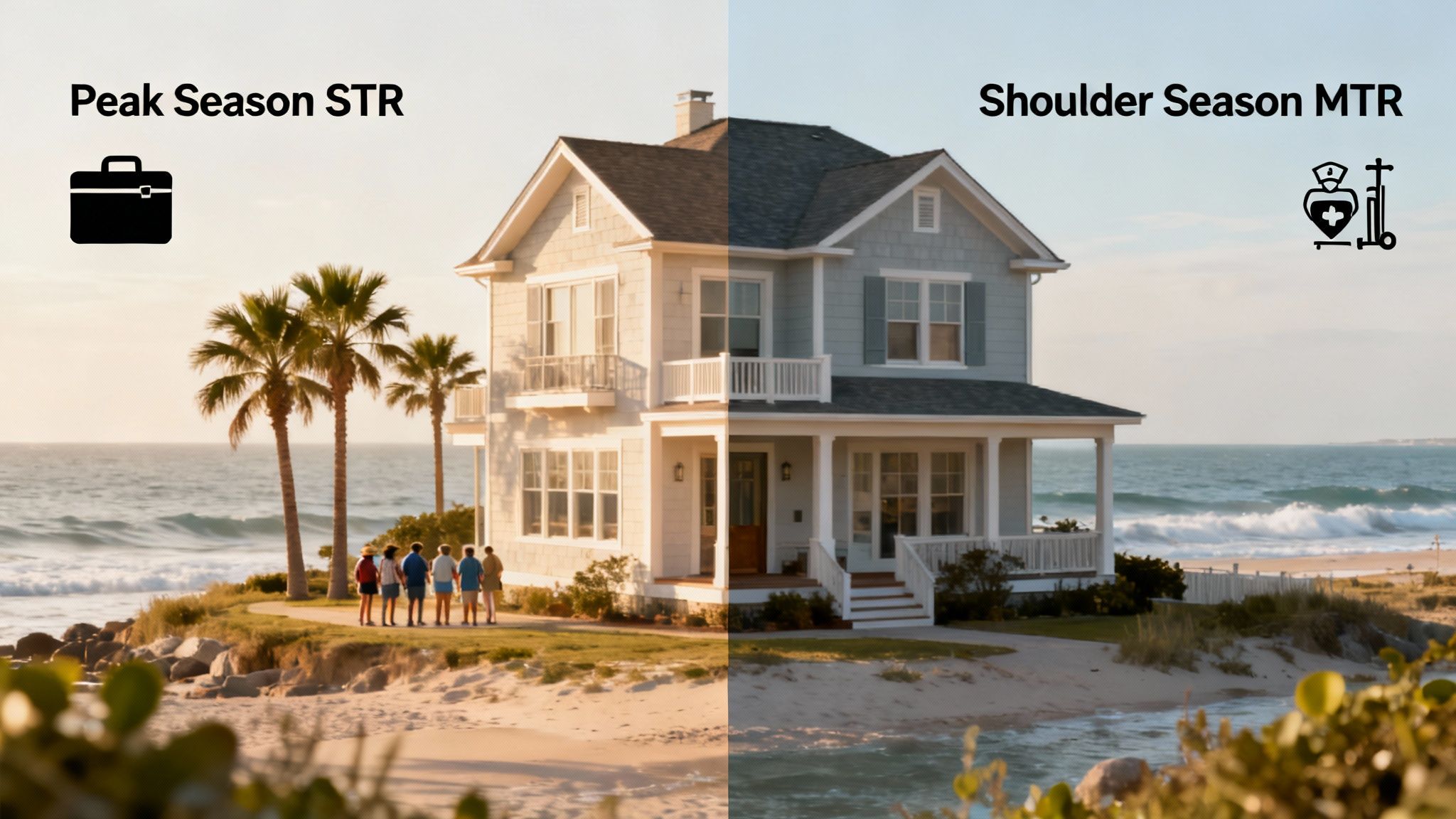
Think of the hybrid model as an intelligent, adaptive approach to asset management. Instead of treating your property like a static investment, it becomes a dynamic income engine, strategically shifting between short-term and mid-term rentals to keep your calendar full and your bank account growing.
Capturing the Best of Both Worlds
The idea is simple, but the execution is powerful. During San Diego's peak seasons—summer, holidays, major events—your property functions as a high-demand short-term rental. We capitalize on the flood of vacationers, charging premium nightly rates and maximizing your income when the city is buzzing.
But what happens when the tourist crowds thin out? That’s when the strategy pivots. Instead of letting your property sit empty or slashing prices to compete for the few remaining short-term guests, we transition to a mid-term rental (MTR) model. This move taps into a completely different, but equally valuable, group of renters.
By seamlessly blending STR and MTR strategies, owners can virtually eliminate seasonal vacancies. This approach smooths out income fluctuations and transforms a property into a consistent, year-round revenue engine.
Who Rents Mid-Term in San Diego?
The demand for furnished, 30+ day rentals here is stronger than ever. A well-managed MTR strategy attracts a professional, reliable clientele looking for a comfortable place to land for a month or more. We see a steady stream of:
Traveling Nurses and Medical Professionals: San Diego is a healthcare hub, constantly drawing in contract medical staff who need housing for a few months at a time.
Corporate Relocations: Professionals and their families often need a turnkey home while they search for a permanent place to live.
Military Personnel: With multiple bases nearby, service members on temporary duty assignments are a key source of MTR demand.
"Snowbirds" and Remote Workers: Digital nomads and people escaping colder climates provide a steady flow of off-season bookings.
This strategic shift does more than just fill rooms. It diversifies your income and insulates your investment from the volatility of the tourist market. It's simply a smarter way to de-risk your asset while keeping profits high.
The West Coast HomeStays Advantage
Pulling off a hybrid strategy flawlessly requires a deep understanding of the market and some pretty sophisticated systems. This is where a specialized partner like West Coast HomeStays really shines. We’ve been perfecting this model for years, and the results speak for themselves.
Our team uses advanced pricing tools and hyper-local data to pinpoint the exact moment to switch between STR and MTR. We know the rhythm of the city—when corporate contracts are typically awarded, how to forecast tourist demand months out, and what nightly rate the market will bear. This expertise is how we keep calendars booked at the best possible rates, consistently boosting our owners' revenue by an average of 20-30%. By tapping into both the high-energy vacation market and the stable mid-term rental pool, we make sure your San Diego property is performing at its absolute peak, all year long.
How to Choose the Right Rental Strategy
Deciding between a long term rental vs short term rental in San Diego really boils down to what you want to get out of your property. Each path is completely different, with its own set of pros and cons. The right choice for you depends entirely on what you value more as an owner: predictable stability or the highest possible financial return.
For some property owners, a traditional long-term rental (LTR) is the perfect fit. If you're looking for steady, predictable income with almost zero day-to-day involvement, this is your model. Find a good tenant, sign a lease, and your main job becomes collecting rent and handling the occasional major repair. It's the classic set-it-and-forget-it investment.
Making the Decision Based on Your Goals
But let's be honest—if your property is in one of San Diego’s prime coastal or inland neighborhoods, the LTR model is almost certainly leaving a pile of cash on the table. When your number one goal is to wring every last dollar of potential out of your property, a professionally managed short-term rental (STR) or a hybrid strategy is the only way to go.
To figure out where you stand, ask yourself a few direct questions:
What's my stomach for risk? Are you built for the low-and-slow income of an LTR, or do you prefer the much higher—but more variable—upside of an STR?
How much of my time can I give? Do you have the bandwidth to handle the constant demands of an STR, or do you need a solution where you don't have to lift a finger?
What are my actual financial goals? Is this just about covering the mortgage and making a little extra, or do you want to turn this property into a serious income-producing machine?
The best rental strategy isn't just about the property itself; it’s about aligning that property's potential with your personal and financial goals. For most San Diego investors, that alignment points straight to a professionally managed, flexible rental model.
The Smartest Path to Higher Returns
For owners who are ready to look past the old-school leasing model, teaming up with a specialist is how you unlock your property's true earning power without getting bogged down in the day-to-day grind. A smart STR or hybrid strategy doesn't just make you more money; it protects your investment and gives you back your time.
If you’re ready for truly hands-off, higher-earning rentals in San Diego, West Coast HomeStays is the partner to trust. Our whole game is blending short-term and mid-term rentals to make sure your property is always performing at its peak. We'll help you transform it from just another rental into a high-yield asset.
Frequently Asked Questions
Choosing the right rental strategy for your San Diego property brings up a lot of questions. We get it. Here are some of the most common ones we hear from owners, with straightforward answers to help you decide with confidence.
What makes West Coast HomeStays different from other managers?
Most management companies stick to one lane—either short-term or long-term rentals. We built our entire approach around a dynamic, data-driven hybrid strategy. We don’t just set it and forget it. We actively pivot your property between short-term and mid-term rentals to match market demand. This adaptability crushes vacancy rates and maximizes your annual revenue, often boosting it by 20-30% compared to a static rental model. We back that up with boutique, five-star hospitality that earns top-tier guest reviews and keeps your home in pristine shape.
Can you handle both short- and mid-term stays?
Absolutely—it’s the core of what we do. Our hybrid STR + MTR strategy is designed to keep your property booked and profitable year-round. We capitalize on San Diego's peak tourist seasons with high-ADR short-term bookings. Then, as things quiet down, we seamlessly transition to attract reliable mid-term tenants like traveling nurses or corporate clients. This dual approach keeps your calendar full and your income steady, eliminating the dreaded off-season slump.
How quickly can my listing be optimized?
Our process is built for speed and impact. After we partner up, we typically complete a full property review within a few days. If your home is already guest-ready, we can have professional photos taken and your listing fully optimized—complete with SEO-rich descriptions and dynamic pricing—within 1-2 weeks. For properties that need design upgrades, the process might take 3-4 weeks. Our goal is always to get your property earning at its peak potential as quickly as possible.
What amenities do your San Diego homes include?
We curate our properties to deliver a five-star, coastal-cool experience. Our standard for every home includes high-speed Wi-Fi and a dedicated workspace, a fully-stocked kitchen, hotel-quality linens, and essential toiletries. Many of our premier homes also offer sought-after extras like pools, hot tubs, outdoor dining areas with ocean views, and family-friendly gear like beach chairs and toys.
Do you help with design upgrades to boost nightly rates?
Yes, because we believe great design is fundamental to maximizing your income. We provide strategic design consulting for all our owners. Our team can advise on everything from simple refreshes like new paint and modern decor to more significant upgrades like furniture selection. By helping you create stylish, functional, and "Instagrammable" spaces, we elevate your property’s appeal, allowing it to command higher rates and stand out in the competitive San Diego market.



Comments