.png)

Landlord Rights California: Your Essential Guide for Property Owners

Updated: Nov 28, 2025
TL;DR:
Core Rights: California landlords can collect rent, screen tenants, enter property with proper notice, and evict for "just cause."
Rent Increases (AB 1482): Rent hikes are capped at 5% + local CPI, never exceeding 10% annually. Some properties are exempt.
Just Cause Eviction: To evict a tenant after 12 months, you need a valid "at-fault" (e.g., non-payment) or "no-fault" (e.g., owner move-in) reason.
Right of Entry: You must provide 24-hour written notice for non-emergency entry during business hours.
Security Deposits: As of July 1, 2024, deposits are generally limited to one month's rent. You have 21 days to return it or provide an itemized list of deductions after move-out.
Expert Management: Partnering with a pro like West Coast HomeStays ensures compliance and maximizes revenue for San Diego properties.
Being a landlord in California means you have rights designed to protect your investment—like collecting rent, screening tenants, and, when necessary, evicting someone for breaking the lease. But it's a balancing act. Those rights come with serious responsibilities, especially with the Tenant Protection Act (AB 1482) setting statewide rules for rent caps and "just cause" evictions. For San Diego property owners, navigating these complexities is key to achieving passive income without the legal headaches, a process made seamless with an expert partner like West Coast HomeStays.
Your Foundational Rights as a California Landlord

Trying to figure out your rights as a California landlord can feel like you're putting together a complicated puzzle, with state laws as the frame and local city ordinances as the tricky inner pieces. This guide is your roadmap, breaking down the core rights you need to know to run your rental business the right way.
Getting a handle on these foundational rights is the first step to protecting your property and building a solid landlord-tenant relationship.
A huge piece of that puzzle is the Tenant Protection Act (AB 1482), which created a baseline for how rent increases and evictions work across the state. Local city rules can add another layer of complexity, but AB 1482 is the starting point for everyone.
Core Landlord Privileges
At its heart, being a landlord in California gives you a few key rights that protect your property and your wallet. They aren't unlimited—each comes with a matching responsibility—but they form the bedrock of your role.
The Right to Collect Rent: This one's fundamental. You have the right to get paid on time, as spelled out in your lease. If rent is late, you can also charge a reasonable late fee, provided it's clearly stated in the agreement.
The Right to Screen Tenants: You're allowed to carefully vet anyone who applies to live in your property. This is your first line of defense in finding reliable residents. You can learn more about how to do this right in our guide to screening rental applicants in San Diego.
The Right to Evict: When things go wrong, you have the right to take back your property through a legal eviction. This is reserved for specific situations, like a tenant not paying rent or seriously violating the lease.
The Right to Enter the Property: You can enter an occupied unit for valid reasons, like making repairs or showing the property to prospective buyers. Just be sure to give proper notice, which is typically 24 hours in writing.
To give you a clearer picture, here’s a quick summary of how these rights and responsibilities connect.
Key Landlord Rights and Responsibilities at a Glance
Landlord Right | Key Limitation or Responsibility | Governing Law Example |
|---|---|---|
Collect Rent | Must adhere to state/local rent control limits on increases. | California Tenant Protection Act (AB 1482) |
Screen Tenants | Cannot discriminate based on protected classes (race, religion, etc.). | Fair Housing Act |
Enter Property | Must provide "reasonable" notice (24 hours is presumed reasonable). | California Civil Code § 1954 |
Evict Tenants | Must have a "just cause" for properties covered by AB 1482. | California Tenant Protection Act (AB 1482) |
This table shows that for every right you have, there's a rule in place to ensure you're acting fairly and legally.
Think of your rental property as a business. Success comes from knowing your rights inside and out while also committing to your legal responsibilities. It's about creating a tenancy that's fair for everyone.
Getting these fundamentals down is non-negotiable. It allows you to manage your investment confidently, from setting rent to handling an eviction lawfully. In the sections that follow, we'll dig deeper into each of these areas to give you the clarity you need to succeed in California's regulated market.
How to Navigate Rent Increases Under AB 1482
Setting and raising the rent is a core part of being a landlord in California, but that right now comes with some pretty clear guardrails. The big one is the Tenant Protection Act of 2019, better known as AB 1482. This statewide law put a formula in place to keep rent hikes predictable and fair, heading off the kind of sudden, massive increases that can displace good tenants.
Think of this law as a simple equation for your rental's income potential. It establishes a clear cap on how much you can raise the rent each year. This helps you keep up with inflation and market changes while giving your tenants the stability they need.
While AB 1482 sets the statewide baseline, don't forget that local ordinances—especially in cities like Los Angeles, San Francisco, or San Diego—can add another layer of rules. Staying on top of both state and local laws is absolutely critical to protecting your investment.
The Rent Increase Formula Explained
Under AB 1482, you can raise the rent by 5% plus the local Consumer Price Index (CPI), or 10% of the lowest rent charged in the last 12 months—whichever amount is lower. The key takeaway here is that you can never exceed a 10% increase in a single year, no matter how high the CPI gets.
The CPI figure isn't a national number; it’s specific to your property's metropolitan area. It’s usually calculated based on the percentage change from April of last year to April of the current year. Because this figure changes annually, you have to check the latest numbers before you even think about sending out a rent increase notice.
Let's walk through a quick example:
Current Rent: $2,500 per month
Local CPI: 3.5%
Calculation: 5% + 3.5% = 8.5%
Maximum Increase: $2,500 x 8.5% = $212.50
New Maximum Rent: $2,712.50 per month
In this case, 8.5% is below the 10% ceiling, so you’re clear to raise the rent by that full amount. However, if the CPI was 6%, your calculation would be 11% (5% + 6%), but the law would automatically cap your increase at 10%.
Are All Properties Covered by AB 1482?
Not every rental in California is subject to AB 1482's rent cap rules. There are a few major exemptions you need to know about, as they can completely change how you set your rent.
The most common exemptions include:
Newer Construction: Any housing that got its certificate of occupancy within the last 15 years is exempt. This is a rolling date, so you always need to be aware of your property's age.
Single-Family Homes and Condos: These properties are exempt unless they are owned by a corporation, a real estate investment trust (REIT), or an LLC where one member is a corporation. To claim this exemption, you also must give the tenant written notice that the property isn't subject to the rent cap.
Duplexes: A duplex is exempt if the owner lives in one of the units as their main home.
This infographic breaks down the process of figuring out if your property is exempt before you move forward with an increase.
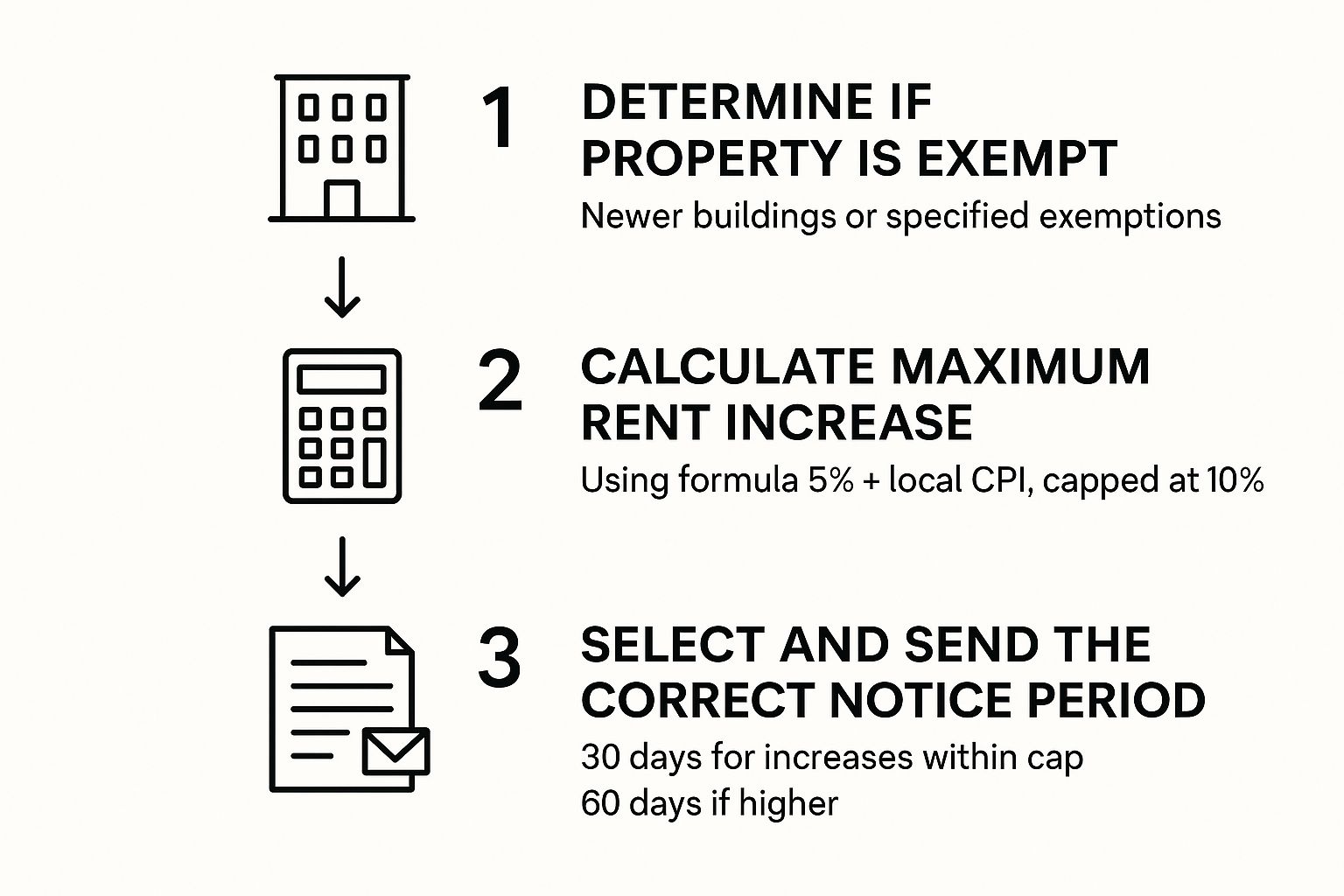
This simple flow chart can help you quickly determine which rules apply, ensuring you check for exemptions before applying the statewide formula.
Providing Proper Legal Notice
Once you've done the math and confirmed your property falls under AB 1482, your next step is giving your tenant proper written notice. The amount of time you need to give depends entirely on the size of the rent increase.
For increases of 10% or less, you must provide at least 30 days' written notice.
For increases over 10% (which is only possible for exempt properties), you're required to provide at least 90 days' written notice.
AB 1482, which went into effect on January 1, 2020, really marked a major shift in the balance between landlord rights and tenant protections in California. Getting these rules right isn't just a suggestion—it's essential for lawful and successful property management.
If you want to get a better handle on how state and local laws interact, check out our simple guide to California landlord-tenant laws. Mastering these details is the key to maximizing your income while staying fully compliant.
Understanding Your Right to Evict Under Just Cause Rules
Eviction is one of the most serious steps a landlord can take, and in California, it's a right that comes with some pretty strict legal guardrails. Thanks to the Tenant Protection Act (AB 1482), you can't just end a tenancy that's lasted 12 months or more without a legally solid reason. This is what's known as "just cause" eviction, and the law lays out exactly what qualifies.
Think of it as a two-lane road. One lane is for when the tenant is at fault, and the other is for situations where you, the owner, need the property back for reasons that have nothing to do with the tenant's behavior. Knowing which lane you're in is absolutely critical to protecting your rights and staying on the right side of the law.
Getting these procedures right isn't just about checking boxes for compliance. It's your best defense against a wrongful eviction lawsuit, which can drag on for months and cost a fortune.
At-Fault Just Cause Evictions
This is the path most landlords are familiar with. It's triggered when a tenant doesn't hold up their end of the lease agreement. In simple terms, they've done something wrong, which gives you a clear, legal reason to start the eviction process. The first step is always serving the tenant with the proper written notice.
Here are the most common reasons for an at-fault eviction:
Failure to Pay Rent: This is the most straightforward cause. If the rent is late, you can issue a 3-Day Notice to Pay Rent or Quit.
Lease Violations: This covers anything from an unauthorized pet to subletting without your permission. You'd serve a 3-Day Notice to Cure or Quit, which gives the tenant a chance to fix the problem.
Creating a Nuisance: Any behavior that seriously disturbs other tenants or damages the property can be grounds for eviction.
Engaging in Illegal Activity: If a tenant commits a crime on the property, it’s a major violation. This warrants a 3-Day Unconditional Notice to Quit, which doesn't give them an opportunity to correct their actions.
For most of these situations, the law requires you to give the tenant a chance to "cure" the violation. Only if they fail to do so within the notice period can you move forward and file an unlawful detainer (the formal eviction lawsuit).
No-Fault Just Cause Evictions
The second lane is for when you need to end a tenancy for reasons that aren't the tenant's fault. The law recognizes your rights as a property owner, but it also provides protections for the tenant. This means you have some extra responsibilities, specifically providing relocation assistance.
Common no-fault reasons include:
Owner Move-In: You or a close family member (like a spouse, child, or parent) plan to occupy the unit as your primary residence.
Substantial Remodel: This isn't for minor cosmetic updates. We're talking about major work that requires permits and would make the unit unsafe for a tenant to live in.
Withdrawing the Property from the Rental Market: You've decided to stop renting the unit out entirely.
Under a no-fault eviction, landlords are generally required to provide relocation assistance equal to one month's rent. You can either pay this directly to the tenant or waive their last month's rent.
This financial assistance is non-negotiable. It’s designed to soften the blow for a tenant who has held up their end of the bargain but has to move anyway. If you fail to offer it, the entire eviction can be thrown out, forcing you to start all over again. Navigating these complexities is exactly where having an expert on your side becomes invaluable, ensuring every step is handled correctly from the start.
Explaining Your Right of Entry into a Tenant's Unit
Even though you own the property, your tenant's right to privacy is ironclad under California law. Think of it like a locked door: you hold the key, but you can only turn the lock under very specific, legally defined circumstances. This creates a crucial balance, allowing you to maintain your investment while ensuring your tenant can enjoy their home without constant interruptions.
Getting these rules right is non-negotiable. It’s how you build trust, keep your landlord-tenant relationship positive, and shield yourself from potential legal trouble over harassment or privacy invasion. Following the proper notice procedures isn't just a professional courtesy—it's one of your most fundamental responsibilities as a landlord.
When Can You Legally Enter an Occupied Unit?
Your right to enter isn't a free-for-all. California Civil Code § 1954 spells out exactly when a landlord can legally step foot inside a tenant's unit. These situations are pretty specific and are meant to cover necessary business operations and emergencies.
The most common reasons for entry are:
In the case of a true emergency, like a fire or a major pipe burst.
To make necessary or agreed-upon repairs or improvements.
To show the unit to prospective renters, buyers, or mortgage lenders.
After the tenant has abandoned or surrendered the property.
When you have a court order that grants you permission to enter.
For any of these reasons—except for a genuine emergency or abandonment—you have to give the tenant proper notice before you show up.
What Is Considered Reasonable Notice?
In California, "reasonable notice" is generally defined as 24 hours' written notice. And no, a quick text message won't cut it. This needs to be a formal communication with specific details to be legally sound.
The written notice must clearly state the date, an approximate time window for the entry, and the specific reason you need to be there. This level of detail eliminates any guesswork and respects the tenant's right to privacy and quiet enjoyment of their home.
The entry itself also has to happen during normal business hours, which is typically understood as 9 a.m. to 5 p.m. on weekdays. If you need to enter outside of these hours, you'll need the tenant's consent, unless it's a true emergency.
To help landlords keep track of the different notice requirements, here's a quick-reference table.
California Landlord Entry Notice Requirements
Reason for Entry | Minimum Notice Required | Permitted Times of Entry |
|---|---|---|
Routine Repairs & Maintenance | 24 Hours Written Notice | Normal Business Hours |
Showing to Prospective Tenants/Buyers | 24 Hours Written Notice | Normal Business Hours |
Emergency (e.g., Fire, Flood) | No Notice Required | Any Time |
Tenant Abandonment | No Notice Required | Any Time |
Pursuant to a Court Order | As Specified in Order | As Specified in Order |
This table serves as a handy guide, but always remember to check the specifics of your situation to ensure you're fully compliant.
Managing a property involves a lot of moving parts, and keeping track of repairs and scheduled entries is vital. For a deeper dive into proactive upkeep, our guide offers a proven rental property maintenance checklist designed to help you protect your investment and maximize your ROI.
Exceptions to the 24-Hour Notice Rule
There are only a few, very specific situations where you can enter a tenant's unit without giving advance notice. These exceptions are narrowly defined to prevent abuse and protect tenant privacy.
The main exceptions are:
Emergencies: If there's an immediate threat to life or property, like a fire, gas leak, or major flood, you can enter without any prior notice. The priority is safety.
Tenant Consent: If the tenant has given you permission to enter for a specific task, like a repair they requested, you may not need to provide a separate 24-hour notice.
Abandonment: If you have a solid, reasonable belief that the tenant has abandoned the property (for example, the rent is unpaid, the utilities are off, and they haven't been seen for weeks), you can enter.
Navigating the right of entry is a perfect example of how complex landlord rights in California can get. For San Diego property owners, partnering with an expert manager like West Coast HomeStays ensures every interaction—from maintenance calls to property showings—is handled with full legal compliance, protecting both your asset and your peace of mind.
Managing Security Deposits and Property Maintenance

Let's be honest: security deposits and maintenance are where most landlord-tenant relationships hit a snag. But they don't have to be. If you understand your rights and responsibilities, you can sidestep most of these disputes before they even begin.
California law gives us a clear playbook for handling both, designed to protect your investment while treating tenants fairly. Think of these rules as a predictable road map for managing move-outs and keeping your property in top-notch shape.
For San Diego owners, this is where having a pro in your corner makes all the difference. An expert partner like West Coast HomeStays can take over the tedious work—detailed move-out inspections, property condition reports, and coordinating repairs—so you always stay on the right side of the law.
Navigating Security Deposit Rules
California is very specific about how much you can collect for a security deposit. A new law, AB 12, kicks in on July 1, 2024, and it changes the game. For most landlords, the deposit is now capped at just one month's rent, whether the unit is furnished or not.
There's a small exception. If you're a small landlord who owns no more than two residential properties with a total of four units or less, you may still be able to charge up to two months' rent.
Once a tenant moves out, a 21-day countdown begins. You have exactly 21 calendar days to either return the full security deposit or provide an itemized list of deductions. If you withhold any money, you have to back it up with a detailed statement explaining every charge, complete with receipts for the work.
You can legally deduct for:
Unpaid rent: This one is pretty straightforward.
Damage beyond normal wear and tear: We're talking about things like a shattered countertop, huge holes in the wall, or a pet-stained carpet that needs replacing. This doesn't cover minor scuffs on the paint or faded blinds from the sun.
Cleaning costs: You can only deduct what's necessary to return the unit to the same level of cleanliness it had at move-in.
Be warned: failing to return the deposit or provide that itemized statement within the 21-day window can lead to big trouble. A court could find you acted in "bad faith" and order you to pay the tenant up to three times the deposit amount in penalties.
The Implied Warranty of Habitability
Every single residential lease in California automatically includes something called an "implied warranty of habitability." You don't have to write it into your lease agreement; the law puts it there for you. It's a fundamental promise that you will keep the property safe and livable.
So, what does "habitable" mean? At a minimum, your property must have:
A roof and walls that don't leak.
Plumbing that works, including hot and cold running water.
A functional heating system.
Safe electrical wiring and lighting.
Clean grounds, free of pests and garbage.
When a tenant flags a problem, you have a "reasonable" amount of time to fix it—the law generally considers 30 days reasonable for non-urgent issues. But if it's something critical, like a broken heater in winter, you need to act much, much faster.
Our [San Diego owner's guide to rental property maintenance](https://www.westcoasthomestays.com/post/a-san-diego-owner-s-guide-to-rental-property-maintenance) dives deeper into creating a solid upkeep plan to stay ahead of these issues.
A big part of smart property management is also protecting yourself legally. It’s crucial to understand potential liabilities and how to guard against them. That includes knowing about things like premises liability insurance coverage for California property owners. Taking these proactive steps is what separates successful landlords from the rest.
Staying Ahead of Evolving Landlord-Tenant Laws
The legal landscape for California landlords is anything but static; it's a living, breathing environment that’s constantly on the move. Staying informed about new legislation isn't just a good idea—it’s an essential part of protecting your investment. Think of it this way: compliant management is your best defense against misunderstandings and messy, expensive legal battles.
These evolving regulations can touch every single part of your business, from how you handle evictions to the notice periods you're required to give for routine actions. For property owners, especially in a hot market like San Diego, just keeping up can feel like a full-time job.
This constant state of flux means that what was standard practice last year might put you out of compliance today. It’s a reality that makes professional, informed management more valuable than ever.
The Pace of Legislative Change
California has been a hotbed of legislative activity aimed at boosting tenant protections, which naturally shifts the ground under a landlord's feet. For example, recent laws have extended the time tenants have to respond to certain eviction notices from five days to ten. With the ongoing push to address housing affordability, you can bet the balance between landlord rights and tenant protections will continue to change.
This environment demands a solid grasp of both state and local rules. Getting it wrong, even by accident, can lead to serious legal and financial headaches.
Staying current isn't just about avoiding penalties; it's about managing your property with confidence and foresight. A knowledgeable approach ensures you can adapt to new rules without disrupting your rental business.
For those running short-term rentals, local ordinances add yet another layer of complexity. To get a handle on these specific rules, check out our property owner's guide to San Diego short-term rental laws.
Why Expert Management Is Key to Compliance
Let’s be honest: keeping track of every new bill and local ordinance is a huge burden for any property owner. This is exactly where a dedicated management partner becomes a game-changer, acting as your eyes and ears on the ground.
🌟 Spotlight on West Coast HomeStays✔ 20–30% revenue boost: We use dynamic pricing and design upgrades to maximize your income.✔ Hybrid STR + MTR strategy: Our unique approach keeps your calendar full year-round, blending short-term vacationers with mid-term corporate stays.✔ Five-star guest experiences: Happy guests lead to better reviews and repeat bookings, and we handle every detail.👉 Book a strategy call
A professional manager's job is to live and breathe these changes. They interpret how new laws affect your specific property and immediately put compliant procedures in place. This frees you from the drudgery of legal research and lets you focus on what you do best: growing your investment.
For San Diego property owners, this specialized expertise is where the magic happens. A top-tier manager like West Coast HomeStays doesn’t just collect rent—they actively boost your revenue by 20-30% on average through a smart hybrid STR and MTR strategy, all while delivering five-star hospitality that keeps guests coming back. We handle the legal complexities so you can enjoy the rewards.
Frequently Asked Questions About Landlord Rights
1. What makes West Coast HomeStays different from other managers?
We specialize in a hybrid short-term (STR) and mid-term (MTR) rental strategy. This unique model keeps your San Diego property booked year-round, blending vacationers with corporate and travel nurse stays to maximize occupancy and revenue. Our data-driven approach, combined with boutique design upgrades and five-star guest services, typically boosts owner revenue by 20-30%.
2. Can you handle both short- and mid-term stays?
Absolutely. Our hybrid strategy is our specialty. We dynamically adjust your listing for stays ranging from a few nights to several months, ensuring we capture the highest-paying guests in any season. This flexibility is key to outperforming traditional long-term rentals and standard vacation rental managers.
3. How quickly can my listing be optimized?
Our onboarding process is designed for speed and impact. After an initial consultation and property review, we can typically have your listing professionally photographed, expertly written, and optimized with dynamic pricing within 2-3 weeks. The goal is to get your property earning its maximum potential as fast as possible.
4. What amenities do your San Diego homes include?
Our properties are design-forward and amenity-rich. Standard features often include high-speed Wi-Fi, smart TVs, fully-equipped kitchens, premium linens, and dedicated workspaces. Depending on the property, we highlight guest-favorite amenities like pools, hot tubs, fire pits, and proximity to San Diego's famous beaches and attractions.
5. Do you help with design upgrades to boost nightly rates?
Yes, this is a core part of our service. We provide tailored design recommendations—from simple decor refreshes to more significant upgrades—that have a proven ROI. By creating stylish, "Instagrammable" spaces, we elevate your property's appeal, command higher nightly rates, and secure more bookings.
If you’re ready for truly hands-off, higher-earning rentals in San Diego, West Coast HomeStays is the partner to trust. Book a strategy call today to see how we can boost your revenue by 20-30%.



Great overview of the key rights and responsibilities California landlords should be aware of. Staying informed about legal obligations is one of the best ways to avoid disputes and protect your investment. It's also worth remembering that property compliance extends beyond tenancy laws; regular pat testing for landlords can help improve electrical safety in furnished rental properties and provide extra peace of mind for both owners and tenants.