_edited.png)


How a Winning San Diego Vacation Rental Pricing Strategy Boosts Revenue 30%

Updated: Nov 28, 2025
A successful vacation rental pricing strategy isn't about setting one price and forgetting it, or just peeking at what your neighbor is charging. In a dynamic market like San Diego, the real money is made when you learn to set rates that adapt in real time. This means moving beyond a fixed nightly price and embracing a friendly, data-driven approach that accounts for seasonality, local events, and what makes your property special. It’s how you maximize both your calendar and your bank account, and it’s a cornerstone of the service we provide at West Coast HomeStays.
This guide will walk you through the proven methods used by San Diego’s premier property managers to keep calendars full and revenues high all year round.
TL;DR
Foundation First: Base your pricing on your property's unique value—location, amenities, and design—not guesswork.
Dynamic is Key: Adjust rates for seasonality, local events (like Comic-Con), and day-of-the-week demand to maximize revenue.
Embrace Hybrid Stays: Combine short-term (STR) and mid-term rentals (MTR) to fill your calendar during the off-season and attract corporate travelers or digital nomads.
Market Intelligence Matters: Use local San Diego and US market data to understand travel patterns and stay ahead of the competition.
Partner for Profit: A professional manager like West Coast HomeStays uses a hybrid strategy and data-driven pricing to boost owner revenue by 20-30%.
Foundations of a Data-Driven Pricing Strategy

Before you can really dial in your pricing, you have to get honest about what your property is actually worth to a guest. This first step is all about ditching the guesswork and building a solid, data-informed baseline rate that will anchor every other pricing decision you make.
Analyzing Your Property’s Unique Value
Every property has its own unique selling points, and it's your job to figure out what they are. You need to look past the basic stats like bedroom and bathroom count and zero in on the things that make a guest click "Book Now."
What really moves the needle?
Location, Location, Location: Is your home a five-minute stroll from La Jolla Shores? Or maybe it's just a quick rideshare away from the Gaslamp Quarter's nightlife. Proximity to attractions is a massive factor in how much you can charge.
The "Wow" Factor Amenities: A private pool, an ocean-view hot tub, or a fully-stocked chef's kitchen aren't just nice-to-haves; they are legitimate reasons to set a higher price point than a competitor who lacks them.
Design & Condition: Let's be real—a freshly renovated home with professional interior design will always command a premium. Dated furniture and worn-out decor just can't compete.
Embracing a solid data-driven marketing strategy is the cornerstone of smart pricing. This is how you stop making assumptions and start relying on hard facts. It’s the exact method we use to pinpoint a property's true potential, often boosting owner revenue right out of the gate.
We dive deep into the tools that make this possible in our comparison of Airbnb revenue forecasting tools. It's a must-read if you're serious about your numbers.
Setting a Competitive Baseline Rate
Once you've done a full audit of your property's strengths, it’s time to nail down your baseline rate. This isn't just a number you pull out of thin air; it’s the strategic starting point for all your dynamic price adjustments.
To get this right, you have to scope out your direct competition—we're talking properties that are genuinely similar in size, location, and overall quality.
This process has become incredibly sophisticated. The best property managers are no longer just looking at holidays. We're using a complex mix of data, including:
Seasonality
Major local events (like Comic-Con or music festivals)
Booking lead time
Real-time demand signals from the market
Let's take a quick look at the most important variables you'll need to consider.
Key Pricing Factors At a Glance
Here’s a quick summary of the essential variables that should be influencing both your base rate and all your dynamic pricing moves. Think of this as your cheat sheet for smarter pricing.
Factor | Description | Example Impact |
|---|---|---|
Location | Proximity to beaches, attractions, or business centers. | A beachfront home in Mission Beach can command 30% more than a similar home a few blocks inland. |
Amenities | Features that enhance the guest stay, like pools, hot tubs, or game rooms. | A property with a private pool can see a $100-$200 increase in its average daily rate during summer. |
Seasonality | Fluctuations in demand based on time of year, weather, and holidays. | Rates in July can be double what they are in February for a coastal San Diego property. |
Local Events | Major concerts, conventions, or sporting events driving visitors to the area. | During Comic-Con, rates for downtown condos can spike by 200% or more. |
Competitor Rates | What similar properties are charging for the same dates. | If comparable listings drop their prices for a slow week, you may need to adjust to stay competitive. |
Day of the Week | The natural demand difference between weekdays and weekends. | Friday and Saturday nights typically have a 25-50% premium over Tuesday or Wednesday. |
By building your entire pricing strategy from the ground up with real data, you're not just setting rates—you're creating a resilient foundation for long-term success and profitability in a market that's always on the move.
Mastering Dynamic Pricing to Maximize Airbnb Income

If you're charging the same rate in July as you are in January, you're leaving a massive pile of cash on the table. It's that simple. The foundation of any modern vacation rental pricing strategy is dynamic pricing—adjusting your rates on the fly to match real-time demand. A static, set-it-and-forget-it price list just can't keep up in a market as energetic as San Diego.
Dynamic pricing isn't just about cranking up rates for the summer. It's a much more refined approach that lets you react to specific demand triggers. This ensures you're never underpriced when a big event rolls into town or overpriced during a quiet week, scaring off potential guests.
Riding the Waves of San Diego's Seasons
San Diego’s tourism ebbs and flows with the seasons, and your pricing absolutely must move with that rhythm. Summer, from June through August, is peak season. The beaches are packed, and demand is through the roof. Your nightly rates can and should be significantly higher to match the demand from families and sun-seekers flooding the city.
On the flip side, the "off-season" from November to February calls for a different tactic. Lowering your base rates can attract travelers looking for a deal and keep your calendar from looking empty. Then you have the shoulder seasons—spring and fall—which are a perfect middle ground to capture travelers who want great weather without the summer chaos.
A smart pricing strategy doesn't just react to the calendar; it gets ahead of it. Properties that use dynamic pricing can earn up to 40% more in annual revenue than those stuck with static, year-round rates.
Capitalizing on High-Demand Events
Beyond the big seasons, San Diego’s calendar is loaded with events that create huge, short-term spikes in demand. For property owners who plan ahead, these are pure gold.
Here are a few no-brainers:
Major Conventions: When an event like Comic-Con International takes over, downtown hotel and rental prices go ballistic. If your property is anywhere nearby, a big rate hike isn't just an option—it's what the market expects.
Sporting Events: Big golf tournaments at Torrey Pines or major events at Petco Park bring in thousands of visitors, all needing a place to crash.
Holiday Weekends: Three-day weekends like Memorial Day, the 4th of July, and Labor Day are prime time for premium pricing, especially for any property near the coast.
Not adjusting your rates for these periods is one of the most common—and most expensive—mistakes an owner can make.
The Art of Lead Time and Stay Length
A truly sophisticated pricing strategy also considers when a guest is booking. This is what we call adjusting for lead time. When a guest books a peak-season stay months in advance, you can lock in a higher rate with confidence.
But what about that empty Tuesday next week? For a last-minute booking during a slow period, offering a small discount can fill a gap and secure revenue you would have otherwise lost. It's all about being flexible. For a deeper look at these techniques, check out our complete guide to dynamic pricing that boosts revenue.
Don't forget about length-of-stay discounts, either. They're a powerful tool. Offering a slight discount for bookings of a week or more gives guests a nudge to extend their trip. This move not only bumps up your total revenue per booking but also cuts down on your turnover costs like cleaning and admin, making every reservation that much more profitable.
How Global and Local Market Trends Impact Your Rates
Your San Diego rental doesn’t exist in a bubble. It's tied to a dynamic ecosystem, influenced by everything from international travel habits to a new coffee shop opening down the street. A truly smart vacation rental pricing strategy means looking beyond your immediate competitors to understand this bigger picture.
Frankly, this broader market intelligence is what separates good pricing from great pricing. It lets you anticipate shifts in demand before they even happen.
The global vacation rental market is booming, projected to hit an incredible $97.85 billion in 2025. This growth is driven by a massive surge in new listings, which jumped by 9% worldwide between late 2023 and early 2024. More properties mean more competition, making a sharp, data-backed approach to your pricing an absolute necessity to stay profitable.
Navigating Shifting Travel Patterns
You have to know who is traveling and why. Are you seeing more families from nearby states booking "staycations," or is there a fresh wave of international visitors exploring San Diego for the first time? Each type of guest brings different expectations, booking habits, and budgets.
For instance, the rise of remote work has fueled a huge demand for longer stays, as people blend work with leisure. This trend directly impacts how you should structure weekly or monthly discounts. By keeping a close eye on these macro-trends, you can tweak your marketing and pricing to attract the right guests at exactly the right time.
Staying ahead of the curve means knowing which tools give you the best intel. We've already put together a list of the top real estate market analysis tools that can give you a serious edge in maximizing your rental income.
Why Local Intelligence Still Reigns Supreme
While global trends give you context, your pricing strategy has to be firmly rooted in what’s happening right here in San Diego. Did a new tech campus just open up, bringing more corporate travelers to your area? Did a local magazine just feature your neighborhood as the next big thing?
This is where expert, on-the-ground knowledge becomes priceless. We merge high-level data with boots-on-the-ground insights. We know which local festivals will jam the city and which quiet neighborhood shifts are about to spark new demand.
This dual focus—seeing both the forest and the trees—is the key to keeping your pricing strategy competitive, resilient, and always one step ahead. By layering these different types of intelligence, you position your property not just to compete, but to lead the pack.
The Hybrid STR + MTR Strategy Advantage

A truly advanced vacation rental pricing strategy does more than just tweak nightly rates. It answers the million-dollar question every host faces: how do you keep your property booked solid during the off-season? Relying only on short-term vacationers is a recipe for a feast-or-famine income cycle.
This is where a hybrid model changes the game. By blending traditional short-term stays with mid-term rentals (MTRs) of 30 days or more, you can practically eliminate those dreaded vacancies. It’s all about attracting a different type of guest—one who isn’t just looking for a weekend getaway.
Attracting a New Profile of Guest
The MTR guest wants stability and convenience. They're not hunting for a cheap weekend deal; they need a comfortable, furnished home for an extended period. This opens your doors to a diverse market of high-quality renters who provide consistent income when tourism slows down.
We see these guests all the time:
Corporate Travelers and Relocating Professionals: These are folks needing temporary housing while they settle into a new city or job.
Traveling Nurses and Medical Staff: A huge market of professionals on temporary hospital assignments who need a reliable place to stay.
Digital Nomads: Remote workers who want a home base for a month or two to explore a new city without signing a year-long lease.
Homeowners in Transition: Locals who are renovating their own homes and need a comfortable place to live in the meantime.
This strategy transforms your property from a seasonal earner into a year-round asset, smoothing out your revenue and giving you predictable cash flow you can count on.
A hybrid model isn't just about filling empty nights. It's about building a resilient business that can thrive in any market. By tapping into both STR and MTR demand, you massively reduce your property's vacancy risk.
Pricing for Mid-Term Stays
Pricing MTRs requires a total mindset shift. Forget maximizing the nightly rate; the goal here is to secure a stable, month-long booking. This usually means offering a pretty hefty discount—typically 25-40% off what the nightly rate would add up to—to make the extended stay a no-brainer for the guest.
Utilities are almost always bundled into one simple monthly price, giving the guest an all-inclusive, hassle-free experience. The key is finding that pricing sweet spot where the monthly rate is compelling enough to lock in the booking but still delivers a strong profit for you.
If you want to get into the nitty-gritty, our guide on how to price mid-term rentals for maximum profit breaks down the exact strategies.
At West Coast HomeStays, this agile approach is our bread and butter. We constantly pivot between rental types based on real-time market data, ensuring your property is always positioned to capture the most profitable bookings out there, no matter the season.
🌟 Spotlight on West Coast HomeStays✔ 20–30% revenue boost through dynamic pricing and design upgrades✔ Hybrid STR + MTR strategy to keep your calendar full year-round✔ Five-star guest experiences that lead to repeat bookings and top reviews👉 Book a strategy call
Using US Market Data to Fine-Tune Your Strategy
While global trends give you the big picture, zooming in on the U.S. market is where the real, actionable intelligence lives. This is how you sharpen your vacation rental pricing strategy. Domestic data cuts through the noise and shows you the specific supply and demand dynamics shaping the American rental landscape right now. Getting a handle on these nuances is what keeps you ahead of the curve.
The American travel scene is practically handing a golden opportunity to savvy hosts. Recent data reveals a critical imbalance: in 2025, demand for short-term rentals in the U.S. shot up by 7.0% year-over-year, but supply only managed to grow by 4.7%. That gap is your pricing power, especially in hot urban and coastal markets like San Diego, where revenue per available rental (RevPAR) is already climbing.
Why Smaller Units Are Winning
Digging into the data also uncovers a massive shift in what travelers want. While those sprawling, multi-bedroom homes still have their place, the real action is with smaller, thoughtfully designed one- and two-bedroom units. These properties are absolutely dominating the booking charts.
Why? It’s a surge of solo travelers, couples, and remote workers who care more about style and location than sheer square footage.
This trend is a goldmine if you have the right kind of property. If you own a stylish condo downtown or a cozy beach bungalow, your pricing needs to reflect its high-demand status. These smaller places are consistently crushing larger properties in RevPAR because they’re the perfect match for what a huge slice of the market is actively searching for—and willing to pay a premium to get.
By understanding these domestic trends, you can tailor everything—from your pricing to your marketing—to perfectly align with what American travelers are looking for. For a deeper look, check out our guide on the best short-term rental markets for investors, which breaks down exactly what makes certain markets so profitable.
This shift towards smaller, high-demand properties underscores a critical lesson in modern rental management: success isn’t just about having a property—it’s about having the right property, priced to reflect its true market value.
This is exactly how professional managers consistently outperform independent hosts. They don't guess. They identify and jump on these specific U.S. market trends, ensuring their properties are never underpriced and always appeal to the most profitable guests.
Bringing Your Winning Pricing Strategy to Life
Let's be honest: a killer vacation rental pricing strategy is worthless if the guest experience doesn't live up to the price tag. You can crunch all the data in the world, but if your property doesn't deliver on its promise, those premium rates won't stick. This is where your strategy gets real—by pairing intelligent pricing with the kind of five-star hospitality that makes higher rates feel like a bargain.
Success in this business comes down to a smart blend: a solid, data-driven foundation, the quick reflexes of dynamic pricing, and the stability that a hybrid STR/MTR model provides. Nail this combo, and you'll keep your calendar full and your revenue flowing, no matter what season it is. The current U.S. market trends back this up, showing a clear link between high demand, low supply, and the opportunity to charge more.
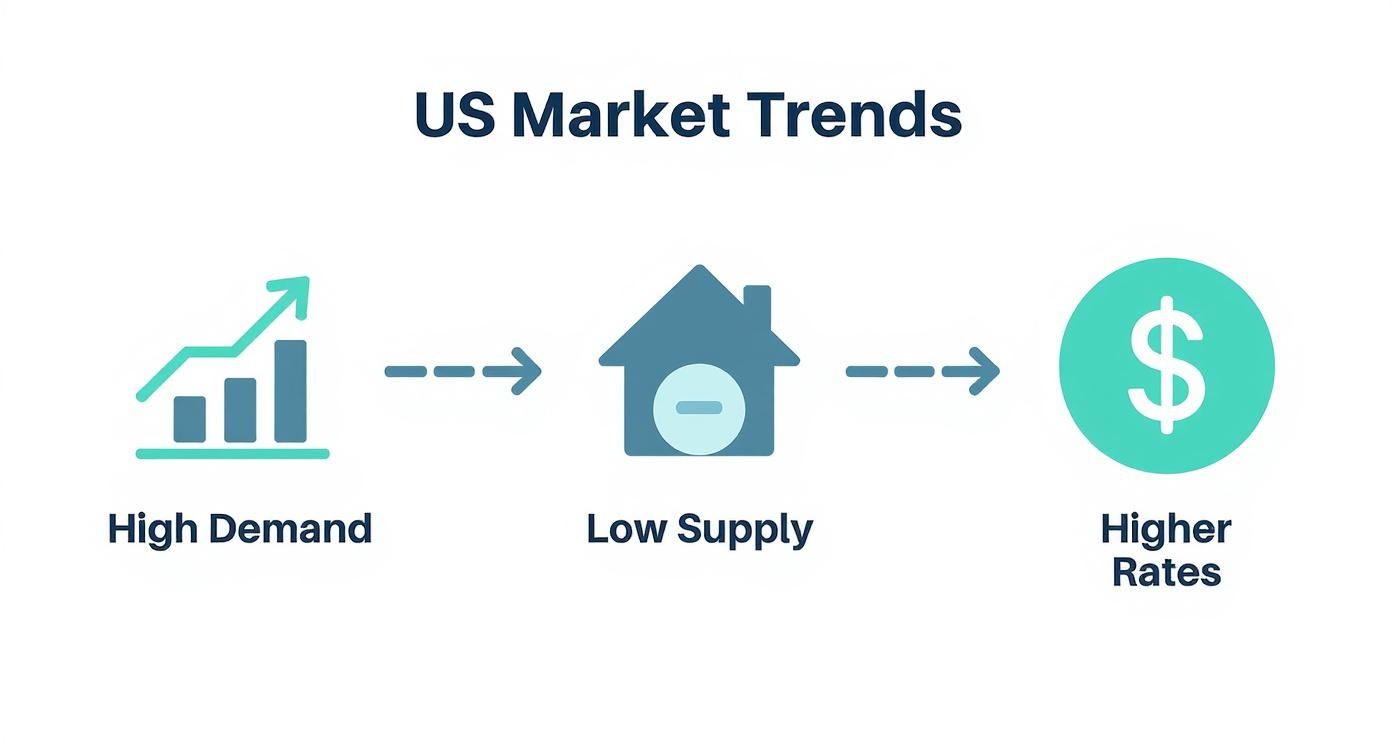
This is a perfect storm for property owners. The gap between surging demand and limited supply gives you serious pricing power. But to truly command top dollar, you have to start with an exceptional presentation. Professional design, amenities that people actually want, and photography that stops scrollers in their tracks—these are your non-negotiables.
If you’re ready for truly hands-off, higher-earning rentals in San Diego, West Coast HomeStays is the partner to trust. Our friendly, data-driven approach consistently boosts revenue while delivering coastal-cool stays that guests love.
Frequently Asked Questions
When you're thinking about your vacation rental pricing strategy, a few questions are bound to pop up. Here are the most common ones we hear from San Diego property owners, answered straight up.
What makes West Coast HomeStays different from other managers?
We specialize in a hybrid STR + MTR strategy that keeps your calendar full year-round, not just during peak season. By combining this with data-driven dynamic pricing, design-forward upgrades, and five-star hospitality, we consistently boost owner revenue by 20-30% on average, providing a truly hands-off and higher-earning experience.
Can you handle both short- and mid-term stays?
Yes, it's our specialty. Our team seamlessly manages everything from weekend getaways to 30+ day corporate stays. This flexibility allows us to pivot based on real-time market demand in San Diego, ensuring your property captures the most profitable booking available at any given time and minimizing vacancy.
How quickly can my listing be optimized?
Our onboarding is built for speed and impact. Once you partner with us, our team gets to work immediately on professional photography, compelling listing copy, and implementing a dynamic pricing engine. We typically have a property fully optimized and ready to command higher rates within one to two weeks.
What amenities do your San Diego homes include?
Our properties are known for being amenity-rich to create a boutique, hotel-like experience. Standard features often include high-speed Wi-Fi, smart TVs, fully-equipped kitchens, premium linens, and local coffee. Many of our coastal homes also feature pools, hot tubs, and outdoor entertaining spaces perfect for enjoying the San Diego lifestyle.
Do you help with design upgrades to boost nightly rates?
Absolutely. We believe great design is the foundation of a premium rental. We provide expert design consultations and can manage everything from simple refreshes to full furnishing projects. Our goal is to create a stylish, comfortable space that stands out online, justifies a higher nightly rate, and earns glowing five-star reviews.
If you’re ready for truly hands-off management and higher earnings from your San Diego rental, West Coast HomeStays is the partner you can trust. Learn more by visiting our website at https://westcoasthomestays.com.



Comments