.png)

Homes for Rent San Diego: 2026 Prices by Neighborhood
- Mark Palmiere

- Jul 20
- 12 min read
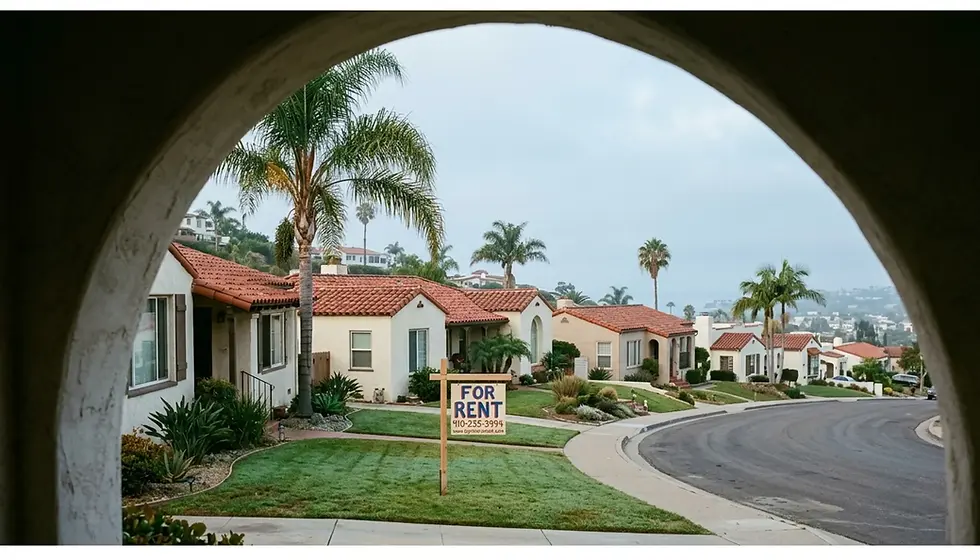
Finding homes for rent in San Diego in 2026 means navigating a market that's shifting fast: county-wide apartment vacancy hit 6.2% at the end of June 2026, the highest this century according to CoStar, while affluent coastal pockets like La Jolla and Encinitas still hover near 3% vacancy with rents topping $3,600 a month. At West Coast Homestays, we track San Diego's rental landscape closely because it directly affects the mid-term and corporate housing demand our managed properties see across the county's coastal neighborhoods. This guide breaks down what you'll actually pay, where, and what most listing sites don't tell you.
Key Takeaways
San Diego County's average asking rent reached $2,583 per month in late June 2026, up 0.5% year over year across roughly 300,000 units, per CoStar data.
Coastal enclaves including Del Mar, Encinitas, Solana Beach, and La Jolla post vacancy near 3% with average rents between $3,348 and $3,654 per month, well above the county average.
Zillow's San Diego rental inventory lists over 1,300 houses for rent, with many single-family listings priced between $4,000 and $6,000 per month.
Median one-bedroom rent in San Diego County fell to $2,220 in January 2026, a 5.5% year-over-year decline, according to Zumper.
Downtown San Diego vacancy sat at 11.9% in mid-2026 with average rents of $3,137, meaning renters willing to consider high-rise living have more negotiating leverage than coastal-neighborhood renters.
Hidden costs like application fees, pet deposits, and security deposits can add $500 to $2,000 to your move-in cost before your first month's rent is due.
San Diego's rental market in 2026 is a tale of two cities. Inland and downtown submarkets are flooded with new apartment construction, pushing vacancy up and giving renters real bargaining power for the first time in years. Meanwhile, the coastline from La Jolla down through Mission Beach and up to Carlsbad remains tight, expensive, and competitive, especially for single-family homes and townhomes near the sand.
This guide is built for renters comparing neighborhoods, budgets, and lease types, whether you're relocating for work, chasing a beach lifestyle, or trying to figure out if a 13-month corporate lease makes more sense than a standard 12-month term. We'll cover pricing by area, property types, the fees nobody mentions until closing week, tenant protections specific to San Diego, and how commute times factor into which neighborhood actually fits your life. As professional operators managing rental properties across San Diego's coastal communities, we've seen firsthand where renters get surprised, and where they get the best value.
What Do Homes for Rent Cost in San Diego Right Now?
Homes for rent in San Diego in 2026 span a wide price band, from studio apartments near $1,846 a month to oceanfront single-family houses exceeding $10,000 a month. According to Kidder Mathews' Q2 2026 San Diego Multifamily Market Report, the county's asking rent averaged $2,453 per month, with studios at $1,846, one-bedrooms at $2,194, two-bedrooms at $2,684, and three-bedrooms at $3,095.
Single-family houses run considerably higher than apartments. Zillow's San Diego rental listings show over 1,300 houses currently available, with many priced between $4,000 and $6,000 monthly, while Redfin's tracking shows roughly 547 houses for rent citywide at any given time. For example, a four-bedroom home in the 92117 zip code was recently listed near $4,500 per month on RentCafe, while a comparable four-bedroom in 92126 reached $8,500, a difference driven almost entirely by proximity to the coast and school district quality.
As of 2026, renters should expect a roughly $2,000 to $3,000 gap between an inland apartment and a coastal single-family rental of similar size. That gap has widened slightly since 2026 as coastal supply stayed flat while inland construction expanded vacancy.

Which San Diego Neighborhoods Offer the Best Rental Value?
Neighborhood choice is the single biggest factor determining what you'll pay for homes for rent in San Diego, more so than square footage or bedroom count. Coastal areas including La Jolla, Encinitas, Solana Beach, and Del Mar posted vacancy rates around 3% in mid-2026 and command rents between $3,348 and $3,654 per month, according to CoStar's San Diego market analysis.
By contrast, downtown San Diego offers more breathing room. Downtown vacancy reached 11.9% in mid-2026 with average rents of $3,137, actually down 0.2% year over year. That means a downtown high-rise unit can cost less than a comparable coastal rental while offering more negotiating leverage, since landlords in high-vacancy submarkets are more willing to offer concessions.
Specifically, renters should weigh these trade-offs:
La Jolla and Encinitas: Highest rents, lowest vacancy, best for renters prioritizing beach access and top-rated schools over price.
Pacific Beach and Mission Beach: Dense rental supply, younger renter base, moderate-to-high pricing with strong walkability to the sand.
Downtown San Diego: Highest vacancy in the county at 11.9%, giving renters the most concession leverage in 2026.
Carlsbad and Oceanside: More suburban character, family-oriented, generally 10-20% cheaper than La Jolla for comparable square footage.
If you're relocating for a corporate assignment and comparing coastal North County options, our Encinitas neighborhood guide breaks down the surf-town character and commute profile of that specific submarket in more detail.
What Types of Rental Homes Are Available in San Diego?
San Diego's rental inventory includes single-family houses, condos, townhomes, and traditional apartment communities, each with distinct pricing and lease structures. Single-family houses, the category most searches for "homes for rent" actually target, make up the smallest but highest-priced segment of the market.
Condos typically rent for less than comparable single-family homes because HOA-covered amenities (pools, gyms, landscaping) reduce the owner's maintenance burden and, in turn, the rent premium. Penny Realty's current San Diego listings show a one-bedroom condo in the 92109 zip code renting near $2,790 per month, while a two-bedroom, 1.5-bath condo in 92120 lists around $2,600.
Townhomes split the difference between condos and detached houses. A three-bedroom, two-bath townhome in the 92154 zip code recently listed for $4,295 per month through Penny Realty, roughly $1,000 less than a comparable detached single-family home in a similar area.
Military housing is also a notable category in San Diego given the concentration of naval installations. Communities such as Admiral Hartman and Canyon View operate specifically for military families and list through Rent.com and similar platforms, with distinct application processes separate from civilian rentals.
For renters comparing furnished, shorter-term options, mid-term corporate rentals (typically 30 nights or more) have become increasingly common in San Diego's coastal submarkets as an alternative to both traditional 12-month leases and nightly vacation rentals.
What Hidden Costs Should You Budget For?
Hidden rental costs in San Diego typically include application fees, security deposits, pet deposits, and sometimes broker or move-in administrative fees, which together can add $500 to $2,000 on top of first month's rent. Most competitor rental guides skip this entirely, focusing only on the advertised monthly rate.
Application fees in San Diego generally run $35 to $60 per adult applicant and are non-refundable regardless of whether you're approved. Security deposits, governed by California state law, are capped at the equivalent of one month's rent for unfurnished units and two months' rent for furnished units as of the 2026 update to California's security deposit statute.
Pet deposits or pet rent are common additions. Many San Diego landlords charge $200 to $500 as a one-time pet deposit, or $25 to $50 monthly in additional pet rent, particularly for houses with yards near the coast where landscaping wear is a real concern.
Additionally, watch for these often-overlooked line items:
Move-in administrative fees: Some property management companies charge $150 to $300 to process a new lease.
Utility setup and transfer fees: San Diego Gas & Electric and city water accounts often require deposits for renters without established credit history.
Parking fees: Downtown and dense coastal buildings frequently charge $100 to $250 monthly for a dedicated parking spot.
Renters insurance requirement: Many San Diego landlords now require proof of renters insurance before handing over keys, typically $15 to $25 monthly.
Before signing anything, ask for a full move-in cost breakdown in writing. A landlord unwilling to itemize costs upfront is a red flag worth taking seriously.
What Tenant Protections Apply to San Diego Renters?
California's statewide tenant protection laws apply to nearly all San Diego rental units, capping annual rent increases and requiring just-cause justification for many evictions. Under the state's Tenant Protection Act, most multifamily units built before a certain threshold are subject to rent increase caps tied to inflation, generally limited to 5% plus the regional Consumer Price Index, up to a maximum of 10% annually.
San Diego renters should also know that just-cause eviction protections mean a landlord generally cannot terminate a lease without a legally valid reason once a tenant has occupied a unit for 12 months or more. Exceptions exist for owner move-in, substantial renovation, or property sale, but even these require proper notice periods.
For renters in single-family homes, it's worth confirming whether your specific property is exempt from these protections, since California law carves out exceptions for certain single-family homes and condos not owned by corporate landlords. A local real estate attorney or tenant rights organization can clarify this for a specific address in minutes.
Short-term rental and mid-term rental units operate under a different regulatory framework entirely. San Diego's short-term rental ordinance requires hosts to obtain a permit and, in many cases, cap the number of rental nights per year depending on zoning. If you're weighing a mid-term furnished rental against a traditional lease, our San Diego Airbnb management guide explains how these two rental categories differ operationally.
How Do Commute Times Affect Which Neighborhood You Should Choose?
Commute time is one of the most underweighted factors renters use when choosing among San Diego neighborhoods, and it often explains why a cheaper inland rental isn't actually the better financial decision. San Diego's freeway system, primarily I-5, I-8, and I-15, sees significant congestion during 7 to 9 a.m. and 4 to 6 p.m. windows, particularly on I-5 through the coastal corridor.
Renters working downtown or near the airport should weigh Mission Hills, North Park, or downtown itself against a coastal commute from Encinitas or Carlsbad, which can add 40 to 60 minutes round-trip during peak traffic. The Coaster commuter rail line offers a transit alternative for North County renters in Encinitas, Solana Beach, Oceanside, and Carlsbad who work near the downtown Santa Fe Depot station, avoiding freeway congestion entirely for the right commute pattern.
For renters without a car-dependent job, Pacific Beach and Mission Beach offer strong walkability to restaurants and the boardwalk but limited direct transit downtown, meaning a car or rideshare budget should factor into your total cost comparison, not just the advertised rent.
As a rule, budget an additional 60 to 90 minutes of daily commute time for coastal North County rentals compared to renting closer to downtown or the I-15 corridor, and weigh that time cost against the rent savings before signing a 12-month lease.

San Diego Rental Market Data at a Glance
The table below summarizes verified 2026 pricing benchmarks across San Diego's rental categories, sourced from Kidder Mathews, CoStar, Zumper, and RentCafe market reports.
Rental Type | Typical Monthly Rent (2026) | Source |
Studio apartment | $1,846 | Kidder Mathews Q2 2026 |
One-bedroom apartment | $2,194 (county avg); $2,220 median | Kidder Mathews / Zumper |
Two-bedroom apartment | $2,684 (avg); $2,950 median | Kidder Mathews / Zumper |
Three-bedroom apartment | $3,095 | Kidder Mathews Q2 2026 |
Single-family house (inland) | $4,000 to $6,000 | Zillow rental listings |
Single-family house (coastal) | $7,000 to $11,000+ | RentCafe / Penny Realty listings |
Coastal enclave average (La Jolla, Del Mar, Encinitas) | $3,348 to $3,654 | CoStar mid-2026 report |
Notably, county-wide average asking rent sat at $2,583 per month as of late June 2026 across nearly 300,000 tracked units, a modest 0.5% year-over-year increase according to CoStar. That flat trajectory reflects the broader vacancy surge inland offsetting continued coastal rent strength.
Why Is San Diego's Rental Market Different from Other California Coastal Cities?
San Diego's rental market in 2026 stands out for its sharp bifurcation between oversupplied inland and downtown submarkets and undersupplied coastal enclaves, a pattern more pronounced here than in comparable coastal California cities. County-wide multifamily vacancy reached 6.2% by the end of June 2026, per CoStar, the highest level this century, driven by a wave of new apartment construction that outpaced household formation.
Yet La Jolla, Encinitas, Solana Beach, and Del Mar remained near 3% vacancy through the same period, according to the same CoStar dataset. That's a four-point spread within a single county, which tells you geography matters more in San Diego than in many other metros where rent tends to normalize across a city.
From what we've observed managing rental properties across these exact coastal neighborhoods, tenants who anchor their search purely on citywide rent averages miss this bifurcation entirely and end up shocked when a La Jolla listing costs 40% more than the county average implies. Understanding submarket-level data, not just city-wide averages, is the difference between a realistic budget and a frustrating search.
This local knowledge is also why property owners considering mid-term or corporate rental strategies in these neighborhoods benefit from working with an operator who tracks submarket performance directly, rather than relying on generic city-wide rent reports.
How Should You Approach Renting a Home in San Diego? A Practical Checklist
Renting a home in San Diego successfully in 2026 comes down to sequencing: verify your budget against submarket data first, then narrow neighborhoods, then compare specific listings against the full move-in cost, not just advertised rent. Follow these steps in order.
Set a realistic budget range using submarket data, not the county average. If you want coastal access, budget closer to $3,300 to $3,600 monthly based on 2026 CoStar figures for La Jolla and Encinitas, not the $2,583 county average.
Decide between apartment, condo, townhome, or single-family house. Each carries different maintenance responsibility and price tiers, as covered above.
Request a full move-in cost breakdown before applying. Include application fees, security deposit, pet deposit, and any parking or amenity fees.
Confirm the property's tenant protection status. Ask directly whether the unit is subject to California's statewide rent cap and just-cause eviction rules.
Map your actual commute during peak hours, not just distance on a map. Use a rideshare app's live estimate for a 7:30 a.m. weekday commute as a reality check.
Compare furnished mid-term options if you have flexible timing needs. A 30-plus night furnished rental can sometimes cost less monthly than a traditional lease once you factor in furniture and utility setup costs for a short stay.
Read the lease's pet, subletting, and early termination clauses carefully before signing, especially if your plans could change within the lease term.
Common mistakes worth avoiding: renters frequently underestimate coastal rent premiums, skip verifying whether a "no fee" listing actually has hidden administrative costs, and fail to confirm parking availability before move-in day, only to discover street parking is scarce in dense beach neighborhoods like Pacific Beach and Mission Beach.
Frequently Asked Questions
How much does it cost to rent a house in San Diego in 2026?
Renting a single-family house in San Diego in 2026 typically costs between $4,000 and $6,000 monthly for an inland property, and $7,000 to $11,000 or more for a coastal home near La Jolla, Del Mar, or Pacific Beach, based on current Zillow and RentCafe listings. Exact pricing depends heavily on proximity to the beach, school district, and square footage.
What is the average rent in San Diego right now?
The average asking rent across San Diego County was $2,453 per month in Q2 2026 according to Kidder Mathews, while CoStar reported a slightly higher county-wide average of $2,583 per month by late June 2026 across nearly 300,000 tracked units. The difference reflects varying methodology and unit mix between the two data sources.
Which San Diego neighborhoods have the cheapest rent?
Downtown San Diego currently offers some of the most competitive rent relative to amenities, with average rents of $3,137 and vacancy at 11.9% in mid-2026, giving renters more negotiating room than in tighter coastal submarkets. Inland neighborhoods generally undercut coastal areas by a meaningful margin, though exact savings vary by specific zip code.
Do San Diego landlords require renters insurance?
Many San Diego landlords now require proof of renters insurance as a lease condition, typically costing $15 to $25 per month, though this is not a citywide legal mandate. Always confirm this requirement directly with the property owner or management company before signing a lease.
Is it cheaper to rent a condo or a single-family house in San Diego?
Condos generally rent for less than single-family houses of comparable size in San Diego, since HOA fees cover shared amenities and reduce the rent premium landlords need to charge. For example, Penny Realty's current listings show one and two-bedroom condos renting in the $2,600 to $2,790 range, well below comparable single-family homes in similar zip codes.
How do I find pet-friendly rental homes in San Diego?
Most rental listing platforms, including Zillow, Redfin, and Zumper, allow filtering specifically for pet-friendly homes for rent in San Diego. Expect an additional pet deposit of $200 to $500 or monthly pet rent of $25 to $50, and always get pet policies in writing before signing.
What documents do I need to apply for a rental home in San Diego?
Standard San Diego rental applications typically require proof of income (pay stubs or offer letter), a government-issued ID, references from prior landlords, and consent for a credit and background check. Some property managers also request bank statements, particularly for self-employed applicants or those relocating from out of state.
Conclusion: Finding the Right Rental Home in San Diego for 2026
Homes for rent in San Diego in 2026 span an unusually wide range, from $1,846 studio apartments to $11,000-plus coastal single-family houses, with the county's overall vacancy at 6.2% masking a sharp divide between oversupplied inland submarkets and tight coastal enclaves near 3% vacancy. The smartest renters treat San Diego as several distinct micro-markets rather than one city-wide average, and they budget for hidden costs, commute time, and tenant protections before signing anything.
Whether you land in a Carlsbad townhome, a La Jolla condo, or a downtown high-rise with more negotiating leverage, the fundamentals stay the same: verify submarket pricing, itemize every fee, and confirm your legal protections in writing. As the coastal rental market continues to evolve through 2026, staying current on submarket-level data, not just headline averages, remains the single best tool a renter has.

If you own a coastal San Diego property and are weighing whether to rent it long-term, mid-term, or as a professionally managed short-term rental, West Coast Homestays manages 80-plus properties across San Diego, Encinitas, Carlsbad, La Jolla, Oceanside, and the beach communities, with documented results including a $121,000-plus revenue increase from dynamic pricing and listing optimization on a single managed property. One recent owner's hybrid short-term and mid-term strategy generated $136,732 in annual revenue, 25% above their comp set occupancy, versus a $98,800 projection under a short-term-only model. If you're deciding how to position your property in this shifting rental market, reach out to West Coast Homestays to talk through what your specific property could earn.
Written by Mark Palmiere, Owner & CEO at West Coast Homestays
Content powered by inkSTR.co


Comments