.png)

A Savvy Owner's Guide to Short Term Rental Market Analysis

Updated: Nov 28, 2025
TL;DR: Key Takeaways
Why Analyze: A solid short term rental market analysis is the foundation for higher revenue, allowing you to master seasonality, attract ideal guests, and make smart amenity investments.
Essential Tools: Combine paid platforms like AirDNA with free manual research (competitor scraping, local event calendars) for a complete market picture.
Key Metrics: Focus on Average Daily Rate (ADR), Occupancy Rate, and Revenue Per Available Rental (RevPAR) to gauge performance.
Competitor Analysis: Identify your direct competitors to find gaps in the market, like a lack of pet-friendly or family-focused rentals, and create a unique niche.
San Diego Seasons: Understand San Diego's high, low, and shoulder seasons, plus major events like Comic-Con, to implement a dynamic pricing strategy that maximizes year-round income.
Compliance is Key: Navigating San Diego's STRO license and local regulations is non-negotiable for a secure, profitable investment.
Think of a short term rental market analysis as your strategic blueprint. It's what tells you what guests actually want, what they're willing to pay, and where the real opportunities are hiding in any given San Diego neighborhood. It’s the single most important first step to building a vacation rental business that not only survives but thrives. It’s about swapping guesswork for proven, data-driven results.
Why Market Analysis Is Your Strongest Asset
At West Coast HomeStays, our data-first approach is why our owners consistently see their revenue lift by 20-30% on average. It’s a game-changer.
A proper analysis gives you the power to:
Master Seasonality: You'll understand San Diego's high, low, and shoulder seasons inside and out, letting you optimize your pricing all year long.
Attract Your Ideal Guests: Figure out exactly who is most likely to book your property and then tailor your amenities and marketing directly to them.
Invest Smarter: You'll know which amenities actually deliver a return on investment—like adding a hot tub in Encinitas or a dedicated workspace in a La Jolla condo.
The Path to Higher Revenue
A disciplined analysis clears the fog. It lays out a direct path from understanding what guests are searching for to seeing a real lift in your revenue. This whole process is about swapping guesswork for proven strategies.
This flow chart breaks it down visually, showing how digging into guest needs directly informs your pricing and, ultimately, your revenue growth.
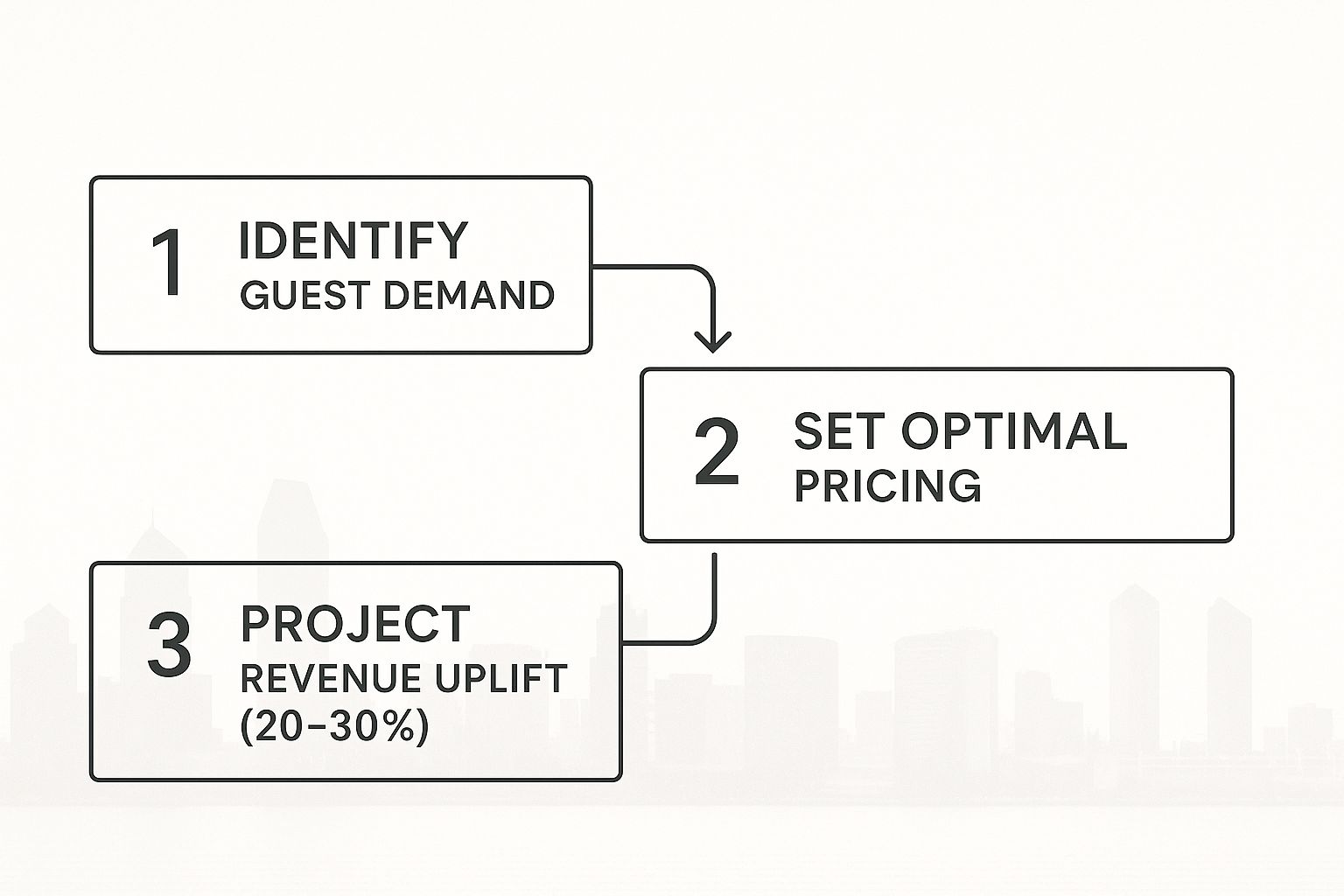
The takeaway here is simple: optimal pricing and bigger profits are the direct result of deeply understanding what travelers in your specific area are looking for.
Identifying San Diego's Unique Opportunities
San Diego is not a one-size-fits-all market. Not even close. A family-focused property in Oceanside needs a completely different playbook than a sleek downtown condo aiming for business travelers.
By drilling down into specific neighborhoods, you can uncover incredibly lucrative niches. Maybe you find there's a serious lack of pet-friendly mid-term rentals near the military bases. Or perhaps you discover a huge demand for homes with pools in some of the inland hotspots.
Finding these gaps in the market is the secret sauce. It's how you command premium rates and keep your calendar booked.
When you start with the data, you stop competing on price and start competing on value. That shift is what separates the top-performing rentals from everyone else.
This data-first approach helps you build a business that isn't just profitable today, but is also resilient enough to handle whatever the market throws at it tomorrow. To get a head start on promising locations, check out our guide on the best short-term rental markets for investors.
Building Your Data and Analytics Toolkit
A killer short term rental market analysis is only as good as the data you're feeding it. Let's be honest, guesswork is a fast track to leaving money on the table, while the right information can light up a clear path to profitability. For a complete picture of the San Diego market, you need to build a solid toolkit that combines powerful data platforms with some good old-fashioned, on-the-ground research.

This isn't just busywork; it's critical. The global short-term rental market was valued at USD 134.51 billion in 2024 and is projected to smash USD 256.31 billion by 2030. That growth is fueled by travelers who want unique, home-like experiences—a trend we see playing out every single day across San Diego's most popular neighborhoods.
Top Data Platforms and Local Resources for San Diego Rentals
To get the most robust data, you really need a mix of tools. Think of each one as a different lens for viewing the market.
Premium Data Platforms:
AirDNA & Mashvisor: These are the industry heavyweights for a reason. They deliver the must-have metrics like Average Daily Rate (ADR), occupancy rates, and RevPAR for specific zip codes, whether you're looking at La Jolla or Oceanside. They let you benchmark your property's potential against the local market with some seriously impressive accuracy.
Free Manual Research:
Competitor Scraping: This is invaluable. Hop on Airbnb and Vrbo and start searching for properties like yours. Filter by neighborhood, bedroom count, and key amenities (pool, hot tub, pet-friendly). Take notes on their pricing, how booked their calendars are, and what guests are saying in the reviews. This is real-time, ground-level intel you can't get anywhere else.
Local Event Calendars: Don't forget to check the San Diego Tourism Authority and local event calendars. Huge events like Comic-Con, music festivals, or marathons create massive demand spikes that automated tools might not fully price in.
If you want a deeper dive into the pros and cons, we've already compared the top Airbnb revenue forecasting tools for you.
Key Metrics to Increase Airbnb Income
When you start digging into the data, it’s easy to get overwhelmed. My advice? Focus on the numbers that actually move the needle. These data points will become the foundation of your entire strategy, telling you exactly what guests value and what they’re willing to pay for it.
Here’s a quick breakdown of the essential metrics you need to collect and what each one really tells you about your property's potential.
Key Metrics for Your San Diego Market Analysis
Metric | What It Tells You | Where to Find It |
|---|---|---|
Average Daily Rate (ADR) | The average rental income per paid occupied day. | AirDNA, Mashvisor, Competitor Listings |
Occupancy Rate | The percentage of occupied nights over a given period. | AirDNA, Mashvisor, Competitor Calendars |
Revenue Per Available Rental (RevPAR) | The gold-standard KPI, calculated by multiplying ADR by occupancy rate. | AirDNA, Mashvisor |
Booking Lead Time | How far in advance guests are booking stays. | Your own data, competitor calendar analysis |
A successful analysis isn't just about collecting data; it's about seeing the patterns hidden within it.
You want to connect the dots and see the bigger picture—like noticing a surge in demand for pet-friendly places in Pacific Beach, or the premium guests will pay for a hot tub in Encinitas during the shoulder season. That's where the real insights are.
Beyond the standard software, other innovative tools are popping up. For example, this ultimate real estate chatbot guide shows how AI is starting to play a role in collecting market data and engaging potential guests. By pulling from all these different sources, you move past just observing the market and start building a predictive, proactive rental strategy that actually works.
How to Analyze Competitors and Find Your Niche
Alright, you've got your data tools ready. Now for the fun part: sizing up the competition. This isn't just a quick scan of nightly rates. We're going deep to figure out what other successful hosts are doing right and, more importantly, where they're dropping the ball. The whole point is to find a profitable niche your property can absolutely own.

First thing's first, you need to build what we call a "competitor set." This isn't just a giant list of every rental in town. Think smaller and much more focused. You're looking for a hand-picked group of 5-10 direct competitors—properties so similar to yours in location, size, and style that your ideal guest would be cross-shopping them.
Creating Your Competitor Set
To make sure your comparisons actually mean something, you need to get specific when building your set. Look for properties that are true apples-to-apples matches.
Neighborhood & Location: Zero in on properties within a few blocks or in an area with a similar vibe. If you're not sure about the nuances, our guide to discovering the best neighborhoods in San Diego is a great place to start.
Property Type & Size: This one's simple but crucial. If you have a two-bedroom condo, your comps are other two-bedroom condos. Don't waste time looking at sprawling five-bedroom houses.
Amenities: Find rentals that offer the same big-ticket amenities you do, whether it's a pool, a hot tub, or dedicated parking.
Guest Reviews & "Superhost" Status: Make sure you're analyzing properties that are actually succeeding. Prioritize listings with a solid review history and Superhost status—these are the ones getting bookings.
Got your list? Great. Now the real detective work begins.
Spotting Gaps in the San Diego Rental Market
Your whole analysis boils down to one question: what’s missing? Stare at your competitor set and start asking the tough questions. Maybe all the top performers are impeccably designed, but not a single one welcomes pets. Or perhaps there's a flood of weekend getaway spots but a serious lack of well-equipped homes for corporate travelers on mid-term stays.
This is exactly the kind of insight we leverage at West Coast HomeStays. Our hybrid STR + MTR strategy is built on finding and filling these gaps. It’s how our owners are able to command premium rates all year long, not just during peak season.
The market is always changing. Between late 2023 and 2024, total short-term rental listings shot up by 9% globally. But here's the catch: mature markets like North America only saw a 3% supply increase. That means finding a unique edge isn't just a good idea, it's essential to stand out.
Finding your niche isn't about being different just for the sake of it. It’s about strategically offering something valuable that everyone else has overlooked—be it an amenity, a design style, or a specific type of guest you cater to.
One way to get ahead is by staying on top of luxury interior design trends. A killer aesthetic can be a powerful differentiator. Once you identify a gap—like a lack of family-friendly rentals with pools in an area full of them—you stop competing on price and start competing on value. That, right there, is the secret to maximizing your rental income.
Mastering San Diego's Seasonality and Demand
If you think you can use a "set it and forget it" pricing model in San Diego, you're leaving a massive amount of money on the table. The rental market here isn't static; it breathes with the seasons. A smart short term rental market analysis means treating your calendar like a living document that reacts to the city's unique rhythm.
A condo in Pacific Beach during the peak of July has a completely different demand profile—and earning potential—than that same exact property in February. Getting a handle on this natural ebb and flow is the first step toward maximizing your revenue all year long.

Mapping San Diego's Demand Calendar
Your first job is to map out the distinct seasons for your specific neighborhood. Sure, some patterns are city-wide, but a rental in the bustling Gaslamp Quarter is driven by different factors than a quiet family home up in Carlsbad.
Here’s a general breakdown:
High Season (June–August): This is classic San Diego summer. The beaches are packed, families are on vacation, and demand skyrockets. Your nightly rates need to reflect this surge, often commanding a significant premium.
Shoulder Seasons (April–May, September–October): Honestly, these are some of the best months here. The weather is incredible, and the crowds have thinned out. You'll attract couples, remote workers, and people in town for smaller events. Pricing should be competitive but strong, catching travelers who want value outside the summer chaos.
Low Season (November–March): While traditional tourism slows, the demand just shifts. This is prime time for mid-term rentals—think traveling nurses, corporate relocations, or "snowbirds" fleeing colder climates for a few months. A hybrid STR/MTR strategy is essential to keep your calendar from looking like a ghost town.
By identifying these seasons, you can build a pricing strategy that gets ahead of demand instead of just reacting to it. You’ll proactively raise rates for the summer beach rush and then pivot to attract longer, more stable stays when the tourist crowds are gone.
The Impact of Major Events on San Diego Rental Revenue
Beyond the broad seasons, San Diego's calendar is jam-packed with major events that create intense, short-term demand spikes. Ignoring these is a rookie mistake.
Take Comic-Con International, for example. It transforms downtown into a global pop culture hub. If you have a well-positioned property, you can easily charge several times your standard nightly rate. Other key events to get on your radar are the Kaaboo music festival, the Rock ‘n’ Roll Marathon, and any major convention hitting the city.
A savvy host maps these out months in advance, tweaking pricing and minimum stay requirements to capitalize on the guaranteed influx of visitors. This is the heart of a profitable strategy, and we dive deeper into this when we show you how to master VRBO dynamic pricing to boost revenue.
When you layer this event-based demand over your seasonal calendar, you're creating a sophisticated, year-round game plan. This ensures your property is perfectly priced not just month-to-month, but week-to-week, capturing every last revenue opportunity San Diego throws your way.
Navigating San Diego's Rental Regulations
A profitable short-term rental is always a compliant one. You wouldn't build a beautiful beach house on unstable sand, and you shouldn't dive into a short term rental market analysis without first understanding the local rules.
It’s only a matter of time before problems arise if you skip this step. San Diego's regulatory environment is specific, and ignoring the rules isn't just risky—it can be incredibly costly. The city has laid out clear guidelines every host must follow, from getting the right licenses to paying the correct taxes. One misstep can lead to huge fines, a forced shutdown, and legal headaches that completely derail your investment.
Understanding San Diego's STRO License
The absolute cornerstone of San Diego's regulations is the Short-Term Residential Occupancy (STRO) license. This is non-negotiable for anyone operating a rental for less than one month.
The city uses a tiered system with different license types, and crucially, the number of licenses is capped. This makes getting and staying compliant even more critical. This isn't just about paperwork; it’s about operating legally and protecting your asset from day one.
For a detailed breakdown of the tiers and application process, you can review our complete guide on navigating San Diego's new short-term rental regulations.
The Broader Regulatory Landscape
San Diego isn't an island. We're seeing cities all over the world tighten their rules to balance tourism with the needs of local communities.
Just look at what happened in New York City—strict compliance measures led to a staggering 80% drop in short-term listings after September 2023. Meanwhile, cities like San Antonio have introduced density limits to manage how many rentals can operate in one area. These examples from these global vacation rental statistics show exactly why staying informed is so critical for long-term success.
Protecting your investment means treating regulations not as a hurdle, but as an integral part of your business strategy. Full compliance is the ultimate form of risk management.
This is where having an expert partner makes all the difference. At West Coast HomeStays, we handle the complexities of compliance so you don’t have to. We make sure every property we manage is fully licensed, all taxes are paid correctly, and every local ordinance is followed to the letter. This lets you enjoy truly hands-off, worry-free ownership.
Turning Your Analysis Into a Winning Strategy
Data is fantastic, but it's only as good as the decisions you make with it. A thorough short term rental market analysis is just a pile of numbers until you turn it into a real, revenue-generating action plan. This is where the rubber meets the road—synthesizing all those insights into a clear roadmap for your property.
The information you've gathered should be the driving force behind every critical decision you make, from your pricing calendar all the way down to which towels you buy. This final step connects the dots between what the market is screaming for and what your property can offer, turning raw potential into actual profit.
🌟 Spotlight on West Coast HomeStays✔ 20–30% revenue boost through our data-driven approach.✔ Hybrid STR + MTR strategy to keep your calendar full year-round.✔ Five-star guest experiences that earn rave reviews and repeat bookings.👉 Book a strategy call and let us create your winning strategy.
From Insight to Action
Let's put this into a real-world context. Say your competitor analysis for Pacific Beach revealed a glaring lack of family-friendly rentals. You've just struck gold.
That single insight tells you that investing in a high chair, a portable crib, and a few beach toys isn't just another expense. It's a strategic move to capture a hungry, underserved slice of the market.
This is exactly how you build a competitive edge. You stop guessing what guests might want and start giving them what the data shows they're already looking for.
The goal is to create a property that doesn't just meet expectations but anticipates them. Your analysis is the playbook that tells you how to do it, turning your rental into the obvious choice for your target guest.
To put this all together, let’s focus on a few key areas where your analysis can have the biggest and most immediate impact. This checklist will help you prioritize where to put your energy first:
Dynamic Pricing: Use your seasonality and event data to build out a pricing calendar that proactively raises rates for high-demand periods. Don't wait for Comic-Con week to start; get those premium prices locked in months ahead of time.
Amenity Upgrades: Go back to your list of competitor amenities. What small, high-impact additions can you make right now? It could be anything from setting up a dedicated workspace with blazing-fast internet to adding a premium coffee bar.
Listing Optimization: It's time to rewrite your listing description and headline to speak directly to the niche you've pinpointed. Start using keywords that scream value to your ideal guest, like "pet-friendly coastal stay" or "family-friendly beach rental."
If you’re ready for truly hands-off, higher-earning rentals in San Diego, West Coast HomeStays is the partner to trust. We turn analysis into action that delivers real results.
Frequently Asked Questions
If you're thinking about a short-term rental in San Diego, you probably have a few questions. Here are the answers to some of the most common ones we hear from property owners like you.
What makes West Coast HomeStays different from other managers?
It's our unique combination of a hybrid STR + MTR strategy, a passion for boutique design, and a relentless focus on data. Most managers pick one lane; we master both short-term vacationers and mid-term corporate guests to keep your calendar full and your revenue high. This approach consistently delivers a 20-30% revenue lift for our owners, supported by five-star guest experiences that drive repeat bookings.
Can you handle both short- and mid-term stays?
Absolutely. In fact, our hybrid STR + MTR model is our specialty. We seamlessly pivot between high-demand vacation seasons and the need for longer stays during shoulder seasons. This keeps occupancy high and income flowing year-round, attracting everyone from families on summer break to traveling nurses and corporate relocations.
How quickly can my listing be optimized?
Our onboarding process is designed for speed and impact. Once we have access to your property, we can typically have our initial data analysis, professional photography, and listing optimization complete within 1-2 weeks. Our goal is to get your property live and generating superior revenue as quickly as possible.
What amenities do your San Diego homes include?
Our properties are stocked with amenities that travelers love. This always includes high-speed Wi-Fi, premium linens, fully-equipped kitchens, and smart-home tech. Beyond the basics, we use market data to recommend property-specific upgrades like pools, hot tubs, dedicated workspaces, or family-friendly items that help your home stand out and command higher rates.
Do you help with design upgrades to boost nightly rates?
Yes, and we consider it a crucial part of maximizing your property's potential. We provide expert, data-backed design consultations to identify the upgrades that deliver the highest ROI in the San Diego market. From a simple refresh to a full-scale redesign, our goal is to create a design-forward, amenity-rich stay that guests love and are willing to pay more for.
If you’re ready for truly hands-off, higher-earning rentals in San Diego, West Coast HomeStays is the partner to trust.


Comments